Blueprints still to build
The Government Fix
106 problems a government has to address, each with a starting proposal and the tension it sits inside. None of the 106 has a full DDS blueprint yet. Any of us can pick one, copy it, add where we stand, and run the method. The blueprint that comes back is ours.
The premise
A position without a context cannot be examined. Every proposal here is placed where its tension balances under present conditions, and every one is open to a run that lands somewhere else.
What this page is for
The list is the work order.
SolveSomething exists to show that Dialectic and Deconstruction Solutions (DDS) can take a problem most of us agree is broken and return a plan that names what it protects, what it costs, and who carries the cost. The blueprints already published are the evidence. This page is the backlog: the problems that still need that treatment, collected in one place so the work can be shared.
Each of the 106 is written the way DDS begins a run. What keeps the problem going. Where action could start. A starting proposal. Whether the trajectory is to innovate, maintain, or let go. The tension the proposal sits inside, and where on that tension it sits. That is enough to run the method on, and it is deliberately not a blueprint. The eight phases, the mechanism, the readiness audit, and the readable explanation are what a run produces.
The proposals are one person’s placements, made where the tension seemed to balance under present conditions. Nobody needs to agree with them. The more useful outcome is a run that starts from a different place on the same line, because the comparison between two blueprints that disagree is where a public can begin to see what the choice is.
The same list appears as an essay, with its argument about parties and hope, at ThoughtsFromATherapist.com. This page carries the working version.
How to run DDS on any of these
Copy a problem. Add where we stand. Run it.
Every entry below ends with a button that copies the whole problem, its fields and its tension, together with a prompt. From there the run takes a few minutes to start and an hour to read.
01
Pick a problem
Any of the 106. The list at a glance links to each one. Start with the one we care about most, or with the one where the proposal seems wrong to us.
02
Copy it
The button at the end of the entry copies the problem and a prompt to the clipboard. Nothing else is needed from this page.
03
Open DDS
The custom GPT is the shortest route. The Engine and Knowledge Base files run in any capable AI. The by-hand worksheets run with a pen. All three are below.
04
Add our position and context
Paste, then say where we sit on the tension: lean freedom, lean heavily collective, sit with the proposal. Add the place, the people, and anything the run should know. Our own narrative belongs here.
05
Run, then revise
The first blueprint is a draft. Change the focus if the run chose the wrong cause. Shift the dialectic if the balance is wrong and ask it to recalculate who benefits and who pays.
Shortest route
The DDS custom GPT
Engine and Knowledge Base already loaded. A ChatGPT account and its limits apply.
Open the DDS GPT →Any capable AI
Upload the source files
Download the Engine v11.6 and the Master Knowledge Base v11.6, upload both, then type “Run DDS.”
The exact setup →No AI
By hand
The eight-phase blueprint, the tension, the entry point, and the fractal map, each as a worksheet that runs on paper.
The by-hand worksheets →The two bracketed lines are ours to fill. A run with no position and no context returns a blueprint for nowhere in particular. A run that says “heavily collective, rural county, aging water system” returns one that can be argued with.
Before running anything
Every change costs something.
Nearly every entry on this list creates a rule, and a rule creates a place to exploit it. Every entry that adds decency to a system costs money, and the money has to be collected, which is itself a change with its own tension.
Taxing concentrated wealth is popular right now and may be part of the answer. It still has to be held inside its tension. A policy investors read as punitive moves the market, and a falling market reduces the revenue, the pensions, and the confidence the original solution was counting on. The intervention feeds back into the condition it was meant to change.
The structure is fractal. A rule at one scale reappears as a cost at another scale, and the cost is the next round’s problem. We may want to stop cutting down trees, and our houses are built of wood. DDS has carried this from the start: because the tensions are inherent, everything we do will carry some problem with it, and a blueprint that cannot say what it costs is not finished.

The seven tensions
Every entry sits on one line.
Seven dialectic tensions recur across the list: freedom and safety, individual and collective, efficiency and humanity, transparency and privacy, justice and mercy, innovation and tradition, urgency and sustainability. A few entries need a pair of their own, such as state equality and population equality. Each entry names its main tension and marks where the starting proposal sits. The middle is a reference point, not a target. Rights, serious harm, and public obligations can justify a position well away from it, with a reason.


Worksheet
Where do I stand on the 106? Every spectrum on this page with the starting proposal shown as a ring and room to mark our own, a page of reflection at the end, and fillable fields for working on screen. Marking the whole list first makes the position line in every prompt easy to fill.

The 106 at a glance
Seven domains, then two that run through all of them.
Each title links to its entry. The domains follow the seven responsibilities of a country: stewardship, education, health and care, infrastructure and access, livelihood and economic life, safety and security, governance and justice. Affordability and corruption come last because each one has to be worked in several domains at once.

Governance and justice
- 48Conflicts in presidential pardons
- 49Executive interference with authorized spending
- 50Congressional oversight
- 51Emergency authority
- 52Constitutional eligibility
- 53Selective enforcement and due process
- 54Retaliation against scrutiny
- 55Personal enrichment through office
- 56Nepotism and unqualified appointments
- 57Politicized professional judgment
- 58Removable watchdogs and unenforced ethics
- 59Concentrated judicial authority
- 60Presidential representation
- 61Senate representation
- 62Gerrymandering and practical voting barriers
- 63Large donors and unlimited outside spending
- 64Hidden and prohibited political money
- 65Coordinated outside campaigns
- 66Vote-linked financial inducements
- 67Opaque online political advertising
- 68Campaign costs and continuous fundraising
- 69Donor access and private sponsorship
- 70Incomplete candidate platforms
- 71Secrecy and misinformation
- 72Contract favoritism
- 73Regulatory capture
- 74Agency dismantling and outdated organization
- 75Public assets and outsourced authority
- 76Technology and artificial intelligence
- 77Symbolic agendas and postponed consequences
- 78Free speech and accurate information
- 79Penalties below the cost of compliance
- 80Supreme Court tenure and ethics
- 81The budget process
- 82Primaries and ranked choice
- 83Recruiting candidates by capability
- 84Cabinet and agency heads drawn from a field's own pool
- 85Age limits for high office
- 86Incapacity in office
- 87Standards of conduct in high office
Making ordinary life affordable
- 88Housing that people can obtain
- 89Health care and prescription costs
- 90Food and basic nutrition
- 91Childcare and family care
- 92Energy and utility bills
- 93Transportation costs
- 94Income and the share left after essentials
- 95Debt fees and insurance
- 96Public services that reduce the household bill
- 97Showing whether affordability improved
Interrupting corruption
- 98Separate public decisions from private enrichment
- 99Make political money traceable
- 100Make contracts and public resource decisions inspectable
- 101Require competence and disclose relationships
- 102Protect the people who investigate
- 103Build restraints before the irreversible decision
- 104Prevent oversight from becoming another instrument of the party
- 105Connect findings to remedies
- 106Keep the enforcement usable
Stewardship · 8 problems
Stewardship
Land, water, soil, wildlife, food production, and energy are an inheritance we hold in common. The problems here concern how that inheritance is protected, used, and accounted for, and who ends up paying when the accounting is skipped.
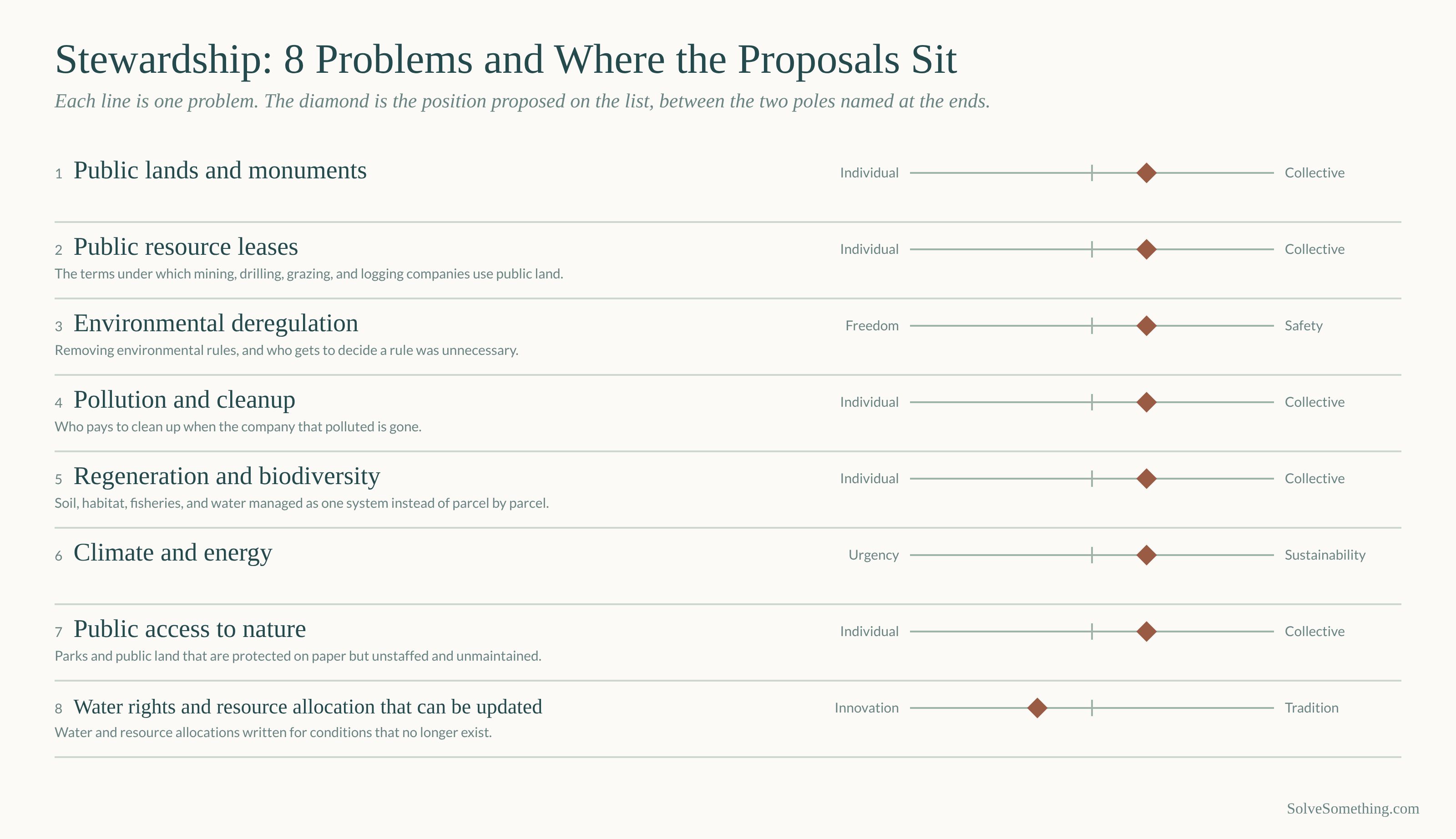
1Public lands and monuments
- What keeps it going
- Protections that can be undone with a signature leave land held by everyone open to whoever has the most to gain at the moment.
- Entry point
- The procedure for shrinking protection on public land.
- Starting proposal
- Before a major reduction, require an independent ecological review, a public comment period, and a vote in the legislature.
- Trajectory
- Maintain protection and innovate decision rules.
- The tension
- A wider approval process protects a common inheritance and slows every decision, including the ones a community wants for its own livelihood. Those communities carry part of the cost of protection.
Proposal leans Collective. Where we each sit on this line is the first thing a run should hear.
2Public resource leases
The terms under which mining, drilling, grazing, and logging companies use public land.
- What keeps it going
- The operator keeps the profit from a public resource while the damage, the lost access, and the cleanup stay with the public.
- Entry point
- The terms a lease has to meet before an operator gets access.
- Starting proposal
- Make fair compensation, enforceable limits, and funded restoration conditions of the lease, settled before extraction begins.
- Trajectory
- Innovate leasing rules.
- The tension
- Leases produce materials, jobs, and revenue. Charging for damage and restoration raises the cost of operating, and weaker terms move the same costs onto the public and whoever uses the land next.
Proposal leans Collective. Where we each sit on this line is the first thing a run should hear.
3Environmental deregulation
Removing environmental rules, and who gets to decide a rule was unnecessary.
- What keeps it going
- The industries a rule constrains have the most reason, and often the most access, to shape whether it survives.
- Entry point
- The evidence and conflict-of-interest review required before an environmental rule is removed.
- Starting proposal
- Require disclosed interests, evidence that does not come from the regulated party, and a public statement of who benefits and who pays before a protection comes off.
- Trajectory
- Innovate review.
- The tension
- Removing a rule that does nothing saves money. Review takes time, and skipping it leaves people carrying costs they never had the power to refuse.
Proposal leans Safety. Where we each sit on this line is the first thing a run should hear.
4Pollution and cleanup
Who pays to clean up when the company that polluted is gone.
- What keeps it going
- A company can go broke, sell, or dissolve before it repairs what it damaged, and the bill lands on the public.
- Entry point
- The financial guarantees required before a potentially damaging operation starts.
- Starting proposal
- Require bonds and liability that follow the operation through changes of ownership, with penalties set above what prevention would have cost.
- Trajectory
- Innovate accountability.
- The tension
- Money set aside in advance protects the public when an operator fails. It also raises the price of entry and can stop some projects, including ones that would have produced useful materials and work.
Proposal leans Collective. Where we each sit on this line is the first thing a run should hear.
5Regeneration and biodiversity
Soil, habitat, fisheries, and water managed as one system instead of parcel by parcel.
- What keeps it going
- Forests, farms, water, and development get decided one at a time, and the losses add up where nobody is looking.
- Entry point
- Land and water decisions that cross an agency line or a property line.
- Starting proposal
- Manage soil, habitat, fisheries, and water together, across the boundaries the systems themselves ignore.
- Trajectory
- Innovate ecological capacity.
- The tension
- Shared ecological standards hold together what no single owner can hold alone. They also constrain local choices and cost the people whose income depends on using the land.
Proposal leans Collective. Where we each sit on this line is the first thing a run should hear.
6Climate and energy
- What keeps it going
- Investment decided on a short horizon moves the risk to the people who will live with the consequences.
- Entry point
- Energy investment and procurement choices that lock in supply for decades.
- Starting proposal
- Build reliable, cleaner supply, cut the emissions we can avoid, and support the workers and places the transition disrupts.
- Trajectory
- Innovate supply and resilience.
- The tension
- A transition lowers future risk and raises present cost. Reliability, household bills, and the communities built around old supply remain obligations the whole way through.
Proposal leans Sustainability. Where we each sit on this line is the first thing a run should hear.
7Public access to nature
Parks and public land that are protected on paper but unstaffed and unmaintained.
- What keeps it going
- Protecting a place on paper does not staff it, maintain it, or get anyone to it.
- Entry point
- The budgets that pay for staff, upkeep, and practical access on public land.
- Starting proposal
- Fund stewardship and access together, and limit the uses that degrade the place itself.
- Trajectory
- Maintain and selectively expand capacity.
- The tension
- Access lets more of us into what we hold in common. More use means more wear and more cost, so an open place still needs limits that can be enforced.
Proposal leans Collective. Where we each sit on this line is the first thing a run should hear.
8Water rights and resource allocation that can be updated
Water and resource allocations written for conditions that no longer exist.
- What keeps it going
- Water rights and resource allocations were set for rivers, populations, and geographies that no longer exist, and the rules contain no way to revise them.
- Entry point
- The review and renewal mechanism attached to an allocation.
- Starting proposal
- Attach scheduled, evidence-based review to water and resource allocations, with transition support for whoever's share shrinks.
- Trajectory
- Innovate updating rules.
- The tension
- A fixed allocation is something a farm or a town can plan on. Review that follows conditions takes away what someone built a livelihood on, so the transition has to be financed, and review without evidence standards turns into redistribution by politics.
Proposal leans Innovation. Where we each sit on this line is the first thing a run should hear.
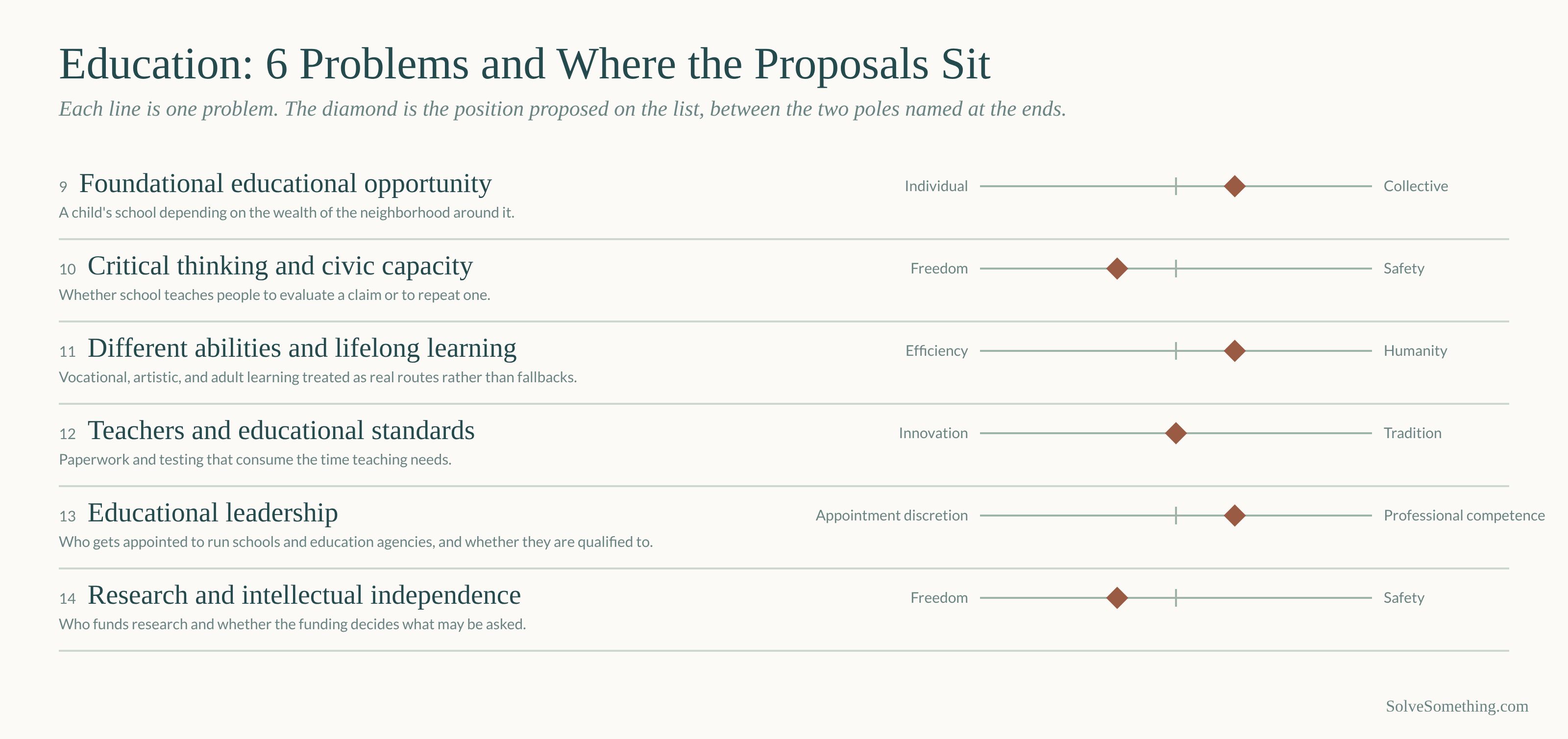
Education · 6 problems
Education
A school system decides what a child can become and what a citizen can examine. The problems here concern funding, the range of routes through learning, the time teachers get to teach, and the independence of the people who lead and research.
9Foundational educational opportunity
A child's school depending on the wealth of the neighborhood around it.
- What keeps it going
- What a school can offer depends on what the neighborhood around it can pay.
- Entry point
- The funding formula and the minimum services every public school provides.
- Starting proposal
- Set a funding and service floor that holds across communities.
- Trajectory
- Maintain dependable schooling and expand access.
- The tension
- A floor protects children in places with less. Paying for it moves public money between places and narrows some local choices. Leaving funding local preserves the unequal start.
Proposal leans Collective. Where we each sit on this line is the first thing a run should hear.
10Critical thinking and civic capacity
Whether school teaches people to evaluate a claim or to repeat one.
- What keeps it going
- Identity and repetition can do the work that examination was supposed to do.
- Entry point
- Curriculum and teacher preparation for weighing evidence and understanding how public institutions work.
- Starting proposal
- Teach evidence evaluation, how institutions function, history, media literacy, and how to disagree productively.
- Trajectory
- Innovate civic education.
- The tension
- Common civic knowledge makes participation possible. Whoever defines that knowledge can turn it into ideological control, so the curriculum has to leave room for disagreement with itself.
Proposal leans Freedom. Where we each sit on this line is the first thing a run should hear.
11Different abilities and lifelong learning
Vocational, artistic, and adult learning treated as real routes rather than fallbacks.
- What keeps it going
- A single preferred route through school leaves the abilities that do not fit the route undeveloped.
- Entry point
- The range of credible learning pathways schools and public institutions offer.
- Starting proposal
- Support vocational, artistic, academic, and adult pathways as legitimate routes.
- Trajectory
- Innovate opportunity.
- The tension
- More pathways give more kinds of ability a place to grow. Variety costs more to staff, equip, and assess than one program, and one program leaves capacity on the table.
Proposal leans Humanity. Where we each sit on this line is the first thing a run should hear.
12Teachers and educational standards
Paperwork and testing that consume the time teaching needs.
- What keeps it going
- Reporting, testing, and approvals can consume the hours that were meant for teaching.
- Entry point
- The administrative requirements that take instructional time.
- Starting proposal
- Keep the standards that catch neglect and unequal quality, and remove the requirements that do not improve learning.
- Trajectory
- Innovate administration and let go of ineffective procedures.
- The tension
- Shared standards reveal neglect. Too much standardization stops a teacher from responding to the students in the room, and removing oversight leaves families without a dependable floor.
Proposal at the midpoint. Where we each sit on this line is the first thing a run should hear.
13Educational leadership
Who gets appointed to run schools and education agencies, and whether they are qualified to.
- What keeps it going
- The power to appoint can outrun the competence the job needs and the purpose the law gave the office.
- Entry point
- The qualification and mission review that comes before an educational appointment.
- Starting proposal
- Require demonstrated qualifications, and public authorization before an essential function is abandoned or replaced.
- Trajectory
- Innovate appointment safeguards.
- The tension
- Elections authorize a change of direction. Students depend on services that continue, so the reform route has to allow lawful change without letting one appointee shut a function down.
Proposal leans Professional competence. Where we each sit on this line is the first thing a run should hear.
14Research and intellectual independence
Who funds research and whether the funding decides what may be asked.
- What keeps it going
- Dependence on political or commercial money narrows what gets studied and what gets said about it.
- Entry point
- How research support is awarded, reviewed, and withdrawn.
- Starting proposal
- Protect transparent professional review and keep space for foundational work with no immediate application.
- Trajectory
- Maintain independence and expand warranted research.
- The tension
- Public money deserves scrutiny and choices among needs. Political control of findings or of acceptable questions hollows out inquiry, and total insulation would leave the public with no recourse.
Proposal leans Freedom. Where we each sit on this line is the first thing a run should hear.
Health and care · 9 problems
Health and care
Care that depends on a job, an income, or an address disappears when any of the three changes. The problems here run from coverage and prevention through the incentives that decide what a provider is paid to do.

15Affordable necessary care
Health coverage that disappears with a job, an income change, or a move.
- What keeps it going
- Coverage tied to a job, an income level, or an address drops people at the moment any of those changes.
- Entry point
- The coverage and financing rules that decide whether necessary care survives a change of circumstances.
- Starting proposal
- Guarantee access to essential care and continuity through changes of job and income.
- Trajectory
- Innovate access and financing.
- The tension
- Dependable coverage protects health and household stability. Financing it means shared contributions and choices about what is covered, what providers are paid, and what happens when need exceeds capacity.
Proposal leans Collective. Where we each sit on this line is the first thing a run should hear.
16Health agency competence
Who runs the public health agencies and on what evidence they decide.
- What keeps it going
- Loyalty can be rewarded over scientific and administrative capability in the agencies that decide health policy.
- Entry point
- Appointment criteria and published evidence standards for health-agency decisions.
- Starting proposal
- Require relevant qualifications, transparent evidence standards, and independent scrutiny of agency decisions.
- Trajectory
- Innovate appointment and decision rules.
- The tension
- Elected leaders set public priorities. Scientific judgment needs protection from loyalty tests, and the expert bodies owe the public their evidence and their corrections.
Proposal leans Professional competence. Where we each sit on this line is the first thing a run should hear.
17Prevention and public health
Funding that rewards treating illness and neglects preventing it.
- What keeps it going
- Budgets reward the treatment people can see and neglect the illness that never happened.
- Entry point
- Protected funding for prevention, before treatment demand takes the whole budget.
- Starting proposal
- Protect prevention, sanitation, nutrition, disease surveillance, and preparedness as a funded line.
- Trajectory
- Innovate upstream capacity.
- The tension
- Prevention asks us to pay now for a benefit that shows up as absence. Protecting that money means turning down some immediate demands, including demands from people who need care today.
Proposal leans Safety. Where we each sit on this line is the first thing a run should hear.
18Food and consumer health
Who tests the safety of what we buy, and who pays them.
- What keeps it going
- The producers of a product can shape how its safety is evaluated.
- Entry point
- The independence of safety evaluation and the information available before purchase.
- Starting proposal
- Require independent safety review, labels people can use, and scrutiny of marketing claims.
- Trajectory
- Innovate oversight where evidence warrants it.
- The tension
- Standards protect people who cannot test what they buy. Requirements raise prices and narrow choice, and weak review hands poorly understood risk to the consumer.
Proposal leans Safety. Where we each sit on this line is the first thing a run should hear.
19Mental health and addiction
Crisis response with nobody responsible for what happens after the crisis.
- What keeps it going
- Systems respond to the same crisis over and over because no one holds responsibility between crises.
- Entry point
- Who is responsible for continuity between crisis response, treatment, and community support.
- Starting proposal
- Fund accessible treatment, follow-up, and coordination across the services a person moves through.
- Trajectory
- Innovate to expand and connect care.
- The tension
- Continuous care keeps people from losing support repeatedly. Coordination costs money and requires information to move, and choice and privacy remain part of what care protects.
Proposal leans Freedom. Where we each sit on this line is the first thing a run should hear.
20Disability, aging, and caregiving
Long-term care falling on families and an underpaid workforce.
- What keeps it going
- Necessary care lands on households and on a workforce paid too little to stay.
- Entry point
- The eligibility and funding rules that decide who receives long-term support.
- Starting proposal
- Provide dependable long-term support, respite for families, and care work that pays enough to be a job.
- Trajectory
- Innovate to expand capacity.
- The tension
- Shared support relieves a burden households cannot carry alone. It requires public money and standards, and families and recipients need say over how help enters their lives.
Proposal leans Humanity. Where we each sit on this line is the first thing a run should hear.
21Unequal health burdens
Communities carrying more disease or exposure than others, and whether that gets studied.
- What keeps it going
- Identical allocations ignore the differences in disease, exposure, and access between populations.
- Entry point
- The criteria for allocating prevention, research, and care across groups.
- Starting proposal
- Direct resources by demonstrated need, and publish the criteria.
- Trajectory
- Innovate allocation.
- The tension
- Equal standing sometimes needs unequal support because burdens are unequal. Targeting needs evidence and public reasons, and real choices remain when other needs also go unmet.
Proposal leans Collective. Where we each sit on this line is the first thing a run should hear.
22Payment incentives and medical costs
A payment system that can make denying care, or over-treating, profitable.
- What keeps it going
- Denying care, multiplying procedures, or gating access can each be the profitable move.
- Entry point
- The payment and appeal rules for treatment approval and provider reimbursement.
- Starting proposal
- Align payment with necessary care, examine conflicts of interest, and provide an independent appeal.
- Trajectory
- Innovate financing.
- The tension
- Payment controls prevent waste. They also reward denial and rushed care, so savings have to answer to access and to what the patient experienced.
Proposal leans Collective. Where we each sit on this line is the first thing a run should hear.
23Reproductive health and unwanted pregnancy
Unwanted pregnancy as the upstream problem, before the abortion fight.
- What keeps it going
- Regulating abortion takes up the question at its most polarized point, after an unwanted pregnancy already exists.
- Entry point
- The upstream conditions that set how many pregnancies are unwanted: contraception, accurate education, and the cost of raising a child.
- Starting proposal
- Reduce unwanted pregnancy through accessible contraception, accurate education, and material support for parents, so fewer decisions arrive at the point where the country cannot agree.
- Trajectory
- Innovate upstream capacity.
- The tension
- Prevention shrinks the number of contested decisions without settling the ones that remain. Funding contraception and education asks people who object to pay for it. Leaving prevention to chance delivers more people to the most polarized point.
Proposal leans Collective. Where we each sit on this line is the first thing a run should hear.
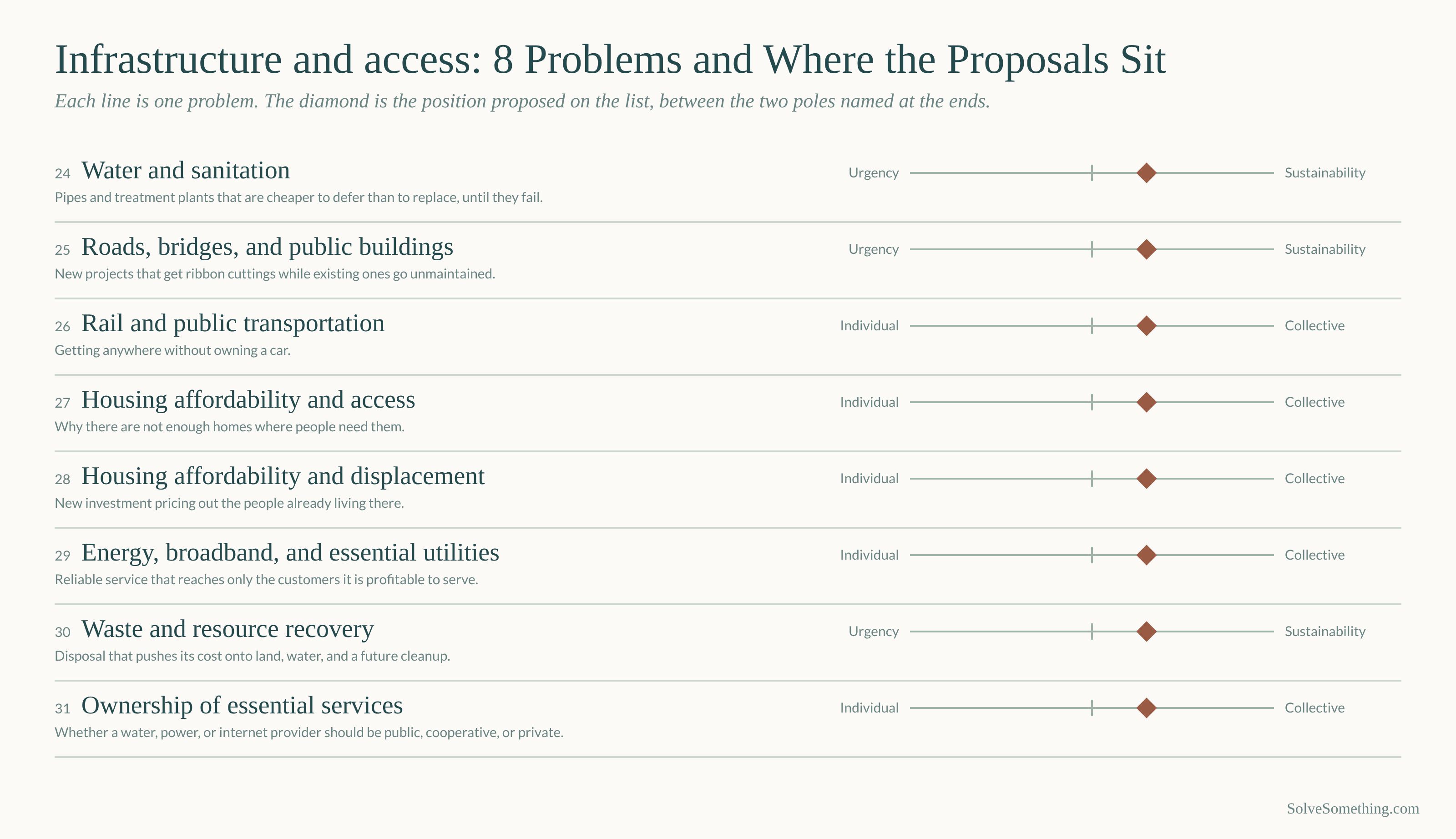
Infrastructure and access · 8 problems
Infrastructure and access
Water, roads, rail, housing, utilities, and waste are the systems everything else runs on. The problems here concern maintenance that gets deferred, supply that never arrives, and services nobody can leave.
24Water and sanitation
Pipes and treatment plants that are cheaper to defer than to replace, until they fail.
- What keeps it going
- Deferring replacement makes this year's budget look better while the pipes keep aging.
- Entry point
- Each water system's replacement schedule, maintenance reserve, and public reporting.
- Starting proposal
- Protect funded maintenance schedules and publish reliability and water-quality results.
- Trajectory
- Maintain essential function.
- The tension
- Paying for replacement raises charges now for benefits years out. Deferral protects today's budget and hands the failure and the larger bill to the people who come after.
Proposal leans Sustainability. Where we each sit on this line is the first thing a run should hear.
25Roads, bridges, and public buildings
New projects that get ribbon cuttings while existing ones go unmaintained.
- What keeps it going
- A new project gets a ribbon cutting. Upkeep gets postponed.
- Entry point
- The budget choice between maintaining what exists and announcing something new.
- Starting proposal
- Count lifecycle costs, and fund existing obligations before discretionary expansion.
- Trajectory
- Maintain, with innovation where needed.
- The tension
- New infrastructure opens opportunity. Maintenance protects the people already depending on the old, and one budget cannot fund every worthwhile project at once.
Proposal leans Sustainability. Where we each sit on this line is the first thing a run should hear.
26Rail and public transportation
Getting anywhere without owning a car.
- What keeps it going
- Where there is no alternative, mobility means owning and operating a car.
- Entry point
- Corridor selection and operating plans that decide whether new service is usable.
- Starting proposal
- Build connected service with credible ridership, access, and operating plans.
- Trajectory
- Innovate where public benefit supports expansion.
- The tension
- Connected transport frees people who cannot or would rather not drive. Construction, land, and ongoing subsidy cost others, including the communities along the line.
Proposal leans Collective. Where we each sit on this line is the first thing a run should hear.
27Housing affordability and access
Why there are not enough homes where people need them.
- What keeps it going
- Housing turns unaffordable when the homes available, the incomes of the people seeking them, and the cost of building and financing stop fitting together. Owners gain from scarcity and seekers pay for it. Assistance without supply leaves households bidding for the same homes.
- Entry point
- Local building approvals and the infrastructure funding that decide where more homes can go.
- Starting proposal
- Permit more housing near existing services, remove approval barriers that serve no purpose, and pair construction with lasting affordability requirements and protection against displacement.
- Trajectory
- Innovate housing access while maintaining safety and dependable infrastructure.
- The tension
- Local control gives residents a voice. As a veto on new housing, it makes the people who need homes pay. Faster approval asks existing communities to absorb change and asks agencies to fund the services growth requires.
Proposal leans Collective. Where we each sit on this line is the first thing a run should hear.
28Housing affordability and displacement
New investment pricing out the people already living there.
- What keeps it going
- New housing can arrive too slowly, or at prices the people already there cannot pay.
- Entry point
- The affordability and relocation conditions attached to redevelopment and public support.
- Starting proposal
- Tie development to affordable units, targeted assistance, and protection against displacement that could have been prevented.
- Trajectory
- Innovate to expand access.
- The tension
- Investment improves a place and prices out the people who live in it. Protecting continuity lowers returns and takes public money. Proceeding without it moves the disruption onto the people with the fewest options.
Proposal leans Collective. Where we each sit on this line is the first thing a run should hear.
29Energy, broadband, and essential utilities
Reliable service that reaches only the customers it is profitable to serve.
- What keeps it going
- Investment follows the profitable customers, and universal reliability is nobody's line item.
- Entry point
- The service obligations placed on providers of essential networks.
- Starting proposal
- Require service standards, redundancy, and practical access in the communities currently underserved.
- Trajectory
- Maintain and expand capacity.
- The tension
- Universal reliability costs more than serving the profitable. The difference comes from rates, taxes, or other contributions, with protection for households that cannot absorb a higher bill.
Proposal leans Collective. Where we each sit on this line is the first thing a run should hear.
30Waste and resource recovery
Disposal that pushes its cost onto land, water, and a future cleanup.
- What keeps it going
- Disposal moves the cost onto land, water, and a future cleanup.
- Entry point
- The design and financing of local collection, processing, and disposal.
- Starting proposal
- Cut unnecessary waste and build recovery where the full benefit exceeds the full cost.
- Trajectory
- Innovate material systems.
- The tension
- Recovery reduces waste and future cleanup. It needs infrastructure and effort from households and businesses, and a recovery process has to be judged against the resources it consumes.
Proposal leans Sustainability. Where we each sit on this line is the first thing a run should hear.
31Ownership of essential services
Whether a water, power, or internet provider should be public, cooperative, or private.
- What keeps it going
- A captive customer has nowhere to go when the provider fails.
- Entry point
- The public decision to award, renew, regulate, or replace a provider of an essential service.
- Starting proposal
- Compare public, cooperative, and regulated private provision on access, reliability, full cost, and enforceable accountability.
- Trajectory
- Innovate ownership or oversight where performance requires it.
- The tension
- Public control improves recourse and concentrates responsibility in one institution. Private provision brings flexibility and needs enforceable obligations when customers cannot leave.
Proposal leans Collective. Where we each sit on this line is the first thing a run should hear.
Livelihood and economic life · 8 problems
Livelihood and economic life
Work, competition, taxation, debt, and the handling of risk decide what a household keeps and who carries a loss. The problems here concern bargaining power, concentration, and the separation of private gain from public cost.

32Wages and working conditions
- What keeps it going
- When bargaining power is unequal, workers end up carrying costs they have no way to negotiate away.
- Entry point
- Enforcement of workplace standards, and whether workers can bargain in practice.
- Starting proposal
- Enforce wage and safety standards, protect the right to organize, and support work that produces something.
- Trajectory
- Innovate worker security.
- The tension
- Standards protect people whose income depends on taking whatever work is available. Higher labor costs reach employers and prices. Weak standards have workers financing the business through low pay and unsafe conditions.
Proposal leans Collective. Where we each sit on this line is the first thing a run should hear.
33Competition and concentrated ownership
A few companies controlling a market everyone depends on.
- What keeps it going
- Whoever controls an essential market can keep others out and alternatives off the shelf.
- Entry point
- Merger review, and the rules that decide whether a competitor can enter.
- Starting proposal
- Enforce competition rules and strip the barriers that serve no purpose for new and smaller firms.
- Trajectory
- Innovate market access.
- The tension
- Scale can lower costs. Concentration can remove alternatives, so intervention has to keep the useful scale while examining the power scale creates.
Proposal leans Collective. Where we each sit on this line is the first thing a run should hear.
34Household stability
A job loss or an illness turning into long-term poverty.
- What keeps it going
- A lost job, an illness, or a disability turns into months or years of deprivation.
- Entry point
- How fast income support arrives after a disruption, and whether it continues.
- Starting proposal
- Provide income protection people can reach, and support through the disruption itself.
- Trajectory
- Maintain and improve social insurance.
- The tension
- A dependable floor lets a household recover instead of compounding the loss. Shared financing and eligibility rules cost money, and administrative savings become hardship when they delay the support.
Proposal leans Collective. Where we each sit on this line is the first thing a run should hear.
35Taxation and public finance
Who pays, who is exempt, and whether anyone can tell.
- What keeps it going
- Complexity and political influence decide who pays, and the result is uneven.
- Entry point
- The preferences, enforcement gaps, and contribution rules that finance shared services.
- Starting proposal
- Simplify the rules, close the preferences nobody can justify, and say plainly who contributes and who benefits.
- Trajectory
- Innovate financing.
- The tension
- Taxation pays for what we cannot buy separately and reduces what each of us can spend privately. Simpler rules make the system reachable. The distribution still needs public reasons for who should carry more.
Proposal leans Collective. Where we each sit on this line is the first thing a run should hear.
36Private gains and public losses
Companies that keep the profits and hand the public the losses.
- What keeps it going
- A firm keeps the returns and passes the foreseeable failures to everyone else.
- Entry point
- The reserves, insurance, and liability required before an enterprise can move risk onto others.
- Starting proposal
- Require reserves, insurance, cleanup guarantees, and penalties for reckless conduct set higher than the gain from it.
- Trajectory
- Innovate liability.
- The tension
- Enterprise needs room to fail. Making firms pay for foreseeable losses limits some investment, and letting the losses fall on the public makes everyone an unwilling guarantor.
Proposal leans Collective. Where we each sit on this line is the first thing a run should hear.
37Auditors and financial gatekeepers
Reviewers paid by the companies they review.
- What keeps it going
- The evaluator depends on the organization it evaluates.
- Entry point
- Who chooses, pays, and can fire the auditor.
- Starting proposal
- Separate selection and payment from the interests being audited.
- Trajectory
- Innovate professional independence.
- The tension
- Independent evaluation protects people relying on numbers they cannot check. Separating payment and selection adds cost and needs oversight of the evaluators themselves.
Proposal leans Safety. Where we each sit on this line is the first thing a run should hear.
38Trade and economic transitions
Trade that benefits the country on average and ruins particular towns.
- What keeps it going
- The gains show up in the aggregate and the losses land on particular workers and towns.
- Entry point
- Assessing a trade decision together with support for the people it displaces.
- Starting proposal
- Evaluate consumer cost, supply resilience, and transition support as one decision.
- Trajectory
- Innovate adjustment capacity.
- The tension
- Wider exchange lowers prices and opens opportunity while closing established work. Aggregate gain leaves concentrated loss unresolved unless the transition is financed and practical for the people inside it.
Proposal at the midpoint. Where we each sit on this line is the first thing a run should hear.
39Debt and long-term obligations
Borrowing today against bills nobody has counted.
- What keeps it going
- Today's benefit is paid for by a commitment whose cost stays hidden.
- Entry point
- The public cost assessment made before borrowing or creating a lasting commitment.
- Starting proposal
- Publish lifecycle costs and weigh borrowing against lasting public benefit.
- Trajectory
- Maintain fiscal capacity.
- The tension
- Borrowing builds what cannot wait. It also spends future revenue, so later households need room for needs nobody can anticipate today.
Proposal leans Sustainability. Where we each sit on this line is the first thing a run should hear.
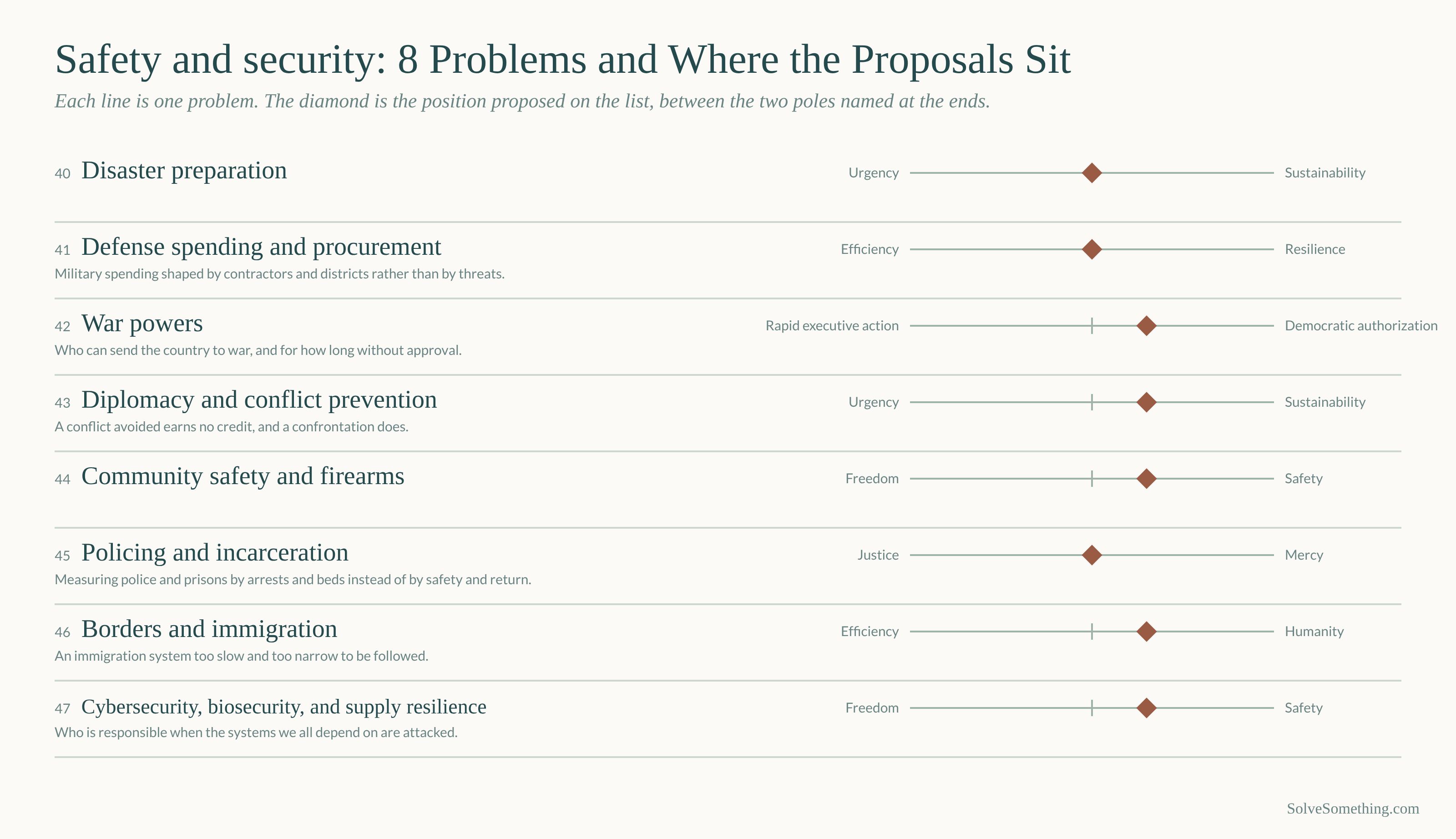
Safety and security · 8 problems
Safety and security
Disaster, defense, war, diplomacy, firearms, policing, immigration, and the newer threats to systems we depend on. The problems here concern readiness that gets neglected, incentives that drift from protection, and authority that outruns authorization.
40Disaster preparation
- What keeps it going
- Prevention gets attention after the disaster shows what neglect cost.
- Entry point
- Readiness budgets and clear responsibility assigned before anything happens.
- Starting proposal
- Protect readiness, mitigation, trained staff, and a clear chain of response.
- Trajectory
- Maintain and update capacity.
- The tension
- Preparation spends money before a threat arrives, sometimes on events that never come. Waiting keeps today's options open and leaves people with fewer when danger does arrive.
Proposal at the midpoint. Where we each sit on this line is the first thing a run should hear.
41Defense spending and procurement
Military spending shaped by contractors and districts rather than by threats.
- What keeps it going
- Contractor and political incentives can decide what gets bought, ahead of what security requires.
- Entry point
- The assessment of military need before a contract or program gets continuing money.
- Starting proposal
- Use independent threat assessment, competitive procurement, and performance audits.
- Trajectory
- Innovate allocation.
- The tension
- Readiness sometimes means paying for capacity that rarely gets used. Scrutiny slows procurement. Weak scrutiny lets political and commercial interests eat the money protection needed.
Proposal at the midpoint. Where we each sit on this line is the first thing a run should hear.
42War powers
Who can send the country to war, and for how long without approval.
- What keeps it going
- Executive initiative can run ahead of any public authorization.
- Entry point
- Authorization and renewal of military action beyond an immediate defensive response.
- Starting proposal
- Require stated objectives, legislative approval, reporting, and renewal deadlines.
- Trajectory
- Innovate checks.
- The tension
- A government has to be able to respond to danger fast. Wider authorization shares responsibility for prolonged force and accepts that deliberation limits tactical freedom.
Proposal leans Democratic authorization. Where we each sit on this line is the first thing a run should hear.
43Diplomacy and conflict prevention
A conflict avoided earns no credit, and a confrontation does.
- What keeps it going
- Confrontation gets rewarded politically. A conflict that never happened gets no credit.
- Entry point
- Professional diplomatic capacity, and the criteria for judging an escalation.
- Starting proposal
- Maintain professional diplomacy and review escalations that could have been prevented.
- Trajectory
- Maintain and improve prevention.
- The tension
- Credible defense discourages aggression. Restraint prevents avoidable conflict. Each fails when applied without context, exposing people either to aggression or to the costs of an unnecessary escalation.
Proposal leans Sustainability. Where we each sit on this line is the first thing a run should hear.
44Community safety and firearms
- What keeps it going
- Symbolic policy and punishment alone leave preventable harm in place.
- Entry point
- The specific access, storage, enforcement, or prevention mechanism tied to an identifiable pattern of harm.
- Starting proposal
- Evaluate targeted prevention, enforceable safeguards, competent response, and access to care.
- Trajectory
- Innovate prevention and accountability.
- The tension
- Safeguards reduce shared risk and constrain individual choice. Their reach has to follow the harm they address, with enforceable rights and attention to communities carrying an unequal burden.
Proposal leans Safety. Where we each sit on this line is the first thing a run should hear.
45Policing and incarceration
Measuring police and prisons by arrests and beds instead of by safety and return.
- What keeps it going
- Arrests, beds filled, and the money attached to them can replace safety and rehabilitation as the measure of success.
- Entry point
- The measures and financial incentives by which police and correctional institutions are judged.
- Starting proposal
- Judge the institutions by harm reduced, lawful conduct, and successful return to the community.
- Trajectory
- Innovate incentives.
- The tension
- Containment protects people now. Confinement carries human and public costs, and the institutions still owe lawful treatment and conditions that make return possible.
Proposal at the midpoint. Where we each sit on this line is the first thing a run should hear.
46Borders and immigration
An immigration system too slow and too narrow to be followed.
- What keeps it going
- Too little processing capacity and no workable route keep uncertainty and enforcement pressure permanent.
- Entry point
- Processing capacity, and whether lawful routes through the system exist.
- Starting proposal
- Provide timely decisions, workable legal routes, and enforcement that answers to someone.
- Trajectory
- Innovate administration.
- The tension
- A country needs working authority over entry and residence. People need timely decisions and humane treatment. Communities and public services carry the effects of admission and of exclusion.
Proposal leans Humanity. Where we each sit on this line is the first thing a run should hear.
47Cybersecurity, biosecurity, and supply resilience
Who is responsible when the systems we all depend on are attacked.
- What keeps it going
- Responsibility split across institutions leaves the gaps between them undefended.
- Entry point
- The minimum safeguards and backup responsibilities assigned across essential institutions.
- Starting proposal
- Assign clear ownership, minimum protections, backup capacity, and regular exercises.
- Trajectory
- Innovate for emerging threats.
- The tension
- Redundancy costs more than a system built for normal conditions. More protection can also restrict access and information sharing, so resilience needs proportionate limits and ongoing review.
Proposal leans Safety. Where we each sit on this line is the first thing a run should hear.
Governance and justice · 40 problems
Governance and justice
The largest group, because the machinery of government is where the other domains get decided. The problems here concern pardons, oversight, elections, money in politics, appointments, the courts, the budget, and the conduct and capacity of the people who hold the highest offices.

48Conflicts in presidential pardons
Clemency in the hands of one person, with no record and no review.
- What keeps it going
- Clemency corrects injustice. Concentrating its authorization and review in one officeholder also permits favoritism and self-protection, and accountability fails when the person granting relief can bypass independent scrutiny.
- Entry point
- The authorization and conflict review required before a pardon takes effect.
- Starting proposal
- By constitutional reform, require a signed, public, multi-party record for every pardon that creates personal liability for misuse, with published reasons, audits, and an exclusion for the officeholder's own misconduct. Independent multi-member approval, a cap of five per term, and an Election Day cutoff before departure are further proposals, the number included.
- Trajectory
- Innovate constitutional safeguards.
- The tension
- A signed public record protects clemency from favoritism and exposes an act of relief to political attack. Independent approval delays relief. A cap prevents excess and can block the correction of a widespread injustice, so the people denied relief carry part of the cost.
Proposal leans Justice. Where we each sit on this line is the first thing a run should hear.
49Executive interference with authorized spending
A president refusing to spend money Congress already authorized.
- What keeps it going
- Control of administration can be used to block what the legislature decided.
- Entry point
- The controls on releasing funds after the legislature has authorized the spending.
- Starting proposal
- Build preventive controls and prompt independent enforcement into the release of authorized funds. A reelection bar for an established constitutional violation is a further proposal, with an explicit standard, valid legal authority, independent judgment, and appeal.
- Trajectory
- Innovate checks.
- The tension
- Administration needs room to respond to changing conditions. Preventive controls protect legislative authority and limit discretion. A reelection bar needs fair adjudication or enforcement becomes political exclusion.
Proposal leans Sustainability. Where we each sit on this line is the first thing a run should hear.
50Congressional oversight
Congress declining to investigate its own party's administration.
- What keeps it going
- Party incentive rewards shielding an administration from scrutiny.
- Entry point
- The power to open an investigation when the governing party would rather not.
- Starting proposal
- Provide independent triggers for investigations, and public findings.
- Trajectory
- Innovate oversight.
- The tension
- Independence lets scrutiny reach officials who still hold political support. It can consume governing time and be abused, so investigators need evidence standards and accountability alongside protection from obstruction.
Proposal leans Transparency. Where we each sit on this line is the first thing a run should hear.
51Emergency authority
Emergency powers that never expire.
- What keeps it going
- Exceptional powers become routine.
- Entry point
- The expiration and renewal conditions attached to exceptional executive powers.
- Starting proposal
- Limit scope and duration, and require independent review and legislative renewal.
- Trajectory
- Innovate limits.
- The tension
- Fast decisions protect people in a crisis. Renewal and review reduce unilateral freedom, and open-ended powers move continuing authority out of ordinary democratic control.
Proposal at the midpoint. Where we each sit on this line is the first thing a run should hear.
52Constitutional eligibility
Deciding who is constitutionally eligible for office before the ballot is printed, rather than after.
- What keeps it going
- A constitutional restriction fails when enforcement comes late or unclear.
- Entry point
- A national process for deciding constitutional eligibility before electoral deadlines.
- Starting proposal
- Establish timely federal procedures, evidence standards, decisions, and appeals ahead of the deadlines.
- Trajectory
- Innovate enforcement.
- The tension
- Enforcement protects constitutional government. The same power can remove an opponent, so notice, evidence, independent judgment, and appeal belong inside the mechanism from the start.
Proposal leans Justice. Where we each sit on this line is the first thing a run should hear.
53Selective enforcement and due process
The law applied to opponents and waived for allies.
- What keeps it going
- Political discretion decides who gets protection and who gets punished.
- Entry point
- The standards for opening a case, and the independent review available to the person affected.
- Starting proposal
- Require consistent standards, timely hearings, access to counsel, and independent remedies.
- Trajectory
- Maintain rights and improve enforcement.
- The tension
- Officials need discretion to investigate real harm. People need protection from coercion and selective punishment, even where fair hearings and legal access slow things down.
Proposal at the midpoint. Where we each sit on this line is the first thing a run should hear.
54Retaliation against scrutiny
Officials punishing the journalists, critics, and whistleblowers who question them.
- What keeps it going
- Officials control access to the people who question them.
- Entry point
- The access, employment, and legal protections of people who investigate public conduct.
- Starting proposal
- Establish enforceable access standards and protections for journalists, critics, and whistleblowers.
- Trajectory
- Maintain scrutiny.
- The tension
- Officials have real security and operational needs. The same needs get invoked to avoid scrutiny, which leaves independent review to separate a necessary limit from protection against criticism.
Proposal well toward Transparency. Where we each sit on this line is the first thing a run should hear.
55Personal enrichment through office
Officials making decisions that raise the value of their own holdings.
- What keeps it going
- A decision made in office raises the value of what the official owns.
- Entry point
- The financial interests an official may keep while exercising decision-making authority.
- Starting proposal
- Require divestment or independent arrangements, financial disclosure, and conflict rules that can be enforced.
- Trajectory
- Innovate separation of interests.
- The tension
- Public service does not require giving up a private economic life. Resolving conflicts restricts investment choices and discourages some candidates. Leaving them unresolved asks the public to trust decisions made under competing obligations.
Proposal leans Transparency. Where we each sit on this line is the first thing a run should hear.
56Nepotism and unqualified appointments
Jobs going to relatives and loyalists instead of people who can do them.
- What keeps it going
- Relationship and loyalty stand in for competence.
- Entry point
- The disclosed criteria and independent assessment that come before an appointment is approved.
- Starting proposal
- Require relevant qualifications, disclosed relationships, and transparent selection.
- Trajectory
- Innovate merit safeguards.
- The tension
- An elected leader needs people who can carry out a lawful agenda. Qualifications and open selection constrain personal discretion and protect the public from appointments made on relationship instead of capability.
Proposal leans Professional competence. Where we each sit on this line is the first thing a run should hear.
57Politicized professional judgment
Experts punished for findings their bosses dislike.
- What keeps it going
- Staff get punished for findings leadership did not want.
- Entry point
- The conditions under which leaders can reject expert findings or penalize the people who produced them.
- Starting proposal
- Protect professional work, and require public reasons when leadership overrides it.
- Trajectory
- Maintain expertise and improve accountability.
- The tension
- Professional independence protects evidence from political punishment. Elected leadership keeps authority over policy, with public reasons showing where the disagreement is about evidence and where it is about priorities.
Proposal at the midpoint. Where we each sit on this line is the first thing a run should hear.
58Removable watchdogs and unenforced ethics
Inspectors general and ethics offices that the people they investigate can fire.
- What keeps it going
- Officials weaken their own investigators, and the review that remains takes too long to matter.
- Entry point
- The removal protections, resources, and deadlines governing an oversight office.
- Starting proposal
- Protect investigators' tenure and resources, and set enforceable deadlines and remedies.
- Trajectory
- Innovate independence and timeliness.
- The tension
- Protected investigators can examine powerful people without needing their approval. The protection can also shelter poor performance, so fair removal and independent review stay in the arrangement.
Proposal leans Transparency. Where we each sit on this line is the first thing a run should hear.
59Concentrated judicial authority
Nine people deciding questions that affect everyone, with no wider review.
- What keeps it going
- A small group of deciders limits how much scrutiny a consequential ruling receives.
- Entry point
- The breadth and transparency of qualified review before a consequential ruling.
- Starting proposal
- Add a certified pool of qualified lawyers, chosen through a defensible process, whose votes on a consequential ruling are aggregated with auditable AI assistance, with published reasons and identifiable human responsibility for the ruling itself.
- Trajectory
- Innovate review.
- The tension
- Wider participation brings more knowledge and more disagreement into view. Selection, coordination, and final responsibility get harder as the pool grows, and a vote count cannot explain a legal judgment on its own.
Proposal leans Innovation. Where we each sit on this line is the first thing a run should hear.
60Presidential representation
The Electoral College, and whether every vote should weigh the same.
- What keeps it going
- Electoral weighting overrides the equal weight of a national vote.
- Entry point
- The constitutional rules that turn presidential votes into a winner.
- Starting proposal
- Adopt a national popular vote through a valid constitutional route.
- Trajectory
- Innovate representation.
- The tension
- Equal weight gives every citizen the same formal contribution. Geographic weighting protects a different idea of political community and assigns people different influence according to where they live.
Proposal leans Equal individual votes. Where we each sit on this line is the first thing a run should hear.
61Senate representation
Equal votes for states with different populations.
- What keeps it going
- Equal votes for states produce unequal representation per person.
- Entry point
- The constitutional split of representation between states and their populations.
- Starting proposal
- Pursue constitutional redesign that addresses state standing and population together, including Article V's requirement that an affected state consent to losing equal Senate suffrage.
- Trajectory
- Innovate representation.
- The tension
- State equality protects small states from domination. Population equality protects the standing of each person. Redesign redistributes influence that existing states will not give up without conditions.
Proposal at the midpoint. Where we each sit on this line is the first thing a run should hear.
62Gerrymandering and practical voting barriers
Politicians drawing their own districts, and rules that make voting harder in some places than in others.
- What keeps it going
- Incumbents draw the map, and inconsistent access decides who shows up and whose votes become seats.
- Entry point
- District drawing, and the administrative requirements a person has to clear to cast a vote.
- Starting proposal
- Use independent districting and dependable voting access.
- Trajectory
- Innovate electoral administration.
- The tension
- Local administration can respond to place. Common standards limit that discretion and protect citizens whose participation would otherwise depend on who drew the map.
Proposal leans Collective. Where we each sit on this line is the first thing a run should hear.
63Large donors and unlimited outside spending
Elections financed by a small number of wealthy donors.
- What keeps it going
- Dependence on concentrated wealth decides who can run and what gets political attention.
- Entry point
- The money a candidate needs to become viable.
- Starting proposal
- Limit private financing and provide substantial public campaign support.
- Trajectory
- Innovate election financing.
- The tension
- People need room to advocate and to back candidates. Dependence on large private money gives some voices more weight. Public financing spends shared money on campaigns many contributors oppose.
Proposal leans Safety. Where we each sit on this line is the first thing a run should hear.
64Hidden and prohibited political money
Political money routed through organizations that hide where it came from.
- What keeps it going
- Intermediaries hide where the money started.
- Entry point
- Traceability of original funding through organizations and intermediaries.
- Starting proposal
- Require traceable source disclosure and independent verification of eligibility.
- Trajectory
- Innovate transparency.
- The tension
- Political association needs protection from harassment. Source disclosure exposes some private relationships and lets voters and investigators see whose interests are paying for influence.
Proposal leans Transparency. Where we each sit on this line is the first thing a run should hear.
65Coordinated outside campaigns
Campaigns and outside groups that claim independence and act together.
- What keeps it going
- Formal separation hides a shared operation.
- Entry point
- The evidence used to decide when supposedly separate political operations are acting together.
- Starting proposal
- Apply shared financing rules once coordination is established, and enforce them promptly.
- Trajectory
- Innovate enforcement.
- The tension
- Independent groups need room to support shared goals. Coordination rules close an evasion of campaign obligations, and a vague standard can also discourage lawful association.
Proposal leans Safety. Where we each sit on this line is the first thing a run should hear.
66Vote-linked financial inducements
Paying people, in money or benefits, for how they vote.
- What keeps it going
- Money or valuable benefits buy electoral behavior.
- Entry point
- The conditions attached to payments or benefits offered in connection with voting.
- Starting proposal
- Prohibit the inducements and provide rapid, independent review of alleged violations.
- Trajectory
- Maintain free choice and improve enforcement.
- The tension
- Participation drives remove practical barriers. Valuable inducements compromise free choice, so the boundary has to be clear and the review quick, without treating ordinary civic help as a purchase.
Proposal leans Safety. Where we each sit on this line is the first thing a run should hear.
67Opaque online political advertising
Political ads whose sponsors and targeting nobody can inspect.
- What keeps it going
- Sponsors and targeting cannot be inspected.
- Entry point
- The information a platform must keep and disclose when it accepts a political ad.
- Starting proposal
- Publish searchable ads, original sponsors, spending, and targeting criteria.
- Trajectory
- Innovate disclosure.
- The tension
- Targeting reaches people who care about an issue. Disclosure makes the influence inspectable, exposes some campaign strategy, and requires protection of audience data.
Proposal leans Transparency. Where we each sit on this line is the first thing a run should hear.
68Campaign costs and continuous fundraising
Officeholders spending their working hours raising money.
- What keeps it going
- Expensive entry and constant solicitation favor wealth and the people who have access to it.
- Entry point
- The funding and communication access available before a candidate has a donor network.
- Starting proposal
- Provide viable public funding, affordable routes to voters, and limits on fundraising during official work.
- Trajectory
- Innovate political access.
- The tension
- Public support broadens who can run and reduces time spent asking for money. It also finances speech people oppose, and access rules can become one more barrier protecting incumbents.
Proposal leans Collective. Where we each sit on this line is the first thing a run should hear.
69Donor access and private sponsorship
Donations and sponsorships that buy meetings with decision-makers.
- What keeps it going
- Funding a campaign or a public project buys proximity to the decision.
- Entry point
- The terms under which a donation or sponsorship creates contact with decision-makers.
- Starting proposal
- Disclose consequential meetings, and prohibit sponsorship from purchasing influence.
- Trajectory
- Innovate access rules.
- The tension
- Officials need contact with constituents, organizations, and people offering resources. Preferential access turns contact into purchased influence, so disclosure and access rules constrain some relationships.
Proposal leans Transparency. Where we each sit on this line is the first thing a run should hear.
70Incomplete candidate platforms
Candidates who run on a feeling instead of on positions.
- What keeps it going
- Emotional signals stand in for a governing position.
- Entry point
- The policy information a candidate is expected to disclose before receiving public support.
- Starting proposal
- Require comparable disclosure across all seven domains, costs and trade-offs included, and publish a conduct scorecard for people seeking or holding power.
- Trajectory
- Innovate public expectations.
- The tension
- Comparable platforms make commitments examinable. Detail costs time to produce and to read. Oversimplified declarations let a candidate avoid the decisions the position would require.
Proposal well toward Transparency. Where we each sit on this line is the first thing a run should hear.
71Secrecy and misinformation
Decisions made without records, so that claims about them cannot be checked.
- What keeps it going
- Missing records and hidden sponsorship make a consequential claim impossible to check.
- Entry point
- The public records and source information needed to verify a claim that matters.
- Starting proposal
- Publish decision records, the evidence under them, sponsorship, and visible corrections, while protecting lawful expression and privacy.
- Trajectory
- Innovate verification.
- The tension
- Verification needs evidence. Disclosure meets privacy and legitimate confidentiality, and a correction mechanism cannot hand officials unchecked power over acceptable political speech.
Proposal leans Transparency. Where we each sit on this line is the first thing a run should hear.
72Contract favoritism
Public contracts awarded to friends under the cover of urgency.
- What keeps it going
- Relationships and urgency route around fair selection.
- Entry point
- The ownership disclosure and selection review completed before public money is committed.
- Starting proposal
- Publish contracts, beneficial ownership, selection criteria, performance, and every emergency exception, with independent audits.
- Trajectory
- Innovate procurement.
- The tension
- Competitive review protects against favors and poor value. It takes time and effort. Broad emergency exceptions turn urgency into the route around accountability.
Proposal leans Transparency. Where we each sit on this line is the first thing a run should hear.
73Regulatory capture
Regulators who expect their next job from the industry they regulate.
- What keeps it going
- A future job and dependence on the industry bend the oversight toward the overseen.
- Entry point
- The employment and financial conflicts around the people who write or enforce a rule.
- Starting proposal
- Restrict revolving-door conflicts and independently review consequential decisions.
- Trajectory
- Innovate independence.
- The tension
- Industry experience improves regulation. Restricting conflicts loses some expertise and some careers. Leaving them unresolved makes the regulator depend on the regulated.
Proposal leans Collective. Where we each sit on this line is the first thing a run should hear.
74Agency dismantling and outdated organization
Agencies shut down before anyone asks what they did.
- What keeps it going
- A function disappears before anyone evaluates its purpose or what replaces it.
- Entry point
- The public evaluation required before an agency function is eliminated, moved, or replaced.
- Starting proposal
- Require public impact review, lawful authorization, and continuity of necessary services while ineffective arrangements are reorganized.
- Trajectory
- Innovate organization and let go of demonstrated duplication.
- The tension
- Reorganization removes dead weight and duplication. Continuity protects services and institutional memory. Preserving every structure prevents reform.
Proposal at the midpoint. Where we each sit on this line is the first thing a run should hear.
75Public assets and outsourced authority
Public functions handed to contractors with nobody left who can evaluate them.
- What keeps it going
- Delegation and unilateral changes hide who owns the asset and who answers for harm.
- Entry point
- The approval rights and retained public expertise attached to an asset transfer or service contract.
- Starting proposal
- Keep public expertise, approval rights, and enforceable remedies.
- Trajectory
- Maintain public responsibility and improve delivery.
- The tension
- Delegation brings flexibility and delivery. Retained approval and expertise cost money. Without them a community depends on a provider it cannot evaluate or replace.
Proposal leans Collective. Where we each sit on this line is the first thing a run should hear.
76Technology and artificial intelligence
Government adopting technology without the expertise to govern it.
- What keeps it going
- Decision authority gets dispersed without the expertise to match.
- Entry point
- Who holds qualified authority over consequential public uses of technology.
- Starting proposal
- Establish qualified public leadership, clear duties, transparent evaluation, and protection of rights.
- Trajectory
- Innovate institutional capacity.
- The tension
- Public expertise improves decisions and protects rights. Building it takes funding and slows adoption, and concentrating technical authority creates a new institution that itself needs democratic scrutiny.
Proposal leans Innovation. Where we each sit on this line is the first thing a run should hear.
77Symbolic agendas and postponed consequences
Attention spent on visible fights while the pipes and the maintenance go unfunded.
- What keeps it going
- Attention rewards visible conflict while the harm and the maintenance bills pile up out of view.
- Entry point
- The public measures by which officials answer for essential services across electoral cycles.
- Starting proposal
- Publish essential-service performance and make timely intervention possible.
- Trajectory
- Innovate accountability across electoral cycles.
- The tension
- Responsiveness includes what people care about now. Sustained obligations need attention when they bring no publicity, and performance measures have to leave room for priorities that resist counting.
Proposal leans Sustainability. Where we each sit on this line is the first thing a run should hear.
78Free speech and accurate information
The right to say something false, and the right to know what is true.
- What keeps it going
- Speech protections were written for a world where reaching millions took a press. Amplification now rewards whatever spreads, true or not, and the design never built the tension between the right to speak and the right to receive accurate information.
- Entry point
- The rules for paid and algorithmic amplification of claims about public matters, not the right to make the claim.
- Starting proposal
- Protect the right to speak, and attach disclosure, visible correction, and liability to the paid or algorithmic amplification of demonstrably false claims about public matters.
- Trajectory
- Innovate a tension the design left out.
- The tension
- Rules on amplification protect the public's ability to know what is true without touching the right to say what is false. The power to label a claim false can become the power to suppress dissent, so the mechanism needs independent judgment, narrow scope, and appeal.
Proposal at the midpoint. Where we each sit on this line is the first thing a run should hear.
79Penalties below the cost of compliance
Fines cheaper than compliance.
- What keeps it going
- A fine cheaper than compliance is a license. The operator pays and continues, and the rule has proven ineffective.
- Entry point
- How a penalty is calculated against the cost of complying and the gain from violating.
- Starting proposal
- Set penalties above both the cost of compliance and the gain from violation, scale them to the violator, and publish the calculation.
- Trajectory
- Innovate enforcement.
- The tension
- A penalty above the gain changes behavior. One fine closes a small operator and is absorbed by a large one, so scale enters the calculation, and a penalty big enough to deter can deter the lawful activity around it.
Proposal leans Justice. Where we each sit on this line is the first thing a run should hear.
80Supreme Court tenure and ethics
Life tenure and no enforceable ethics code on the highest court.
- What keeps it going
- Life tenure with no enforceable ethics code concentrates authority in a few people for decades, and the timing of a vacancy becomes a lottery that raises the stakes of every appointment.
- Entry point
- Term length, appointment cadence, and ethics enforcement for the highest court.
- Starting proposal
- By a valid constitutional or statutory route, set fixed staggered terms with a regular appointment cadence, and an enforceable ethics and recusal code reviewed by an independent body.
- Trajectory
- Innovate structure.
- The tension
- Fixed terms regularize appointments and lower the stakes of any one vacancy. Life tenure was built to insulate judges from political pressure, and a shorter term exposes a ruling to the next appointment cycle, so the term has to stay long enough to keep the insulation.
Proposal leans Innovation. Where we each sit on this line is the first thing a run should hear.
81The budget process
Shutdowns, continuing resolutions, and the debt ceiling.
- What keeps it going
- A budget that can be held hostage rewards whoever is willing to let the government stop. Continuing resolutions, shutdowns, and the debt ceiling make the routine act of funding the country into leverage, and the people who depend on the services pay for the standoff.
- Entry point
- The default that takes effect when Congress misses the deadline.
- Starting proposal
- Replace shutdown with automatic continuation at current levels, remove the debt ceiling as a separate vote on obligations already incurred, and attach consequences for missed deadlines to the legislators instead of the public.
- Trajectory
- Innovate the default.
- The tension
- Automatic continuation protects people from a standoff they did not choose. A deadline without consequence removes the pressure that forces a deal, so the consequence moves from the public to the people responsible for the deadline.
Proposal leans Continuity of government. Where we each sit on this line is the first thing a run should hear.
82Primaries and ranked choice
How a small slice of one party picks the candidates everyone else chooses between.
- What keeps it going
- A closed primary decided by a small, committed slice of one party produces a candidate chosen for identity, and the general election then offers two people selected for winning a faction rather than governing a whole. A primary rewards the position that needs no context.
- Entry point
- Who may vote in a primary, and how a ballot with more than two candidates is counted.
- Starting proposal
- Open primaries and ranked-choice general elections, so a candidate has to be acceptable to people outside their faction to win.
- Trajectory
- Innovate electoral design.
- The tension
- Ranked choice rewards the candidate who can hold a second and third preference, the one who can govern a divided public. Parties lose some control over who carries their name, and a more complex ballot asks more of the voter and the count.
Proposal leans Voter choice. Where we each sit on this line is the first thing a run should hear.
83Recruiting candidates by capability
Asking capable people to run instead of waiting for whoever wants the job.
- What keeps it going
- Office goes to the people who want it enough to raise the money, which selects for a temperament. People whose record shows they can run an institution or carry a hard negotiation rarely run, because nobody asks and the route to a ballot is built for self-promotion.
- Entry point
- The route by which a capable person who never sought office reaches a ballot.
- Starting proposal
- Establish a nonpartisan recruitment route, with public funding and ballot access, through which people with demonstrated records of running things are asked to run, beside the ordinary route for anyone who chooses it.
- Trajectory
- Innovate candidacy.
- The tension
- Recruitment puts people on the ballot whose records already suggest they can do the job. Whoever decides who gets asked holds a new kind of power, so the recruiting body needs open criteria, disclosed membership, and no authority to exclude anyone from the ordinary route.
Proposal leans Innovation. Where we each sit on this line is the first thing a run should hear.
84Cabinet and agency heads drawn from a field's own pool
Where cabinet secretaries and agency heads come from.
- What keeps it going
- A president has to be able to hire the people who carry out an agenda. When Senate confirmation is the only constraint, loyalty and donor relationships decide who runs education, defense, health, and public land, and the field being run has no voice in the choice.
- Entry point
- The pool a cabinet secretary or agency head may be chosen from.
- Starting proposal
- Let the people who work in each field nominate a pool, teachers for education, service members for defense, the agency's own professionals for public land and health, and let the president choose from it. The president keeps the hiring decision and the field keeps a say in who is eligible.
- Trajectory
- Innovate appointment.
- The tension
- A field's own pool puts competence ahead of loyalty. A field can also nominate people who will protect it from reform, so the pool needs to be large, the nominating process open, and the president's authority to set direction preserved once the choice is made.
Proposal leans Professional competence. Where we each sit on this line is the first thing a run should hear.
85Age limits for high office
- What keeps it going
- The probability of cognitive decline rises with age. Not every person past eighty is impaired, and the probability at eighty differs enough from the probability at fifty that a system which ignores it has chosen to accept a known risk. Because the question is uncomfortable, it gets decided by partisans defending their own candidate instead of by a rule that applies to everyone.
- Entry point
- A single age rule for federal elected office and the court, set before anyone knows which candidate it will touch.
- Starting proposal
- Set an upper age limit for candidacy and service in federal office through a valid constitutional route, applied identically across parties and branches.
- Trajectory
- Innovate eligibility.
- The tension
- A limit excludes some people who remain fully capable, a cost to them and to the public that would have chosen them. No limit asks the public to carry the probability of decline in the most consequential job in the country, one candidate at a time.
Proposal leans Fairness. Where we each sit on this line is the first thing a run should hear.
86Incapacity in office
What happens when an officeholder can no longer do the job and will not step aside.
- What keeps it going
- A head injury, a stroke, an illness, or the onset of a psychiatric condition can remove a person's capacity for judgment without removing them from office. The existing mechanism depends on the officeholder's own appointees acting against the person who appointed them, the arrangement least likely to work when it is needed.
- Entry point
- Who decides an officeholder can no longer do the job, and on what evidence.
- Starting proposal
- Establish a standing, independent medical and cognitive assessment for the highest offices, scheduled and triggered by defined events, with a succession process that does not run through the officeholder's own cabinet.
- Trajectory
- Innovate protection.
- The tension
- An independent assessment protects the public from a leader who can no longer lead. The same mechanism can remove a leader someone wants gone, so the standard has to be medical, the assessors independent of every party, and the finding open to appeal.
Proposal leans Protection of the public. Where we each sit on this line is the first thing a run should hear.
87Standards of conduct in high office
Behavior that would end any other career carrying no consequence at the top.
- What keeps it going
- Every workplace, school, and profession has a standard of conduct and a method of correction. The highest offices have neither, so behavior that would end a career anywhere else carries no consequence at the top, and the public learns the rules apply to everyone except the people who make them.
- Entry point
- A published standard of conduct for high office and the graduated correction attached to it.
- Starting proposal
- Define a standard of conduct for federal office covering destructive, polarizing, and erratic behavior, with graduated, enforceable correction decided by an independent body and applied to allies and opponents alike.
- Trajectory
- Innovate accountability.
- The tension
- A conduct standard holds the most powerful to the rule everyone else already lives under. The power to define unacceptable conduct can punish dissent or style, so the standard has to be behavioral and published in advance, with independent adjudication and appeal.
Proposal leans Justice. Where we each sit on this line is the first thing a run should hear.
Two problems that run through all seven domains
Affordability and corruption do not belong to one domain. Each one needs coordinated work in several places at once, so the list returns to them here with entries written from the household side and from the side of the public decision. Many of these entries point back to problems above; the difference is the frame, and the frame changes what a blueprint has to deliver.
Making ordinary life affordable · 10 problems
Making ordinary life affordable
A household experiences one combined bill. Government divides responsibility for that bill among institutions that rarely answer for the total. The problems here revisit housing, care, food, energy, transport, income, and debt from the household's side of the ledger.

88Housing that people can obtain
- What keeps it going
- Housing cost is the product of available homes, financing, land-use rules, infrastructure, and income. Assistance by itself leaves people bidding for the same scarce homes.
- Entry point
- Coordinating approvals, public investment, and help for people who cannot wait for new supply.
- Starting proposal
- Remove building barriers that serve no purpose, develop lasting affordable housing, and pair targeted assistance with new capacity and displacement protection.
- Trajectory
- Innovate supply and access while maintaining essential services.
- The tension
- People need relief before construction finishes. Immediate assistance adds pressure on limited supply. Waiting for supply leaves current households carrying the hardship.
Proposal leans Collective. Where we each sit on this line is the first thing a run should hear.
89Health care and prescription costs
- What keeps it going
- Coverage, provider payment, administrative complexity, and market power each shape the cost of care, and lowering one bill can move the expense somewhere else in the system.
- Entry point
- The purchasing and payment arrangements through which public programs and insurers buy care and medicines.
- Starting proposal
- Guarantee essential access, negotiate prices where it fits, examine intermediary conflicts, and simplify administration while keeping independent appeals.
- Trajectory
- Innovate financing and maintain clinical capacity.
- The tension
- Collective purchasing lowers what households pay and constrains provider and manufacturer returns. Savings have to preserve access and capacity, including the resources that develop and deliver treatment.
Proposal leans Collective. Where we each sit on this line is the first thing a run should hear.
90Food and basic nutrition
- What keeps it going
- Food prices reflect production, distribution, wages, disruption, and who gets to set terms in the market. A household with little left over experiences an ordinary increase as lost access.
- Entry point
- Dependable supply together with direct access to adequate nutrition.
- Starting proposal
- Support resilient production and distribution, examine demonstrated anticompetitive practices, reduce waste, and provide reachable nutrition assistance and school meals.
- Trajectory
- Innovate supply resilience and maintain access to food.
- The tension
- Families need affordable food, and producers and workers need viable incomes. Public support redistributes the bill. Lower prices bought by degrading soil or working conditions cost somewhere else.
Proposal leans Collective. Where we each sit on this line is the first thing a run should hear.
91Childcare and family care
- What keeps it going
- Care requires paid time and capable people, and households need care in order to work. Assistance without places leaves families competing for the same slots.
- Entry point
- The workforce and financing needed to open and sustain more care places.
- Starting proposal
- Expand public or supported provision alongside household assistance, adequate care-worker pay, paid leave, and practical support for family caregivers.
- Trajectory
- Innovate care capacity and household access.
- The tension
- Lower household bills and adequate caregiver wages both need financing. Safety standards protect the people receiving care. Unnecessary administrative burden shrinks the capacity the standards were meant to support.
Proposal leans Collective. Where we each sit on this line is the first thing a run should hear.
92Energy and utility bills
- What keeps it going
- A bill combines supply, infrastructure, financing, and household efficiency. A low charge today can hide deferred maintenance or a cost shifted to later users.
- Entry point
- Utility investment plans and rate decisions considered together with household affordability.
- Starting proposal
- Develop reliable supply, grid capacity, and efficiency improvements, with transparent rates and targeted protection for households that cannot meet essential charges.
- Trajectory
- Maintain reliability and innovate lower total costs.
- The tension
- Investment makes future service dependable and raises charges now. Assistance protects current households, and the investment still needs a credible source of payment.
Proposal at the midpoint. Where we each sit on this line is the first thing a run should hear.
93Transportation costs
- What keeps it going
- Reaching work, school, and care depends on where housing is and what transport exists. A nominal service too infrequent to use offers no relief.
- Entry point
- Housing and transport planning that connects destinations through dependable service.
- Starting proposal
- Build usable alternatives to car dependence, coordinate them with housing, and finance continuing operations alongside construction.
- Trajectory
- Innovate practical mobility and maintain existing networks.
- The tension
- Shared transport cuts household vehicle costs and widens access. It takes public investment and land-use change, including contributions from people who use it less.
Proposal leans Collective. Where we each sit on this line is the first thing a run should hear.
94Income and the share left after essentials
What a household has left after the essentials are paid.
- What keeps it going
- Affordability depends on income as much as prices. Low earnings, unstable work, taxes, and gaps in support decide what is left after basic needs.
- Entry point
- Workplace standards and income supports measured against the cost of essentials.
- Starting proposal
- Enforce wage rules, strengthen practical bargaining and worker development, simplify access to support, and direct credibly financed tax relief toward household need.
- Trajectory
- Innovate household security and productive employment.
- The tension
- More disposable income protects households, and employers need conditions they can survive. Financing and design decide how the costs reach prices, public budgets, and employment.
Proposal leans Collective. Where we each sit on this line is the first thing a run should hear.
95Debt fees and insurance
Fees and premiums that compound a household's bad month.
- What keeps it going
- Debt charges and insurance costs compound a disruption. Opaque terms block informed choice, and a premium also reflects risk that remains when the price is suppressed.
- Entry point
- Contract terms, fee rules, and the financing of underlying risk, before households get trapped.
- Starting proposal
- Require clear terms, curb exploitative charges, provide workable restructuring and appeals, and reduce insurable risk alongside help with necessary coverage.
- Trajectory
- Innovate financial protection and maintain viable coverage.
- The tension
- Affordable protection needs someone to finance the risk. Controls that ignore that obligation shrink coverage. Unrestrained pricing puts essential protection out of reach for the people who need it.
Proposal leans Safety. Where we each sit on this line is the first thing a run should hear.
96Public services that reduce the household bill
Needs we each buy separately that could cost less provided together.
- What keeps it going
- Households pay privately for needs that can sometimes be met together. Comparing taxes alone misses private charges, administrative cost, unpaid time, and differences in access.
- Entry point
- The choice between individual purchasing and shared provision of an essential service.
- Starting proposal
- Compare the full household and public cost of credible delivery models, quality, access, reliability, and recourse included, and expand shared provision where it performs better.
- Trajectory
- Innovate provision where it improves total cost and access.
- The tension
- Shared provision reduces private expense and increases taxes and shared control. Individual purchasing keeps some choices and can leave households with no bargaining power and no alternative.
Proposal leans Collective. Where we each sit on this line is the first thing a run should hear.
97Showing whether affordability improved
Measuring affordability by what households are left with, rather than by the headline inflation rate.
- What keeps it going
- An average price or a headline inflation figure can improve while households still cannot meet essential needs, and charges move between bills, taxes, fees, and unpaid obligations.
- Entry point
- Public evaluation of essential costs against household income and practical access.
- Starting proposal
- Publish measures by place and household circumstance, assign responsibility for results, and separate immediate relief from structural work on longer timelines.
- Trajectory
- Innovate public measurement and accountability.
- The tension
- Comparable measures make progress inspectable. Every measure leaves something out, so numerical improvement has to be read alongside reliability, access, and the experience of the households carrying the cost.
Proposal leans Transparency. Where we each sit on this line is the first thing a run should hear.
Interrupting corruption · 9 problems
Interrupting corruption
Corruption is the capture of a public decision by a private interest, and it recurs in every domain above. The problems here are the mechanisms that make capture harder: separation, traceability, inspection, competence, protection for investigators, and enforcement people can use.
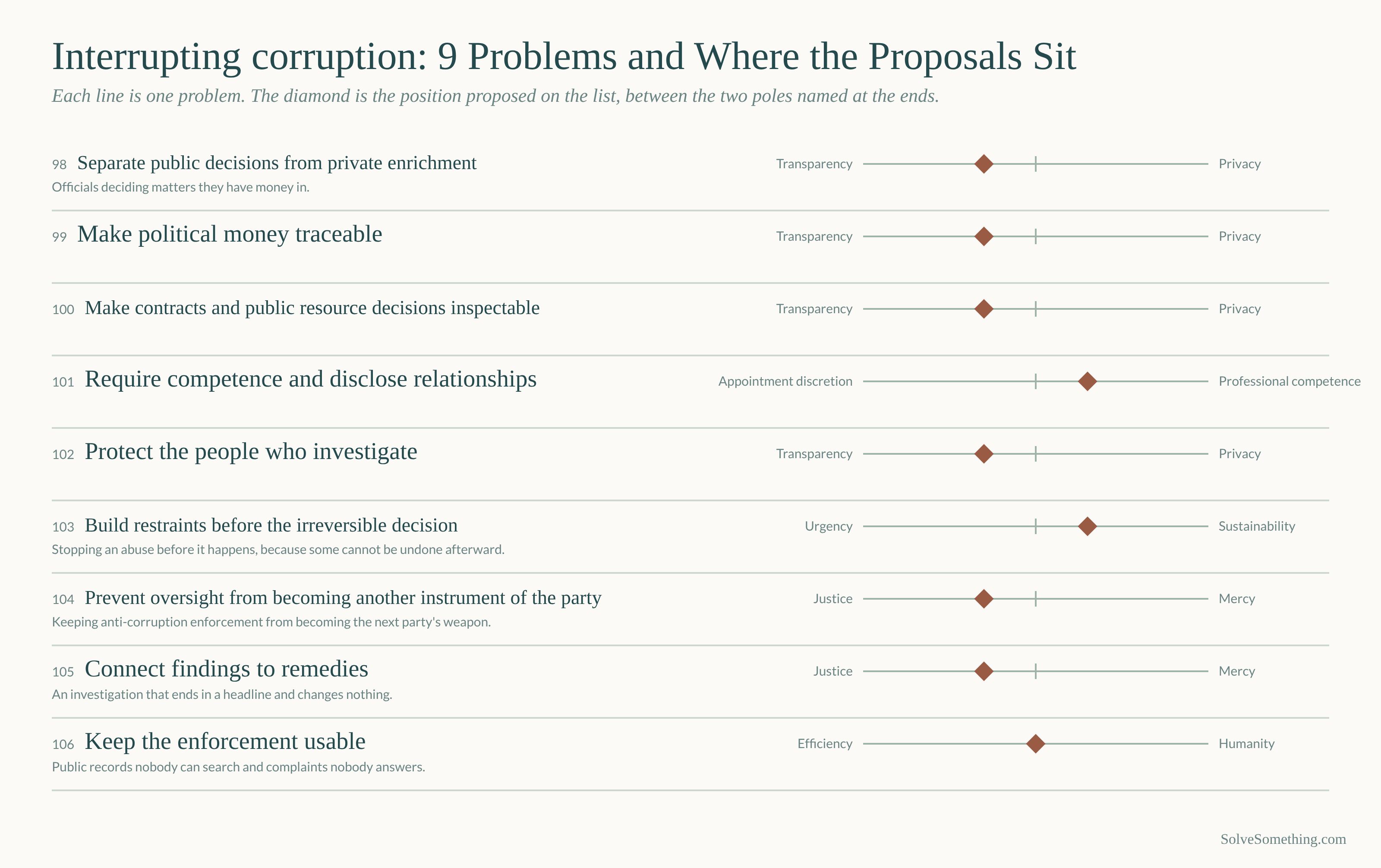
98Separate public decisions from private enrichment
Officials deciding matters they have money in.
- What keeps it going
- Officials decide matters that touch their own investments. Disclosure leaves the conflict in place when the interest stays.
- Entry point
- The financial arrangements required before taking part in a consequential decision.
- Starting proposal
- Require divestment or independent arrangements, restrict individual stock trading by lawmakers, and provide disclosure, recusal, and independent enforcement.
- Trajectory
- Innovate separation of private interests and public authority.
- The tension
- Officials keep a legitimate interest in financial security and a life after office. Conflict rules limit some choices and deter some candidates. Unresolved interests ask everyone else to accept divided obligations.
Proposal leans Transparency. Where we each sit on this line is the first thing a run should hear.
99Make political money traceable
- What keeps it going
- Money passes through organizations that hide the original contributor, and voters meet advocacy they cannot trace.
- Entry point
- The disclosure and verification required when political money enters or moves through an organization.
- Starting proposal
- Trace original funders, verify prohibited sources, provide timely public records, and reduce dependence on large contributions through public financing and enforceable limits.
- Trajectory
- Innovate transparent campaign financing.
- The tension
- Disclosure supports accountability and exposes associations to scrutiny and harassment. Public financing reduces donor dependence and asks people to fund a system that includes speech they oppose.
Proposal leans Transparency. Where we each sit on this line is the first thing a run should hear.
100Make contracts and public resource decisions inspectable
- What keeps it going
- Public money and resources get committed before ownership, selection, and obligations are visible, and the favored recipient benefits while performance and restoration fall to the public.
- Entry point
- The information and independent review required before a contract or resource lease is awarded.
- Starting proposal
- Publish beneficial ownership, selection criteria, alternatives, terms, and results, with narrow emergency exceptions, prompt review, and enforceable restoration obligations.
- Trajectory
- Innovate procurement and preserve public value.
- The tension
- Open review protects fair access and public resources. It adds time and cost. Broad exceptions let urgency become the reason to avoid scrutiny.
Proposal leans Transparency. Where we each sit on this line is the first thing a run should hear.
101Require competence and disclose relationships
- What keeps it going
- Loyalty, family, and donor relationships substitute for the capability a job requires, and the people using the service pay for the unsuitable appointment.
- Entry point
- A transparent assessment of qualifications and conflicts before appointment.
- Starting proposal
- Require relevant competence, disclose relationships, justify selections publicly, and keep a fair process for evaluating and removing appointees.
- Trajectory
- Innovate selection and maintain institutional capability.
- The tension
- Elected leadership needs people who can carry out its agenda. Independent qualification review limits that discretion, and professional control over selection needs its own protection against exclusion and self-interest.
Proposal leans Professional competence. Where we each sit on this line is the first thing a run should hear.
102Protect the people who investigate
- What keeps it going
- An investigation gets stopped sideways, through dismissal, budget cuts, or retaliation against whoever supplied the evidence. A formal right to investigate means little without practical protection.
- Entry point
- The tenure, funding, and retaliation protections attached to oversight and reporting.
- Starting proposal
- Protect investigators and whistleblowers, provide enough capacity and deadlines, and make findings actionable through institutions with independent authority.
- Trajectory
- Maintain scrutiny and innovate enforceable protection.
- The tension
- Independence lets investigators examine the powerful. It also gives investigators power, so fair review of their conduct and justified removal must stay possible without becoming retaliation.
Proposal leans Transparency. Where we each sit on this line is the first thing a run should hear.
103Build restraints before the irreversible decision
Stopping an abuse before it happens, because some cannot be undone afterward.
- What keeps it going
- Accountability afterward cannot always recover an asset, restore a protection, or undo an abuse. An official intent on bypassing a rule exposes every safeguard that depends on voluntary cooperation.
- Entry point
- The authorization step just before a consequential action takes effect.
- Starting proposal
- Build conflict exclusions, independent approval, spending controls, and review pauses into valid legal arrangements, with constitutional change where required.
- Trajectory
- Innovate preventive restraints.
- The tension
- Prior review prevents damage later remedies cannot repair. It slows legitimate action, so the scope has to be narrow and the decision timely or protection becomes indefinite obstruction.
Proposal leans Sustainability. Where we each sit on this line is the first thing a run should hear.
104Prevent oversight from becoming another instrument of the party
Keeping anti-corruption enforcement from becoming the next party's weapon.
- What keeps it going
- The power to investigate, punish, or exclude can itself be used to advantage allies, and replacing one officeholder leaves the incentive for the next.
- Entry point
- The standards and independent adjudication an allegation goes through before consequences land.
- Starting proposal
- Apply consistent evidence thresholds, notice, public reasons, appeal, and valid legal authority to allies and opponents alike.
- Trajectory
- Innovate fair enforcement and maintain political rights.
- The tension
- Timely enforcement protects the public from continuing abuse. Fair adjudication restrains that power and takes time. Shortcuts hand political participation and individual rights to partisan control.
Proposal leans Justice. Where we each sit on this line is the first thing a run should hear.
105Connect findings to remedies
An investigation that ends in a headline and changes nothing.
- What keeps it going
- A finding becomes a public event without stopping the harm or changing the process that allowed it. The individual is dealt with and the institutional opening remains.
- Entry point
- The legally authorized remedy attached to a substantiated finding.
- Starting proposal
- Stop continuing harm, recover funds where warranted, impose proportionate consequences, and assign responsibility for repairing the rule, contract, or incentive that enabled the conduct.
- Trajectory
- Innovate repair alongside individual accountability.
- The tension
- Consequences deter and give the public recourse. They have to be proportionate and fairly established, and structural repair can cost money and disruption after individual responsibility is settled.
Proposal leans Justice. Where we each sit on this line is the first thing a run should hear.
106Keep the enforcement usable
Public records nobody can search and complaints nobody answers.
- What keeps it going
- Records are public in theory and unsearchable in practice, and complaints go unanswered where review lacks staff or authority. The procedure consumes effort and delivers no recourse.
- Entry point
- The path from a public record or complaint to a timely, accountable decision.
- Starting proposal
- Provide searchable records, clear complaint routes, enough review capacity, deadlines, and remedies, and remove procedures whose costs exceed their protective function.
- Trajectory
- Innovate usable enforcement and let go of demonstrated duplication.
- The tension
- Careful review protects against error and misuse. Speed and simplicity improve access. Removing a necessary safeguard moves the cost of efficiency onto the person seeking a fair decision.
Proposal at the midpoint. Where we each sit on this line is the first thing a run should hear.