The Dialectic and Deconstruction Solutions method
Start with what can move.
We find a specific part of the problem people can change, name the competing values that make the choice difficult, and build a plan honest enough to include its costs and consequences.
Deconstruction moves rural teacher turnover toward training people who already live there. Dialectics shows that a speed limit protects safety by restricting freedom. Design turns a bike path into easements, funding, engineering, and construction.
DDS in ordinary language
A driver is something that causes a problem or keeps it going. A viable entry point is one part we can actually change. A tension is a choice between two things that both matter. A mechanism is how the plan works in practice.
The usable version
Deconstruction and dialectics make action possible.
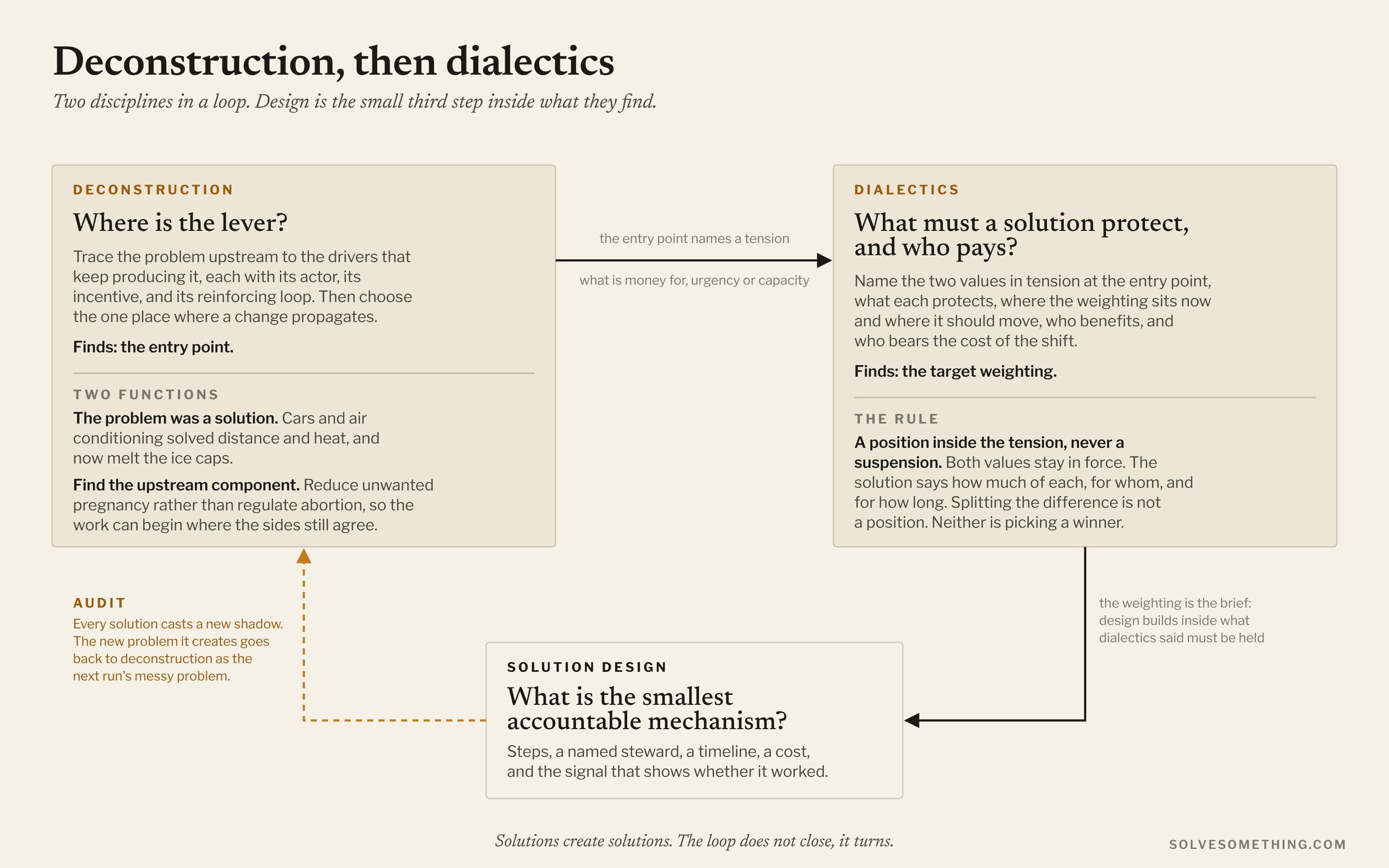
Break the problem down until we find a part that can change. Use dialectics when two legitimate values collide.
Deconstruction moves from a broad argument toward a condition people can actually affect.
Homelessness becomes several workable causes: housing supply, wages, treatment access, and mental health capacity.
Dialectics names what both values protect, decides how much weight each receives in this situation, and names who carries the cost.
A higher speed limit gives drivers more freedom and exposes everyone to greater danger.
Resilience means expecting every solution to create another consequence without treating that consequence as proof that the original work failed.
The deeper architecture
Each discipline has a front door and a lower floor.
The first layer is sufficient for use. The later layers explain why the method keeps working across civic, relational, psychological, and philosophical problems.
Deconstruction
From the visible problem to the wider system.
The immediate task is finding one place to act. The deeper task is understanding the history and connections the visible problem carries.
What is this a symptom of?
Look beneath the surface for the smallest cause or condition that can be addressed.
Hungry students may avoid free lunch because the required form publicly marks them as poor.
Why does it keep happening?
Trace the rewards, rules, and repeated reactions that make the outcome keep returning.
Healthcare rewards the volume of treatment more than prevention.
What did this once protect?
Understanding what a behavior accomplished reduces shame without excusing present harm.
Defensiveness may protect against shame and still prevent repair.
How do the pieces change one another?
Changing one part alters the conditions around the others.
Stable housing can improve treatment continuity and make steady employment more possible.
What larger pattern is this inside?
Fractal means that a similar connected pattern can appear in a person, a family, an institution, or a society.
Teacher housing can change retention, classroom stability, traffic, childcare demand, and water use.
Dialectics
From a difficult choice to a way of understanding reality.
The immediate task is an honest choice. The deeper task is recognizing that life often asks us to hold things that remain in tension.
What does each position protect?
Name both legitimate values before choosing.
A speed limit protects safety by restricting some driving freedom.
What happens when one side takes over?
Either value can become harmful when it no longer answers to the other.
No speed limit creates danger. A five-mile-per-hour limit makes travel unusable.
Where should the balance fall here?
Dialectics makes a choice for this situation and names its cost.
We choose 45 mph here, accepting less freedom to reduce risk.
Can we stay connected after the choice?
We remain present with disagreement and consequence without collapsing into blame.
A driver can oppose the limit and still be part of the shared decision.
What if opposites generate one another?
Ontology asks what reality is made of. Here, DDS asks whether tension is part of reality rather than a defect in it.
Freedom requires limits; individuality requires belonging.
The universal dialectical library
Seven tensions recur across personal and public life.
They are a starting library, not a ceiling. Each tension asks what both values protect, what happens when either dominates, where the balance should fall in this context, and who carries the cost.
01
Freedom and Safety
Freedom permits movement and risk. Safety limits harm to others.
A speed limit restricts freedom and lowers danger.
02
Individual and Collective
Individual choice exists inside shared consequence.
A homeowner’s water use affects the community’s supply.
03
Efficiency and Humanity
Efficiency protects finite resources. Humanity protects context and dignity.
A ten-minute medical visit serves more people and understands each person less.
04
Transparency and Privacy
Transparency makes power accountable. Privacy protects the interior.
A public budget should be visible. A patient’s record should not.
05
Justice and Mercy
Justice applies standards. Mercy makes room for context and proportion.
A school keeps the rule against fighting and reduces the punishment when a student was defending themselves after months of bullying.
06
Innovation and Tradition
Innovation meets new conditions. Tradition carries accumulated learning.
A school preserves a graduation tradition and changes the parts that no longer include every family.
07
Urgency and Sustainability
Urgency meets immediate harm. Sustainability changes what keeps producing it.
Emergency shelter helps tonight. Housing supply changes next year.
The requirement
Dialectics still chooses.
The method decides how much weight each value receives, takes a position, and names what the choice gives up.
Forty-five miles per hour here, with less freedom accepted for less risk.
The threshold
The loss must be concrete.
The design names who gives something up and what they lose.
Drivers lose time. Pedestrians gain safety.
Solution design
Insight becomes a blueprint only when responsibility becomes visible.
A preferred outcome is not yet a solution. DDS requires ten layers of integrity so the design can be funded, tested, challenged, revised, and stopped.
The ten layers of integrity
Every complete blueprint answers all ten.
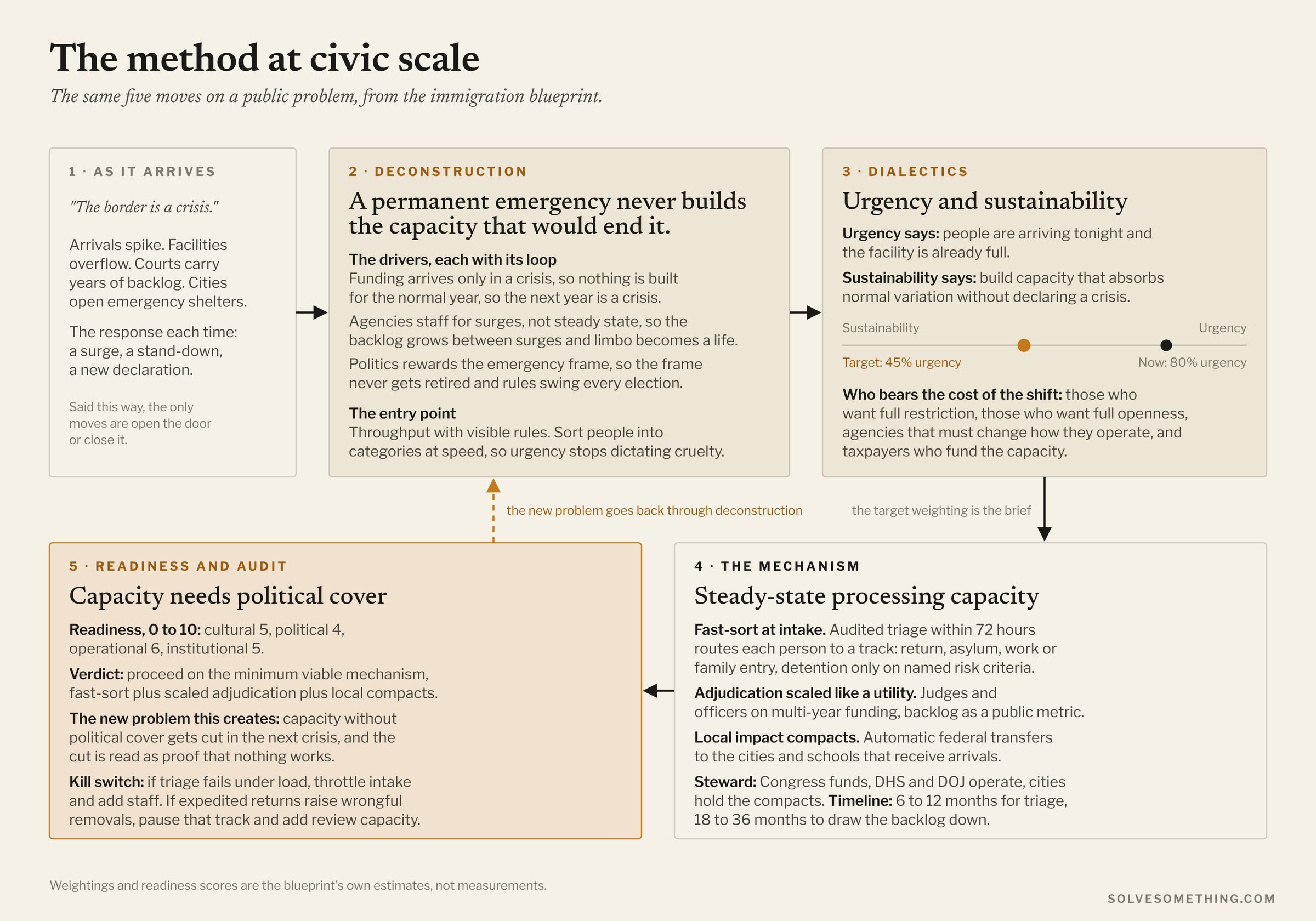
The completion requirement. If authority, resources, timing, consequences, or the failure condition remain imaginary, the work is still an aspiration.
“Build a bike path” becomes a solution only when the route, easements, funding, permits, builders, and maintenance are named.
The human remains the architect. The Engine carries the cognitive load of completing the structure. Judgment, authorship, and responsibility remain human.
Why this leads toward collaboration.
Deconstruction gives us one thing to examine together. We can look at a cause or condition instead of fighting through identity.
People who disagree about abortion may still work together to reduce unwanted pregnancy.
Dialectics lets disagreement remain connected. We can recognize what another person protects without abandoning what we hold.
One motorist prioritizes freedom. Another prioritizes pedestrian safety.
Design gives people different responsibilities. Authority, expertise, money, and labor can carry different parts.
The county approves. The engineer designs. The donor funds. The crew builds.
Movement creates grounded hope. Something previously stuck becomes possible to work on.
Repeated use builds collective resilience. Solving leaves knowledge, relationships, and practical experience for the next problem.
The alternative
From an economy of reaction to an architecture of use.
Much of public life is optimized to capture attention, intensify identity, and keep grievance circulating. DDS gives the same energy somewhere else to go.
Performance becomes orientation
The question shifts from who sounds certain to what is happening.
Instead of promising to fix healthcare, examine incentives that reward treatment volume more than prevention.
Blame becomes structure
A causal mechanism creates somewhere to intervene.
Replace “greedy insurers” with the payment rules that make greater treatment volume more profitable.
Catharsis becomes a blueprint
Feeling understood matters. It does not substitute for structure.
A housing plan has to name land, zoning, financing, builders, and timing.
Outrage becomes contribution
Concern becomes useful when it finds a piece of work it can carry.
Write the grant. Negotiate the easement. Fund one segment.
The lowest floor
The method eventually becomes a way of seeing.
Nothing exists in isolation, and tension is not evidence that reality has malfunctioned.
Deconstruction opens into the fractal field, the recognition that each problem is connected to other problems and that similar patterns repeat at different scales.
New housing changes commuting patterns; commuting shapes development; development changes water use.
Dialectics opens into ontology, the study of what reality is. Opposites may depend on one another rather than cancel one another.
Freedom depends on limits. Individuality depends on belonging. Safety contains risk.
No reader has to accept that account of reality to use DDS.