Dialectic and Deconstruction Solutions
Turn polarized problems into accountable solutions.
DDS makes complex problems navigable. Deconstruction finds the part we can actually change. Dialectics tests every answer against seven recurring tensions, from freedom and safety to urgency and sustainability. Every solution creates a benefit, a cost, and a new problem. DDS makes all three visible, then builds a plan that can be tested.
Example: Lower speed limits can reduce road deaths. They also restrict some freedom and create new enforcement burdens.
See why problems stay stuck
How fear, blame, and tribal identity turn competing values into opposing sides.
Inspect the evidence
Read the public blueprints and examine every benefit, cost, assumption, and failure condition.
Run the method
Try the custom GPT or upload the DDS source files to a capable AI.
Why DDS matters
We have been organized around the fight instead of the Solution.
Problem fixation keeps attention on visible harm and blame. Fear and rage reduce the flexibility needed to think clearly. Belonging turns positions into tribal identities. We become easier to organize against one another and harder to organize around the work.
DDS is a counterbalance. It deconstructs the conflict until action becomes possible, identifies the recurring tension underneath it, and requires a contextual choice: what are we protecting here, what are we giving up, and who carries the cost?
See why DDS is needed →
Examine dichotomous thinking and tribalism →
Read the room before the solution →
The method
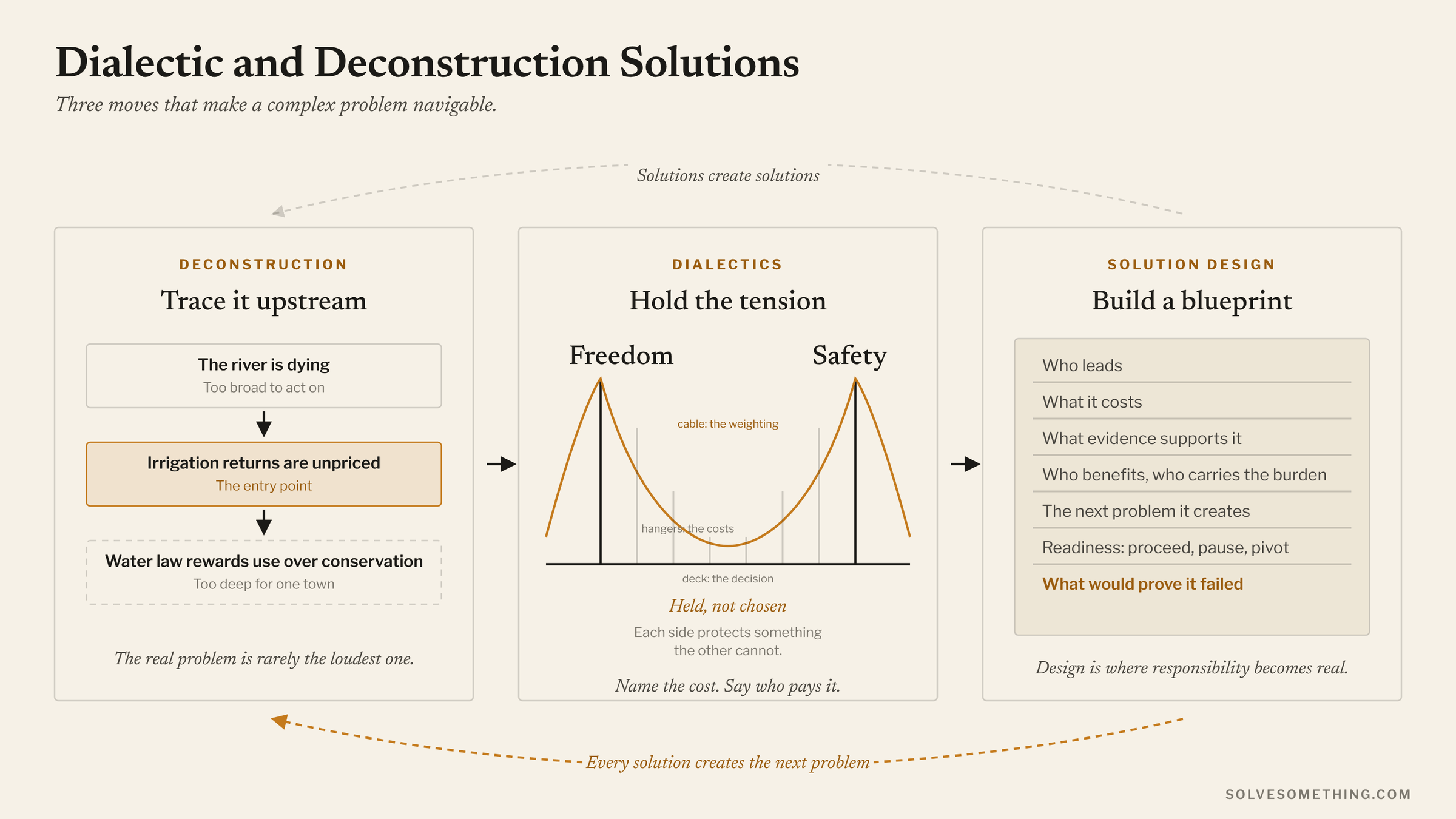
Deconstruction. Dialectics. Accountable design.
DDS slows the rush toward solutions long enough to find the actual point of leverage. Then it requires the resulting plan to carry the full weight of reality.
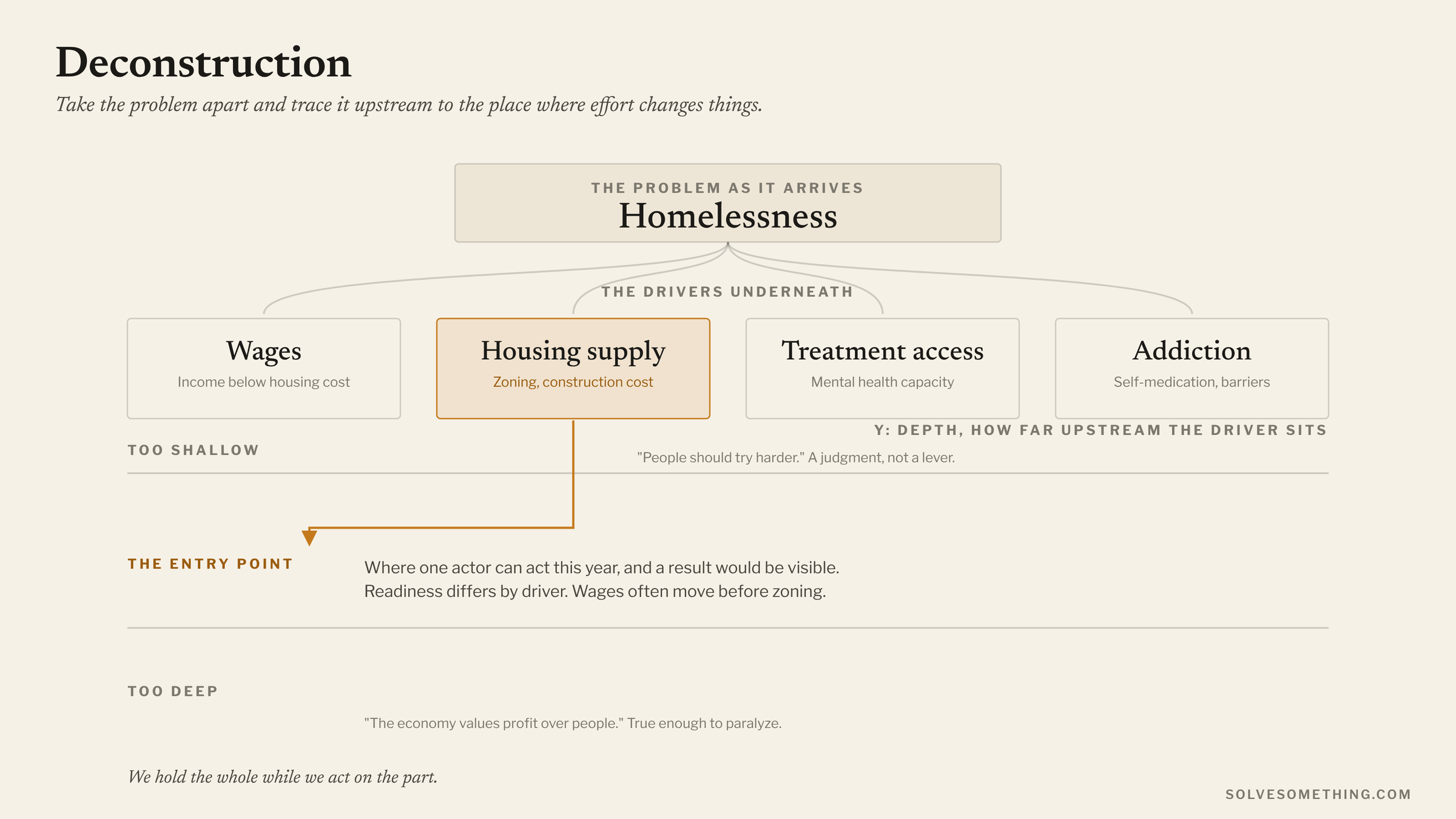
Deconstruct
Separate the large problem from the conditions causing it. Stop when we reach a specific part that can be changed. We keep the whole in view while acting on one part.
Example: Traffic grows when housing is far from jobs and walking or transit is not practical.
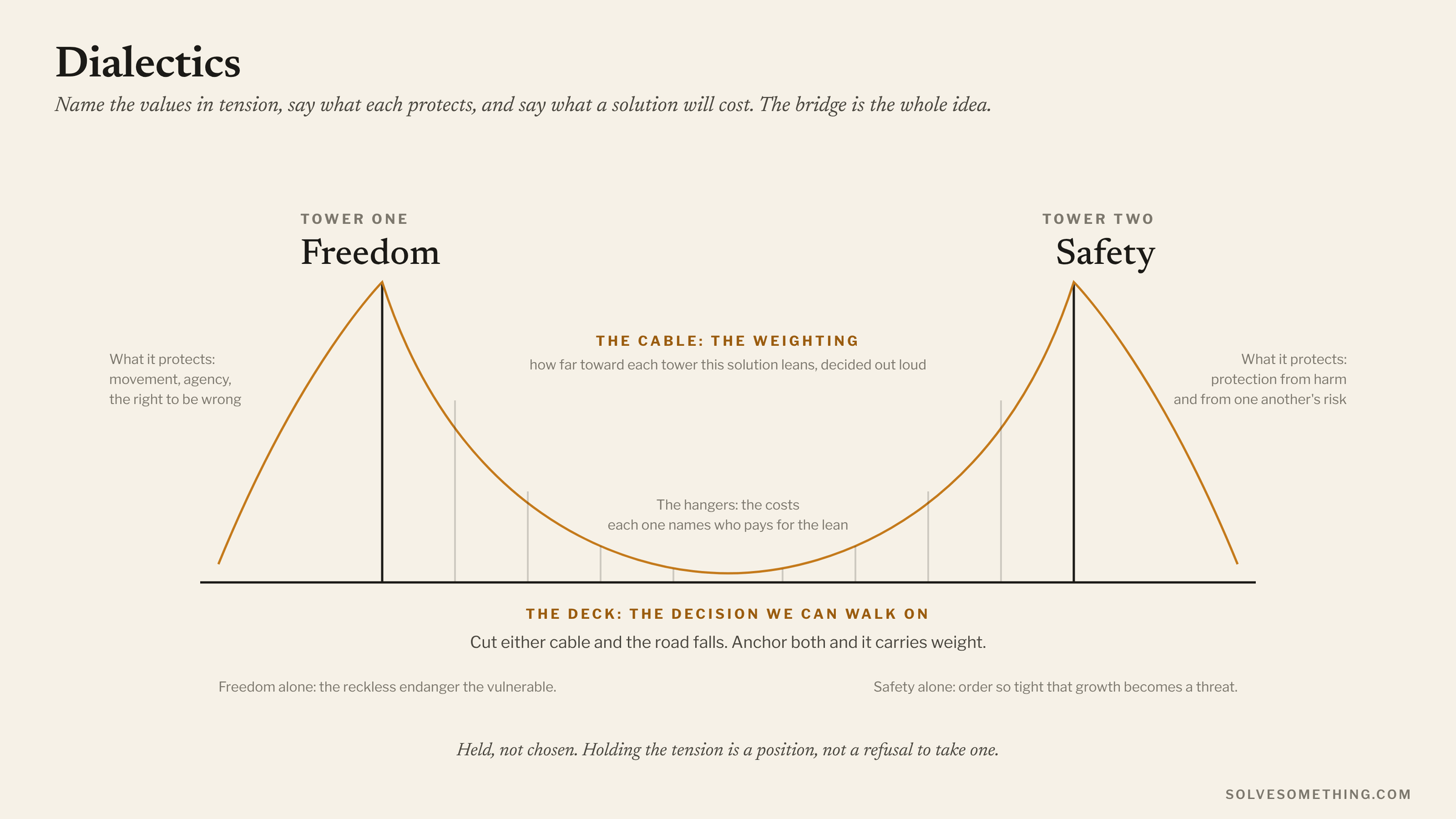
Dialectics
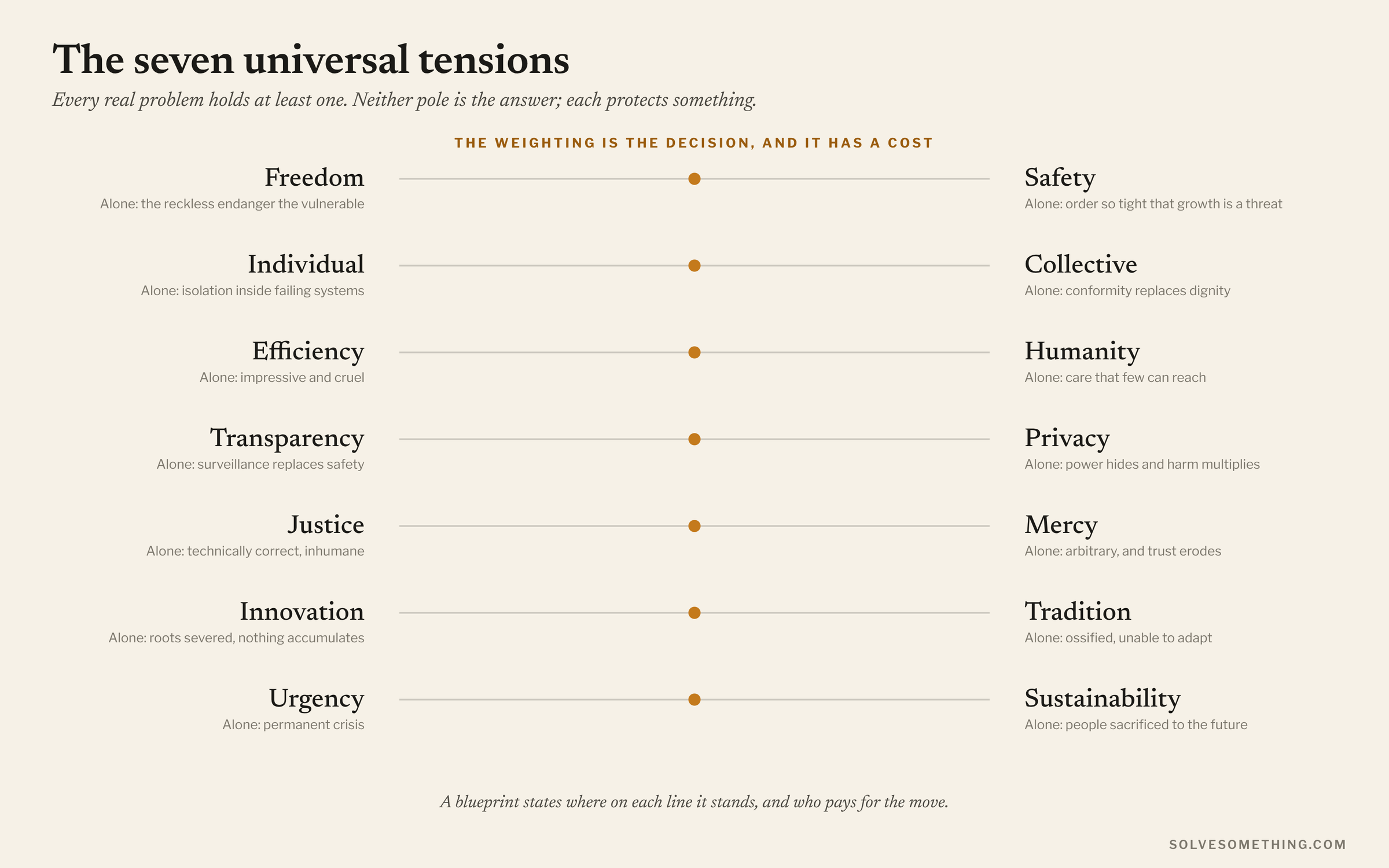
Test the answer against the seven recurring tensions. Name what each value protects, how the weighting falls here, and who pays the price.
Example: Faster hospital turnover serves more patients and leaves less time to understand each one.
Design
Name who acts, what they need, what happens first, how we will judge the result, and what would make us stop.
Example: A bike-path plan names who secures the easements, who wins the grant, and who builds each segment.
The ten layers of integrity
Every published blueprint carries all ten.
The executable method
The book became instructions an AI can run.
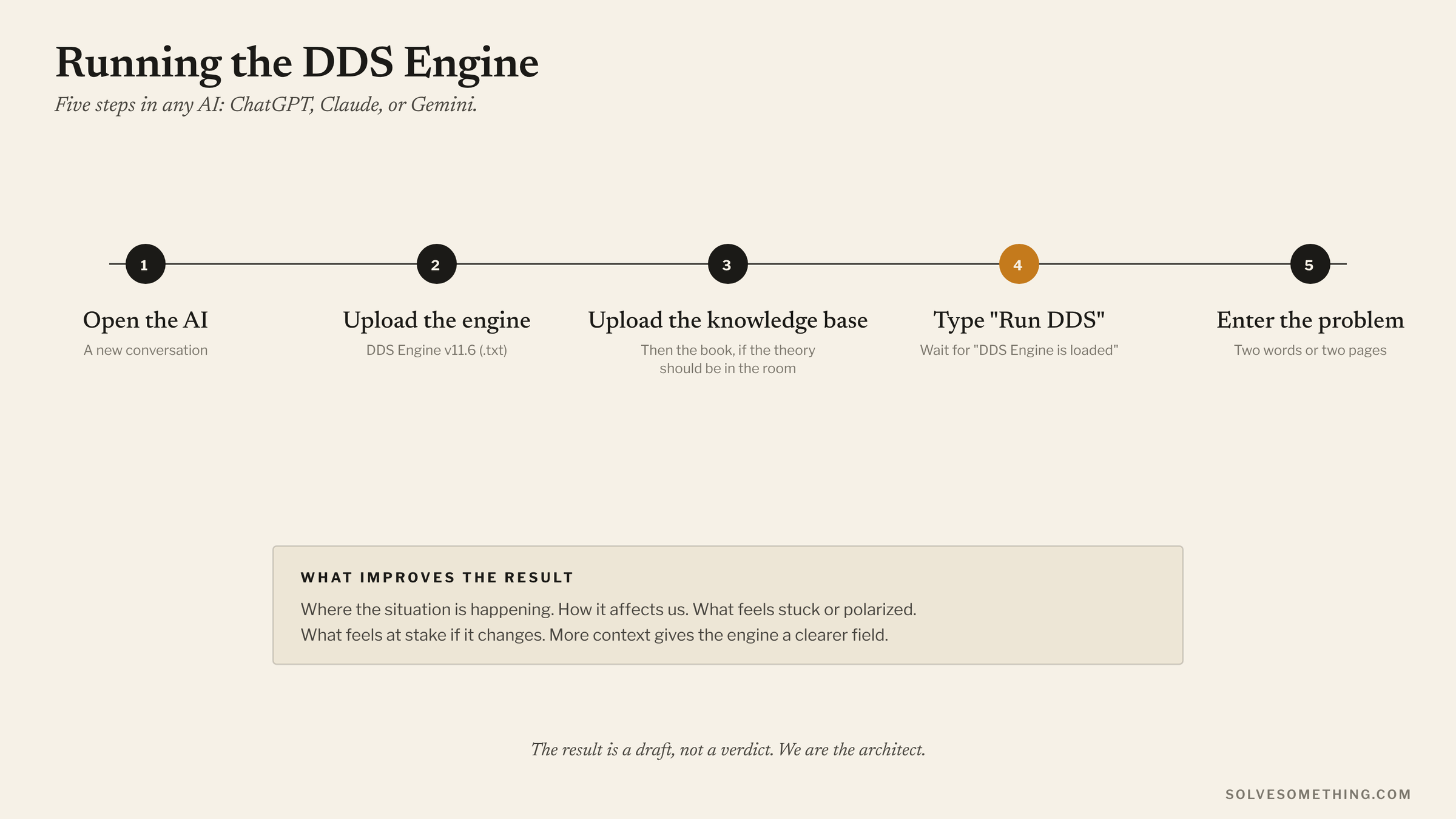
DDS can be tried through a custom GPT or loaded into a capable AI as plain text files. These are current workarounds for using the method, not the DDS platform.
Bring a problem. See every step.
The custom GPT is the shortest route, but it requires a ChatGPT account and remains subject to plan limits and third-party behavior. Manual use means downloading the files, uploading them, and typing “Run DDS.”
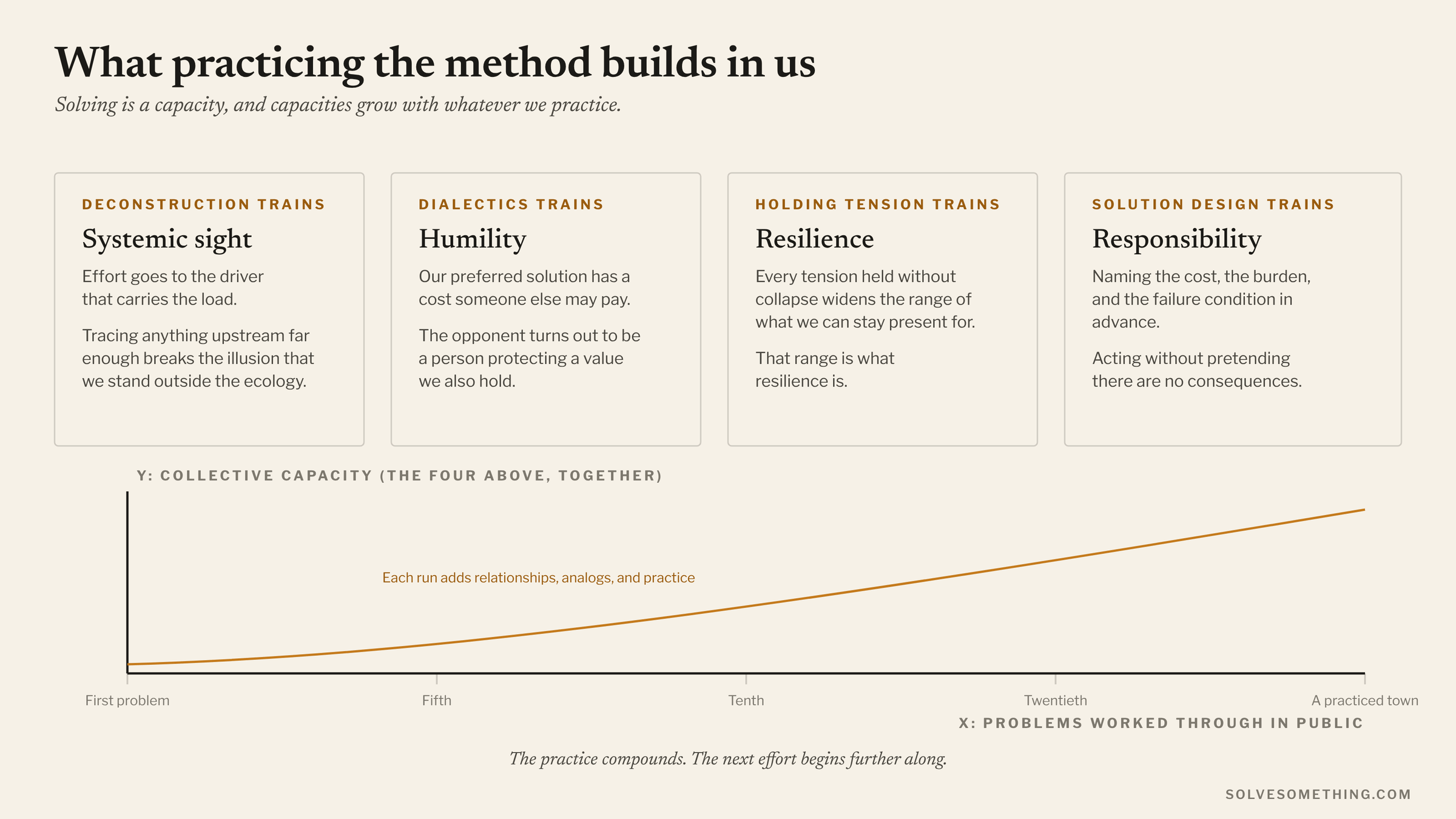
The blueprint is the output. Capacity is the work.
Deconstruction redirects effort. Attention moves from the loudest symptom to the condition causing it or keeping it in place.
Example: A partner called lazy may be exhausted, grieving, or disconnected from work that no longer feels possible.
Dialectics expands what we can remain present for. We can recognize what another person protects without abandoning our position.
Example: A parent protects a teenager’s need for freedom and the need to keep their mistakes survivable.
Design turns responsibility into structure. Authority, budget, coordination, evidence, timing, and consequences become visible parts of the plan.
Example: The city grants permission. A writer secures funding. A contractor builds.
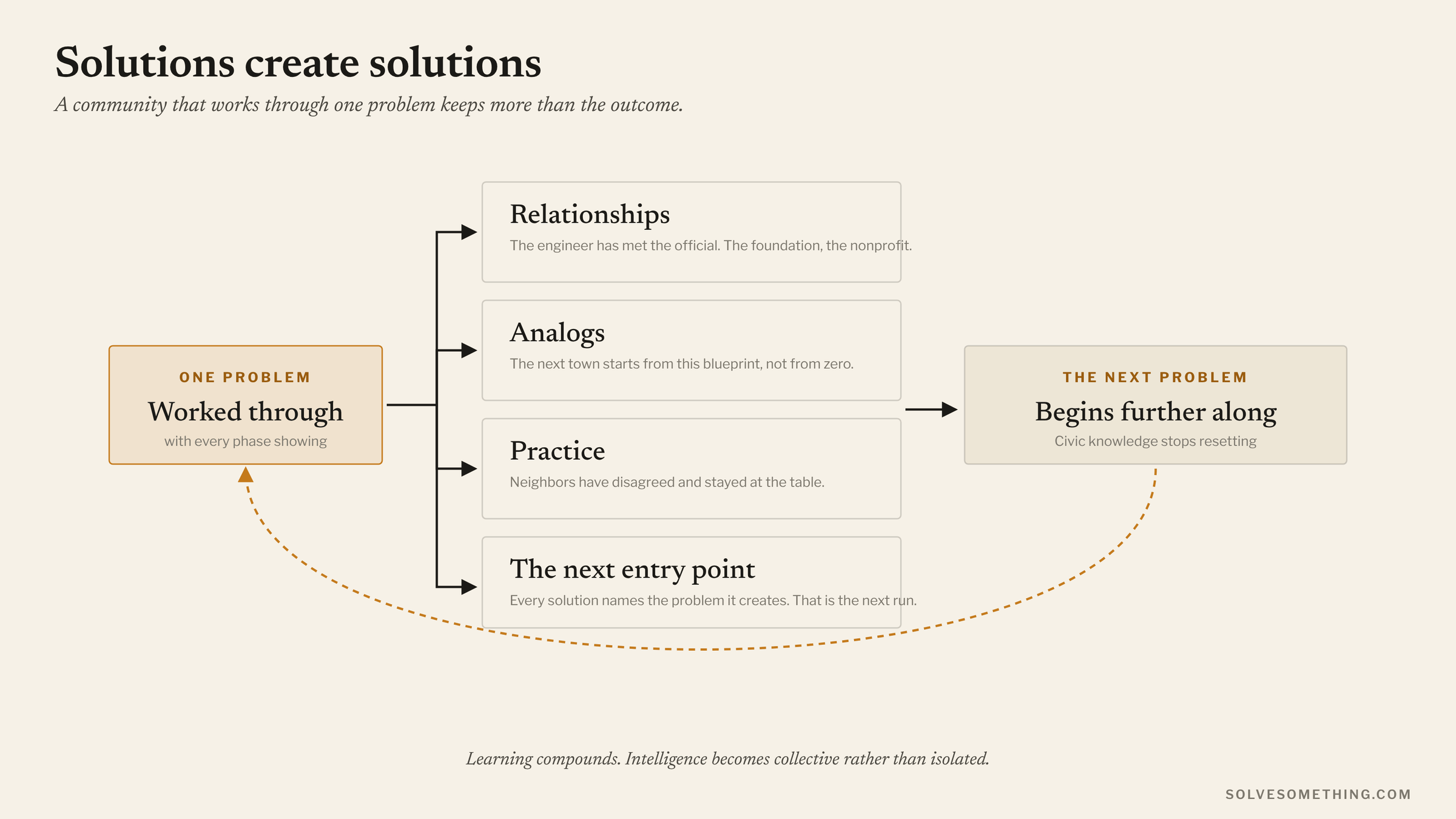
Solving makes us better at solving. Each honest blueprint leaves behind knowledge, relationships, and greater capacity for the next problem.
Example: One town’s working grant structure becomes another town’s starting point.
This is collective resilience. We can absorb a cost, revise the plan, remain in relationship, and continue.
The platform DDS still needs
A living map of what connects, what remains, and who can carry it.
None of this platform exists yet. SolveSomething.com demonstrates the method and publishes completed blueprints as posts. The future platform would turn that evidence into a shared place where people, expertise, money, institutions, and individual pieces of work can find one another.
Problems ↔ problems
One missing walking route creates congestion and new safety risks around the school.
Solutions ↔ problems
A habitat solution can help bees and create a new obligation for the crews maintaining the road.
Solutions ↔ solutions
Progress in one piece can unlock work somewhere else. DDS calls the map fractal because the same connected pattern can appear at different sizes and in different places.
Contribution routing
Nobody solves the whole thing. Everyone can carry a piece.
A contributor can see the exact opening: write the grant, negotiate an easement, verify the evidence, fund a segment, design the bridge, do the digging, or carry the public authority only government can carry.
Illustration only · This collaboration layer does not exist yet
Corridor feasibility and parcel map
Civil engineering · technical authority
Needs ownerEasements
17 of 23 secured · landowners + legal
6 remainGrant package
Grant writer · foundation match
OpenElk River bridge crossing
Engineering + permitting dependency
BlockedTown to Mad Creek surface
Contractor + field crew · funded
UnderwayMaintenance endowment
40% funded · long-term steward needed
OpenExists now
The method and its evidence.
- A public gallery of completed blueprint posts
- The DDS Engine, Unified Knowledge Base, and full book
- A custom GPT and a manual file-upload route for running the method
Does not exist yet
The place where people work together.
- A searchable, multi-user Solution Library
- A Fractal Engine mapping problems, solutions, and consequences
- Civic profiles and Solution Résumés
- Democratic participation and media connected to solutions
- Public and private workspaces
Explore the complete platform vision →

Go as deep as the problem requires
The method works before we understand all of its philosophy.
DDS is designed for immediate use, without adopting a philosophy or learning its full vocabulary. The deeper structure remains available when the problem asks for it.
Deconstruction
From one changeable part to the wider system.
What can actually move?
Find one part people can change.
Example: School drop-off congestion becomes a safe sidewalk families can actually use.
What keeps the pattern stable?
Trace the rewards, rules, and repeated reactions that keep producing it.
Example: Healthcare rewards treatment volume more than prevention.
What did this pattern protect?
Understand what the behavior once accomplished before trying to change it.
Example: Defensiveness may protect against intolerable shame.
What is this connected to?
Follow the same pattern into the other people, systems, and places it affects.
Example: Teacher housing can affect retention, classroom stability, traffic, childcare, and water use.
Dialectics
From a difficult choice to a way of understanding reality.
What does each side protect?
Name both values.
Example: A speed limit protects safety by restricting some driving freedom.
Where does the burden move?
Name the next cost and who carries it.
Example: A coal closure lowers emissions and displaces workers.
Can we remain present and still choose?
Make a decision without pretending nothing was lost.
Example: We accept slower travel here to reduce danger.
What if tension is part of reality?
Ontology asks what reality is made of. DDS asks whether opposites sometimes depend on one another.
Example: Freedom requires limits. Individuality requires belonging.
The depth is not decoration. It is there because some problems eventually ask what a person, a society, or reality itself is.
The point is to help.
If people read this, use what they learn to help solve civic problems, and I make no money from it, that is still a win.
I would like DDS to become sustainable, and I want to be part of the team using it with communities. But the knowledge is not being hidden to manufacture scarcity, and public participation in the future civic platform is intended to remain free.
Authorship and copyright still matter. They protect the coherence of the method and keep commercial or institutional deployment accountable. Profitability is infrastructure, not motive.
Read the public business plan →
Current license: free for individual and non-commercial personal, relational, educational, and exploratory use. Commercial, professional, and organizational use requires a separate license. Read the legal and ethical protocols.
Sources and authorship
The architecture behind the method.

The book
Dialectic & Deconstruction Solutions
The full philosophy, method, and civic vision across twenty chapters, an epilogue, and four appendices. Written to be read. Structured so it can also run inside AI.
View the chapter map →