We regulate false claims everywhere except where they matter most.
By The Dialectic and Deconstruction Solutions Framework
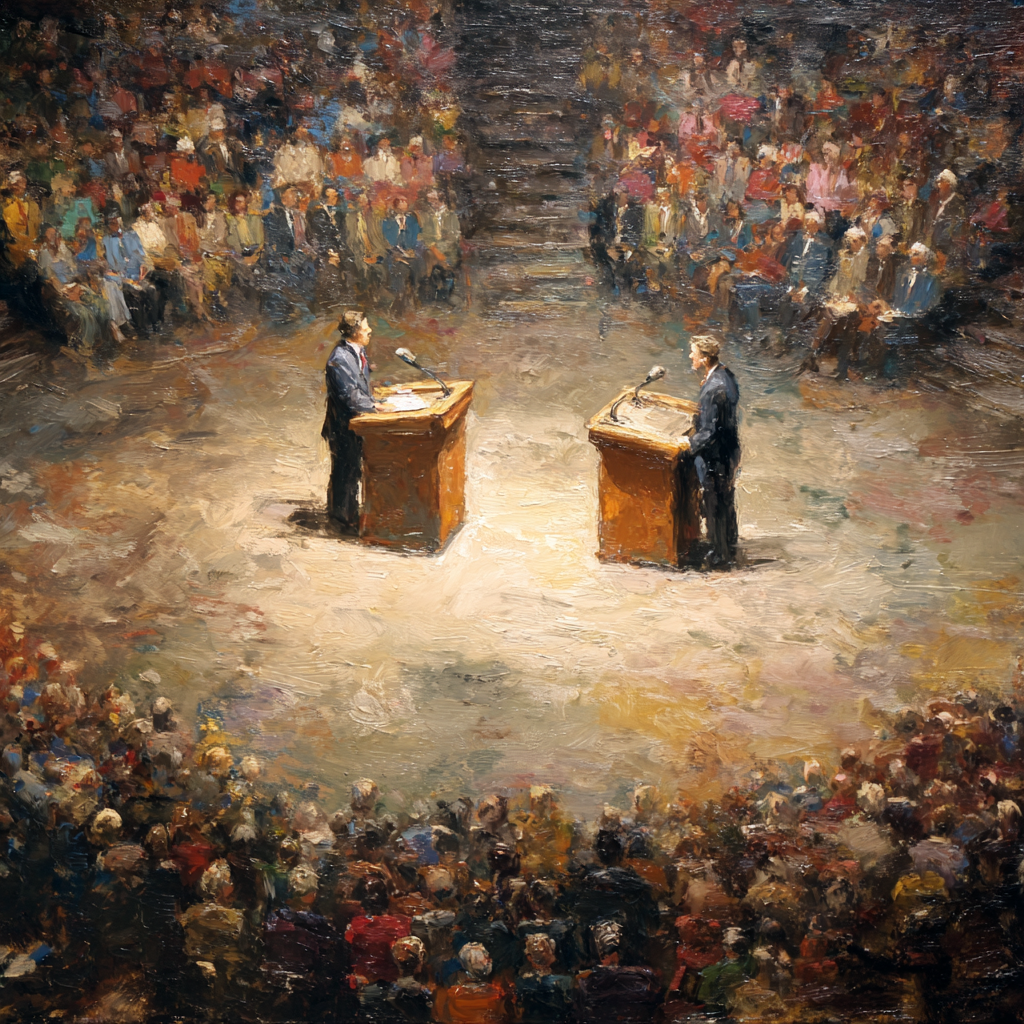
You watch the debate. One candidate says their opponent voted to defund the police. The opponent says no. You have no way of knowing which is true. The next day, fact-checkers publish corrections. By then, the clip has been shared 200,000 times. The correction reaches 3,000 people.
A week later, you see an ad claiming the same thing. You remember reading it was false. Or was it? You are no longer sure what you know.
This is the information environment we have built. Candidates make claims voters cannot verify. Corrections arrive too late to matter. Both sides accuse each other of lying, so you assume everyone is lying, and you stop trying to tell the difference.
We call this freedom of speech. It might be more honest to call it freedom to deceive.
If a cereal company claims its product cures cancer, it faces legal consequences. If a car manufacturer fabricates safety ratings, it is held accountable. We decided long ago that commerce requires accurate information, and that markets fail when sellers can lie without cost. So we regulate commercial speech. We call this consumer protection.
Political campaigns operate under the same conditions. You are making high-stakes decisions based on claims you cannot easily verify. The person making the claim knows more than you do. Your welfare depends on the accuracy of what they tell you.
But politicians face no equivalent accountability. They can say almost anything. If they lie, nothing happens.
This is not an oversight. It is a constitutional interpretation. Political speech receives the highest protection under the First Amendment, more than commercial speech, more than artistic expression. The assumption was that democracy would self-correct. False claims would be rebutted. Voters would punish liars. The marketplace of ideas would find truth.
This has not occurred.
Misinformation spreads faster than correction. Voters punish honesty when truth is inconvenient. Both parties have optimized for emotional activation rather than accuracy, because emotional activation works and accuracy is a competitive disadvantage.
The legal immunity that protects political speech was designed to prevent government from silencing dissent. That protection was necessary. It remains necessary. But it now also protects something else: the systematic use of fraud to win elections.
We are living with two truths at once. Government must not control political speech, because any such control risks tyranny. And voters must have accurate information, because democracy cannot function when the information environment is poisoned.
Right now we have chosen the first truth completely and abandoned the second. We treat political speech as if it exists in a separate category from every other form of consequential communication. The result is an information commons where lying costs nothing and honesty is penalized.
This weighting made sense when the primary threat was censorship. It makes less sense when the primary threat is fraud.
One way of responding to this would be to treat verifiable false statements in political campaigns as a form of consumer fraud, subject to civil penalties.
The distinction is narrow. Opinions remain protected. Predictions remain protected. Policy advocacy remains protected. A candidate can argue that a policy will harm the economy. They cannot claim their opponent voted for something when the voting record shows otherwise.
This is the difference between political expression and factual fraud. We already make this distinction in commercial speech. A company can say its product is the best on the market—that is opinion. It cannot say the product is made in America when it is made in China—that is fraud.
The mechanism would work through two paths. The Federal Election Commission could investigate complaints and levy fines for verified false statements. Penalties would scale with reach—a local mailer costs less to correct than a national ad campaign. Candidates would receive 48 hours to issue corrections before penalties apply, creating incentive for rapid self-correction rather than punishment.
Any registered voter could also file a civil lawsuit, with damages capped at $50,000 to prevent weaponization. Losing plaintiffs would pay defendant legal fees to discourage frivolous suits. The burden of proof would require showing the statement was verifiably false and that the speaker knew or should have known it was false.
This is not a guarantee of good outcomes. It is a guarantee of consequences for fraud.
The costs are real. Campaigns would need to hire fact-checkers and legal compliance staff. Courts would face difficult questions about where opinion ends and fraud begins. Free speech advocates would warn of tyranny, and they would not be entirely wrong—any mechanism that penalizes speech creates risk of abuse.
Politicians would lose the tactical advantage of lying. Campaign consultants would lose revenue from deceptive advertising. Media outlets would face liability for knowingly airing false claims. Wealthy candidates would gain advantage—they can afford better compliance infrastructure.
And voters would bear a different kind of cost. We would need to learn to distinguish protected political advocacy from actionable fraud. This requires effort. Democracy requires effort. We have been trying to shortcut that effort by allowing lies to do the work of persuasion, and the shortcut has failed.
The alternative cost is what we have now. A population that cannot evaluate policy proposals. Governance by manufactured crisis. Institutional trust collapsing. Voters oscillating between rage and despair because they cannot tell what is real.
Both major parties benefit from the current system. Each believes they lose more from honesty than from lying. Free speech absolutists will oppose this as censorship. Courts will struggle with line-drawing. Enforcement will sometimes be biased or incompetent.
These are not hypothetical problems. They are the reasons this will be difficult to implement. They are also the reasons we have tolerated a system that rewards fraud.
We regulate speech when the harm from false information exceeds the value of protecting it. We have decided this is true for medicine, for commerce, for financial advice. We have not decided it is true for politics, even though political decisions affect more lives than any product ever could.
The question is not whether regulating political speech is dangerous. It is. The question is whether unregulated political misinformation is more dangerous.
Right now we are running an experiment in pure information freedom. The results are visible. Democratic legitimacy is eroding. Collective problem-solving capacity is declining. The information environment is degrading every election cycle.
This mechanism does not solve misinformation. It removes the legal immunity that makes lying cost-free. That is a smaller thing than fixing democracy. It is larger than doing nothing.
⚙️ The Full DDS Blueprint
The article above was derived from the following structural analysis. The complete, unedited blueprint is provided below for policymakers, students, system architects, and anyone interested in the methodology.
PHASE 1: PROBLEM FRAMING
Umbrella Problem: Political misinformation is structurally rewarded in democratic systems, degrading collective decision-making capacity, eroding institutional trust, and creating governance by manufactured crisis rather than evidence-based problem-solving.
Macro Drivers:
- Electoral incentives reward emotional activation over accuracy — Politicians gain votes by triggering fear, outrage, or tribal loyalty more efficiently than by presenting complex trade-offs or acknowledging uncertainty.
- Media ecosystems amplify sensational claims over corrections — Algorithmic distribution and attention economics prioritize content that generates engagement (often false or misleading) while corrections receive minimal circulation.
- Voters lack tools to verify claims in real-time — The cognitive load required to fact-check political statements during debates, ads, or social media exceeds most citizens’ available time and expertise.
- Legal frameworks provide no accountability for political speech — First Amendment protections and “political speech” exemptions shield candidates from fraud statutes, defamation suits, or consumer protection laws that govern commercial speech.
- Opposition research and negative campaigning are normalized — Both parties engage in strategic distortion, creating mutually assured destruction where calling out lies invites retaliation, making honesty a competitive disadvantage.
- Concentrated ownership of information channels creates epistemic capture — A small number of media companies, social platforms, and funding sources control narrative framing, allowing coordinated misinformation campaigns to dominate discourse.
Component Selected for This Blueprint: Legal frameworks provide no accountability for political speech.
This driver addresses the structural asymmetry: commercial speech is regulated to prevent fraud, but political speech operates without consumer protection. Solving this component does not eliminate media bias or voter cognitive limitations, but it removes the legal immunity that makes lying cost-free for politicians.
PHASE 2: DECONSTRUCTION
Upstream Driver Analysis:
- Actor: Politicians, campaign managers, political consultants
- Incentive/Constraint: Winning elections requires maximizing voter turnout among supporters and suppressing turnout among opponents; truth-telling constraints electoral strategy
- Behavior: Candidates make demonstrably false claims about opponents’ records, policy effects, economic data, or institutional threats; campaign ads distort context or fabricate quotes; debate responses prioritize emotional resonance over factual accuracy
- Loop: Misinformation generates media coverage → coverage increases name recognition and fundraising → electoral success validates strategy → future candidates adopt same tactics → information environment degrades → voters trust institutions less → politicians exploit distrust with more misinformation
Why This Driver Matters:
The absence of legal consequences for political lying creates a tragedy of the commons in democratic information ecosystems. While individual politicians benefit from deception (short-term electoral gain), the collective result is a population unable to evaluate policy proposals, hold leaders accountable, or coordinate around shared problems.
Commercial speech is regulated precisely because false advertising harms consumer decision-making. A cereal company cannot claim its product cures cancer. A car manufacturer cannot fabricate safety ratings. These restrictions exist because markets fail when information asymmetry becomes too severe.
Politics operates under identical conditions—voters are consumers of governance, making high-stakes decisions based on claims they cannot easily verify—but politicians face no equivalent accountability. This is not an oversight; it is a First Amendment interpretation that treats political speech as categorically different from commercial speech, even when the function (persuading people to make choices affecting their welfare) is identical.
Entry Point:
Create a legal framework treating verifiable false statements in political campaigns as a form of consumer fraud, subject to civil penalties and enforceable through both government enforcement and private right of action.
PHASE 3: DIALECTICS
Core Tension: Freedom / Collective Responsibility
Current Weighting: 95/5 (Freedom-dominant)
How We Got Here: First Amendment jurisprudence evolved to protect political dissidents, ensuring government could not silence criticism or imprison opposition. This protection was essential for democratic function—without it, those in power could criminalize dissent. Over time, this evolved into near-absolute immunity for political speech, even when that speech is demonstrably false and made in bad faith. The Supreme Court established that political speech receives the highest protection, more than commercial or artistic speech. The assumption was that “the marketplace of ideas” would self-correct—false claims would be rebutted, and voters would punish liars. This has not occurred. Instead, misinformation spreads faster than corrections, and voters punish honesty when truth is politically inconvenient.
Cost of Current Imbalance: Democratic legitimacy erodes when elections are won through deception. Policy debates become impossible when baseline facts are contested. Governance capacity degrades as officials prioritize narrative management over problem-solving. Public health crises worsen (COVID misinformation killed tens of thousands). Climate action stalls due to manufactured doubt. Voters experience chronic anxiety, distrust, and political learned helplessness. The emotional toll is collective dysregulation—populations oscillating between rage and despair rather than engaging in coherent deliberation.
Target Weighting: 75/25 (Freedom-leaning, but Collective Responsibility-integrated)
What This Means in Practice: Politicians retain broad freedom to express opinions, advocate policies, criticize opponents, and engage in hyperbole or satire. Collective responsibility means they cannot make verifiable false statements about empirical facts (vote records, budget figures, scientific consensus, institutional processes) without legal consequence. Freedom protects political expression; responsibility prevents fraud. The distinction is between “I believe this policy will harm the economy” (protected opinion) and “My opponent voted to cut Social Security” when voting records show otherwise (actionable fraud).
Who Bears the Cost: Politicians lose the tactical advantage of lying. Campaign consultants face legal liability for crafting deceptive ads. Donors funding misinformation campaigns risk financial penalties. Media outlets amplifying false claims without correction may face secondary liability. Voters bear the cost of learning to distinguish protected political advocacy from actionable fraud—this requires civic education and access to verification tools.
Secondary Tension: Efficiency / Humanity
Current Weighting: 90/10 (Efficiency-dominant)
How We Got Here: Political campaigns operate under extreme time pressure—candidates must persuade millions of voters in months. This creates ruthless efficiency logic: whatever messaging works fastest wins. Fact-checking is slow. Nuance loses to simplicity. Emotional manipulation is more efficient than education. Over decades, both parties optimized for persuasion efficiency, treating voters as targets to activate rather than citizens to inform. This logic is rational within the game structure—lying works, and honesty is penalized by opponents who lie more effectively.
Cost of Current Imbalance: Voters are treated as mechanisms to manipulate rather than agents to respect. Campaigns become psychological warfare rather than democratic discourse. The emotional cost is humiliation—voters realize they are being played, lose trust in all institutions, and withdraw from participation. Efficiency produces electoral victories but destroys the human capacity for collective intelligence.
Target Weighting: 60/40 (Efficiency-leaning, but Humanity-integrated)
What This Means in Practice: Campaigns can still be strategic, competitive, and persuasive—but not through fraud. Efficiency serves the goal of winning, but humanity demands that voters are treated as dignified agents deserving accurate information. This means campaigns must invest more time in verification, accept slower messaging cycles, and prioritize long-term democratic health over short-term tactical advantage.
Who Bears the Cost: Candidates must hire fact-checkers and legal compliance staff, increasing campaign costs. Political consultants lose revenue from deceptive strategies. Media buyers face liability for false ads. Voters bear the cost of slower, more complex information processing—democracy requires more effort when shortcuts through misinformation are removed.
PHASE 4: MECHANISM
Proposed Solution:
Establish a Political Fraud Accountability Act creating civil liability for verifiable false statements made by political candidates, with enforcement through both Federal Election Commission penalties and private citizen lawsuits.
How It Works:
Scope of Actionable Speech
The law applies only to verifiable factual claims—statements about objective reality that can be proven true or false through evidence. Protected: opinions, predictions, policy advocacy, rhetorical hyperbole, satire. Actionable: false claims about vote records, budget numbers, scientific consensus, institutional processes, opponent statements (when video/transcript exists), crime statistics, economic data.
- Example of Protected Speech: “This policy will destroy the economy” (opinion/prediction).
- Example of Actionable Speech: “My opponent voted to defund the police” when voting records show no such vote (verifiable falsehood).
Legal Standard: Reckless Disregard
Liability requires proof that the speaker knew the statement was false or showed reckless disregard for truth (made no effort to verify). This protects honest mistakes while penalizing deliberate or negligent deception. Burden of proof on plaintiff.
Enforcement Mechanisms
FEC Administrative Path: Citizens or opposing campaigns file complaints with FEC. Commission investigators review evidence (voting records, budget documents, transcripts). If violation confirmed, penalties range from $10,000 to $500,000 per false statement, scaled by reach (local vs. national ads). Repeat offenders face escalating fines. Candidates receive 48-hour notice to retract/correct before penalties apply—creating incentive for rapid self-correction.
Private Right of Action: Any registered voter can sue for damages in federal court. Plaintiff must prove: (1) statement was factually false, (2) defendant knew or should have known it was false, (3) statement reached substantial audience (1,000+ people). Damages capped at $50,000 per plaintiff to prevent weaponization. Losing plaintiffs pay defendant legal fees (discourages frivolous suits). Class actions prohibited (prevents coordinated harassment).
Judicial Review Standards
Courts apply strict scrutiny to avoid chilling effect. False statements must be unambiguous and material (likely to affect voter behavior). Contextual interpretation protects hyperbole (“worst president ever” is opinion, not actionable). Satire and parody explicitly exempted.
Correction Requirements
Before financial penalties, defendants receive opportunity to issue public correction with equal prominence to original statement (same ad buy, same airtime, same social media spend). Compliance voids penalties. Refusal triggers full financial liability.
Evidence Base: Research
Studies on misinformation show corrections are most effective when issued rapidly by the original source (Swire-Thompson & Lazer, 2020, Journal of Applied Research in Memory and Cognition). Regulatory deterrence works when penalties exceed benefits—FCC fines for broadcast violations successfully shape behavior (Hazlett & Sosa, 1997, Journal of Law & Economics). Consumer protection laws reducing false advertising improve market function (Beales, Craswell & Salop, 1981, Journal of Marketing Research).
Why This Addresses the Driver:
The legal immunity that makes lying cost-free is removed. Politicians retain full freedom for political expression but face consequences for fraud. The mechanism aligns political speech regulation with consumer protection standards already governing commercial claims.
Feasibility Check:
- Authority: Congress holds power to regulate federal elections under Article I, Section 4. Requires simple majority (or reconciliation). President signs. Federal Election Commission administers enforcement. Federal courts adjudicate private lawsuits. States may adopt parallel frameworks for state/local elections.
- Budget: FEC budget increase of $50 million/year to hire investigators and adjudicators (100 additional staff). Court system absorbs private cases through existing infrastructure (estimated 500-1,000 cases/year initially). Net revenue from penalties: $100-300 million/year (penalties exceed costs). Revenue directed to civic education programs.
- Enforcement: FEC investigates complaints, issues findings, levies fines. Courts hear private lawsuits. Defendants may appeal to Circuit Courts. Non-payment of penalties disqualifies candidates from ballot access. Media outlets may face secondary liability for knowingly airing false ads after notice.
- Timeline:
- Year 1: Legislation passes, FEC establishes rules, public comment period
- Year 2: Law takes effect for federal elections, first complaints filed
- Years 3-5: Case law develops, standards clarified through adjudication
- Years 6-10: Behavioral change measured, policy adjusted based on outcomes
- Coordination: FEC coordinates with Department of Justice on enforcement. State election boards adopt compatible standards. Media outlets receive guidance on liability thresholds. Fact-checking organizations provide verification resources. Universities offer civic education on distinguishing protected vs. actionable speech.
Trade-Offs:
This mechanism creates compliance costs for campaigns (legal review, fact-checking staff). It empowers bad-faith plaintiffs to weaponize lawsuits (mitigated through fee-shifting and damage caps). It risks judicial overreach if courts interpret “false statements” too broadly. It may advantage wealthy candidates who can afford compliance infrastructure. It creates new FEC bureaucracy with potential for political capture.
Deprioritized:
Absolute First Amendment maximalism is constrained. Campaigns lose the tactical efficiency of rapid-response lies. Political consultants specializing in negative advertising face reduced market. Media platforms gain liability exposure, requiring more content moderation.
Key Assumptions:
- Courts will apply standards rigorously without political bias — If false: One party weaponizes enforcement, destroying legitimacy and creating constitutional crisis.
- Voters will trust FEC/courts as neutral arbiters — If false: Enforcement is dismissed as partisan, penalties fail to change candidate behavior.
- Fact-checking infrastructure can scale — If false: Verification bottlenecks prevent timely corrections, undermining deterrence.
- Protected vs. actionable speech distinction is workable — If false: Ambiguity chills legitimate political debate, creating self-censorship.
- Penalties large enough to deter but not bankrupting — If false: Either ineffective (too small) or weaponized (too large).
- Media will cooperate with correction requirements — If false: Outlets refuse compliance, penalties become unenforceable.
PHASE 5: READINESS & AUDIT
Political Readiness: 2/10
Why: Both major parties benefit from current misinformation environment—each believes they lose more from honesty than from lying. Incumbents fear losing tactical advantages. Free speech absolutists oppose any regulation. First Amendment advocacy groups (ACLU, FIRE) will mobilize against this as censorship. Conservative coalitions see it as liberal attempt to control speech; progressive coalitions worry about government overreach. Bipartisan support is nearly impossible.
What Strengthens This: Post-election crises where misinformation demonstrably caused harm (e.g., January 6th aftermath, vaccine hesitancy deaths). Grassroots movements demanding accountability. State-level pilot programs showing effectiveness without chilling effects. Endorsements from retired politicians acknowledging system dysfunction.
Economic Readiness: 8/10
Why: Costs are minimal ($50 million FEC expansion offset by $100-300 million in penalties). Implementation requires no new taxation. Courts absorb case load within existing budgets. Penalties create revenue stream for civic education. Economic barrier is low.
What Constrains This: Campaign costs increase (legal compliance staff). Media outlets face liability exposure. Political consulting industry loses revenue from negative ad production. Wealthy candidates gain advantage (can afford better compliance teams).
Social Readiness: 6/10
Why: Majority of Americans report distrust in political information (70% believe politicians lie regularly, Pew 2023). Exhaustion with misinformation campaigns creates openness to solutions. Younger voters especially support accountability mechanisms. However, partisan identity complicates enforcement—voters support penalties for opponents’ lies but defend their own candidates’ distortions.
What Strengthens This: High-profile cases where misinformation caused measurable harm. Civic education campaigns explaining difference between protected opinion and actionable fraud. Bipartisan fact-checking coalitions demonstrating neutrality. Gradual norm shift through incremental enforcement.
Operational Readiness: 5/10
Why: FEC infrastructure exists but is chronically underfunded and politically gridlocked (3-3 partisan split). Federal courts can handle case load but lack expertise in rapid political fact-checking. Fact-checking organizations (FactCheck.org, PolitiFact) have capacity but lack enforcement authority. Media companies have compliance departments but resist additional liability.
What Constrains This: FEC must be restructured to break partisan gridlock (difficult without broader reform). Courts need specialized training in election law and misinformation standards. Verification infrastructure must scale rapidly during election cycles. First Amendment case law creates legal uncertainty requiring Supreme Court clarification.
Emotional Readiness: 4/10
Who Experiences Relief: Voters exhausted by information overload gain clearer signal. Citizens who value honesty feel validated. Fact-checkers and journalists gain structural support for their work. Vulnerable populations (elderly, less educated) less exploited by targeted misinformation.
Who Experiences Burden: Politicians lose tactical freedom and face legal anxiety. Campaign staff work under compliance pressure. Lawyers gain work but clients resent costs. Voters bear cognitive burden of distinguishing protected vs. actionable speech. Free speech absolutists experience ideological betrayal—belief that government regulation of speech, even false speech, violates sacred principle.
Capacity for Loss: Resistance will be ferocious. Politicians on both sides will frame this as authoritarianism. Media will amplify free speech concerns. Wealthy candidates and establishment figures who benefit from current system will fight hard. First Amendment groups will sue immediately. Success requires accepting that many people will genuinely believe this is tyranny, even if implemented neutrally. The mechanism protects democracy by limiting fraud, but the cost is confronting the reality that some forms of speech cause structural harm—and Americans are deeply uncomfortable with that trade-off.
Minimum Viable Mechanism (Given Extremely Low Political Readiness):
State-Level Pilot Program: One state (e.g., Colorado, Oregon) adopts this framework for state elections only. Track outcomes over two cycles: (1) Does enforcement occur equitably? (2) Do false claims decrease? (3) Do voters report increased trust? (4) Do courts manage case load? (5) Is political debate chilled or improved? Federal adoption waits for proof of concept. This lowers national political stakes while creating evidence base.
PHASE 6: NARRATIVE SYNTHESIS
We regulate speech all the time. We do it when the harm from false information exceeds the value of protecting it.
A company cannot lie about its product’s safety. A doctor cannot fabricate research findings. A financial advisor cannot misrepresent investment risks. In each case, we decided that the information asymmetry—the speaker knows more than the listener, and the listener’s welfare depends on accuracy—justifies legal consequences for deception.
Political speech operates under identical conditions. Voters depend on accurate information to make decisions affecting their lives, and politicians possess information voters cannot easily verify. The only difference is that we have granted political speech absolute protection, treating it as categorically distinct from every other form of consequential communication.
This protection made sense when the threat was government silencing dissent. It makes less sense when the threat is candidates winning elections through fraud. We are living with the second threat now, and it is degrading democratic function.
The mechanism proposed here is narrow. It does not regulate opinions, predictions, or policy advocacy. It regulates verifiable lies about objective facts—the political equivalent of false advertising. A candidate can argue that a policy is terrible; they cannot claim their opponent voted for it when the record shows otherwise.
The dialectical tension is real. Freedom demands that political speech remain largely unregulated, because any regulation creates risk of abuse. Collective responsibility demands that voters receive accurate information, because democracy cannot function when the information environment is poisoned. The current weighting sacrifices collective intelligence to protect individual tactical freedom—and the result is a population that cannot distinguish truth from performance.
The cost of moving toward accountability is not small. Campaigns will become more expensive. Courts will face difficult adjudication. Free speech advocates will warn of tyranny. Some enforcement will inevitably be biased or incompetent. These are genuine risks.
But the cost of staying where we are is also not small. We are watching democratic legitimacy erode in real time. Voters do not trust institutions, cannot evaluate policy, and oscillate between rage and despair. Politicians optimize for emotional manipulation rather than governance. The collective capacity for problem-solving declines every cycle.
The question is not whether regulation is dangerous—it is. The question is whether unregulated misinformation is more dangerous. Right now, we are running an experiment in pure information freedom, and the results are clear: we are losing the ability to coordinate around shared problems.
This mechanism does not guarantee good outcomes. It guarantees consequences for fraud. That is a lower bar than utopia, but it is higher than what we have now.
PHASE 7: COMPONENT STATUS
Umbrella Problem: Political misinformation is structurally rewarded in democratic systems, degrading collective decision-making capacity, eroding institutional trust, and creating governance by manufactured crisis rather than evidence-based problem-solving.
This blueprint addressed: Legal frameworks provide no accountability for political speech.
Remaining Components:
- Electoral incentives reward emotional activation over accuracy
- Media ecosystems amplify sensational claims over corrections
- Voters lack tools to verify claims in real-time
- Opposition research and negative campaigning are normalized
- Concentrated ownership of information channels creates epistemic capture
Status: Component 1 of 6 complete.
PHASE 8: HOW WOULD YOU LIKE TO PROCEED?
- [A] Publish This Blueprint (Mark component complete)
- [B] Solve Next Component (Begin blueprint for next driver)
- [C] Revise This Blueprint → Deconstruction (Change entry point) → Dialectics (Shift weighting or add tensions) → Mechanism (Design a different solution / alternative mechanism) → Feasibility (Strengthen implementation grounding) → Narrative (Adjust tone or emphasis)
- [D] Clarify Before Proceeding (Ask me questions)
- [E] Start Fresh (New umbrella problem)
This blueprint was produced with Dialectic and Deconstruction Solutions (DDS), a method created by William Hambleton Bishop. The method, the book, and the public archive of worked blueprints are free at SolveSomething.com.