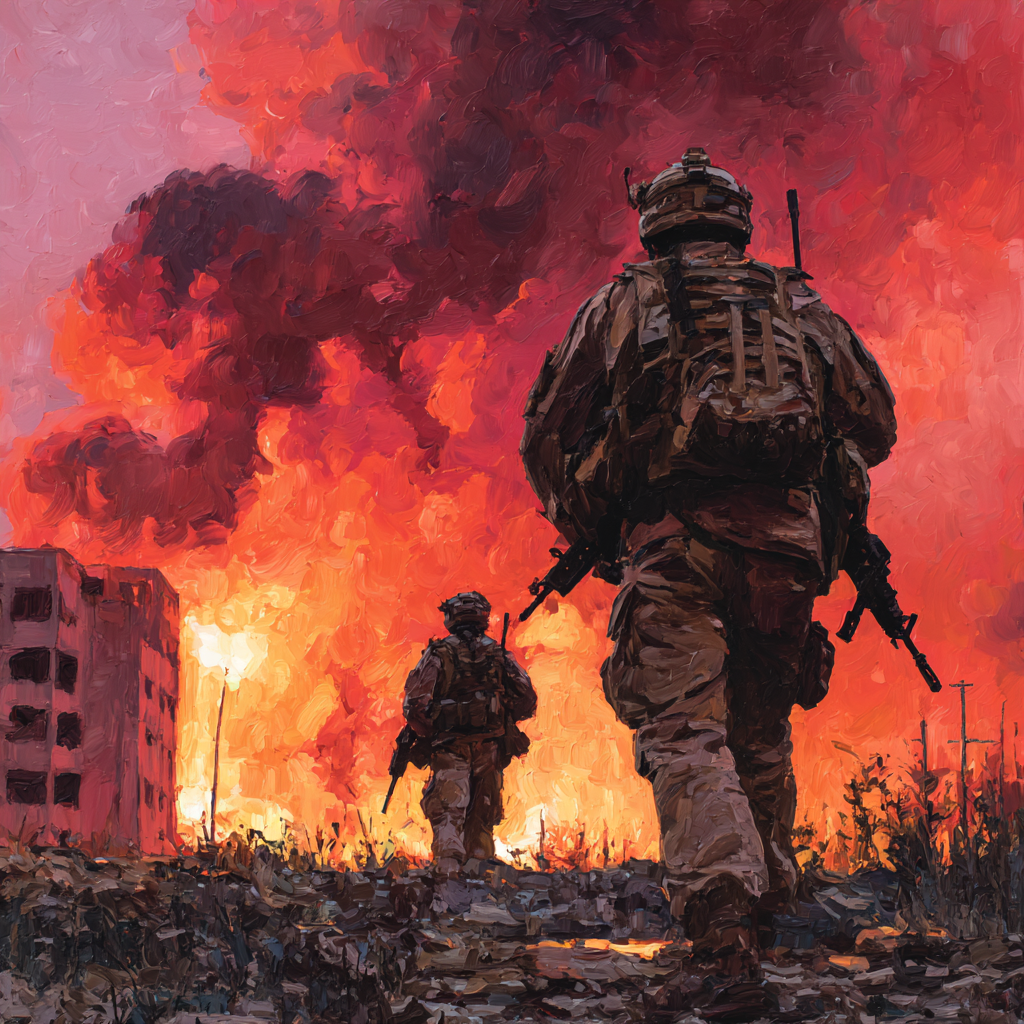
We already know that violence is wrong. That is not where this problem lives.
The problem begins when a society that holds that truth encounters a system that does not—and is willing to use that difference as an advantage. At that point, moral clarity does not disappear. It divides. Two truths come into view at the same time, and they do not resolve into a clean answer.
If we do nothing, people remain inside systems that impose harm without restraint. If we act without limits, we risk reorganizing that same logic of harm under our own justification. Both paths carry consequence. Neither preserves what we say we value without qualification.
So the question shifts. It is no longer is violence wrong. It becomes: how does a society that believes violence is wrong act coherently in the presence of a system that does not share that belief?
That is a structural question, not a moral slogan. And most of our public discourse answers it with positions that feel complete but collapse under pressure.
Tyranny is a system, not a figure
We instinctively reduce tyranny to a person. A dictator. A leader. A visible embodiment of the problem.
That instinct simplifies the moral landscape. It gives us a target. It suggests an endpoint. Remove the leader, and the system falls.
But tyranny is rarely organized that way.
It is distributed across institutions, incentives, fears, and dependencies. It lives in security structures, economic arrangements, information control, and learned patterns of compliance and survival. The leader is the most visible node in that system, but not the system itself.
When intervention focuses on removing the visible node without transforming the underlying structure, it produces a predictable outcome: disruption without reorganization. The top layer collapses. The generative conditions remain.
And systems built on coercion do not stabilize in a vacuum. They reorganize around the actors most capable of consolidating control under uncertainty. That often means the next iteration carries equal or greater intensity.
So the deeper question is not whether a regime should be removed. It is whether removal alters the conditions that made it possible.
Without that, we are not resolving tyranny. We are cycling it.
The real terrain is legitimacy
Force operates in physical space. But in conflicts involving tyranny, the decisive terrain is psychological and social. It is the question of legitimacy—who is seen as having the right to act, and at what cost.
A regime may be internally fragile, dependent on coercion to maintain order. But external intervention does not automatically weaken that fragility. It can reorganize it.
When an outside force enters, the regime gains access to a powerful narrative shift: from oppressor to defender. Internal dissent can be reframed as disloyalty. The population can be reorganized around threat rather than grievance.
This is not an abstraction. It is a structural move available to any regime capable of shaping perception.
The same intervention can either erode or reinforce the system it is confronting. The difference is not primarily intention. It is how the action is experienced by the population inside the system.
That experience determines whether intervention opens space for change or closes it.
So the question is not only whether intervention is justified. It is whether it changes the legitimacy field in a way that makes transformation possible.
The asymmetry that creates the bind
A high-ethic society imposes limits on itself. It establishes a floor—constraints around what it will and will not do, even under pressure.
It commits, at least in principle, to not deliberately targeting civilians, to maintaining accountability, to preserving distinctions that prevent force from becoming indiscriminate.
Those constraints are not decorative. They are what keep force connected to meaning rather than domination.
But in asymmetric conflict, those constraints become visible—and therefore usable.
A system without comparable limits can operate where the constrained actor will hesitate. It can embed itself within civilian populations. It can provoke responses that carry reputational cost. It can absorb losses without the same political consequences.
This produces a real dilemma:
- Maintain constraints, and accept tactical disadvantage
- Abandon constraints, and dissolve the distinction that justified acting at all
Once that distinction dissolves, the conflict changes. It is no longer a constrained response to an unconstrained system. It becomes two systems operating without reliable limits. The moral argument collapses because the behavioral difference collapsed first.
This is why “do whatever it takes” is not a neutral escalation. It is a transformation. It shifts the nature of the actor itself.
The constraint is not the obstacle. It is the anchor.
Violence as cost, not resolution
One of the more stabilizing moves in this framework is to stop treating violence as a solution.
Violence can interrupt. It can constrain. It can protect. It can create openings. But it does not build legitimacy, restore institutional trust, or reorganize societies.
Those are separate processes.
When we treat violence as a solution, we ask it to produce outcomes it cannot generate. When those outcomes fail to appear, we oscillate—either escalating force or withdrawing prematurely—without revisiting the assumption itself.
A more accurate frame is this: violence is a cost embedded within certain strategies, not the strategy itself.
That shift forces a different kind of thinking.
Intervention carries visible costs—casualties, escalation risk, institutional burden, moral injury. Non-intervention carries less visible but equally real costs—prolonged suffering, normalization of harm, expansion of coercive systems.
There is no path without cost. The work is to name it clearly and align it with something more durable than immediate emotional relief.
Without that, we perform conviction without doing accounting.
The phase that determines everything
Most societies attempt to solve this problem at the moment of crisis—when harm is visible, urgency is high, and public demand is activated.
By that point, the most important conditions have already been set.
A coherent response to tyranny requires preparation that happens before intervention is even on the table:
- Clear criteria for what qualifies as intervention-worthy tyranny
- Established pathways for collective legitimacy rather than unilateral action
- Identification and support of internal alternatives capable of sustaining change
- A realistic model for what follows disruption—not just how to initiate it
Without this groundwork, decisions are made reactively. Thresholds shift under pressure. Coalitions are assembled opportunistically. Regime removal is treated as an endpoint rather than the beginning of the most complex phase.
Urgency mobilizes action. It does not organize complexity.
This is why similar failures repeat across very different conflicts. The issue is not only poor decisions in the moment. It is the absence of structure that would make different decisions possible.
A society that has not prepared for how it will act under pressure will not discover coherence when pressure arrives.
The problem of time
There is another asymmetry that complicates everything.
Tyrannical regimes can absorb time in ways democratic societies cannot.
A system that does not depend on broad consent can endure prolonged instability, loss, and suffering without the same internal constraints. A democratic society must maintain public support, navigate political cycles, and respond to visible costs.
This creates a structural imbalance.
The strategies most likely to produce durable change—delegitimization, internal organization, institutional preparation—are slow. They resist dramatization. They do not satisfy the immediate demand to act.
But the societies capable of those strategies are also the ones least able to tolerate their pace.
So pressure builds to move faster than the situation can support.
And that pressure often comes from care. People see suffering and want it to stop. The problem is that urgency, on its own, cannot coordinate the complexity required for durable change.
We rush because we care. And because we rush, we often fail the conditions that would allow that care to translate into coherence.
What a coherent response actually requires
A workable response to tyranny does not eliminate tension. It organizes it.
It holds that intervention may be necessary, but not always immediately available. It holds that ethical constraints carry real cost, but that abandoning them carries deeper structural cost. It holds that removing a regime is not the same as building what comes next.
It also requires conditions.
There needs to be some internal capacity for change, even if fragile. There needs to be a plausible post-disruption structure. There needs to be legitimacy that extends beyond the intervening actor. There needs to be honest public accounting of cost.
Without these, intervention is not impossible. It is unstable.
And unstable interventions tend to produce outcomes that require further intervention, creating cycles that feel necessary in the moment and corrosive in hindsight.
What this ultimately asks of us
The hardest part of this problem is not deciding what is right.
It is deciding whether we are willing to build the conditions that allow what we believe is right to remain intact under pressure.
That work happens before crisis. It requires defining limits when they are inconvenient. It requires investing in structures that do not produce immediate visibility. It requires preparing publics to tolerate complexity rather than react to immediacy. It requires accepting that some answers will feel slower and less satisfying than we want.
Without that preparation, our moral language becomes reactive. We speak in values but act within whatever structure is available in the moment.
And that gap—between what we claim and what we have built to sustain it—is where this entire problem lives.
The question is not only how to confront tyranny.
It is whether we are willing to organize our own commitments in a way that survives contact with it.
DIALECTIC AND DECONSTRUCTION SOLUTIONS (DDS) ENGINE — v11.2
Blueprint: War, Tyranny, and Ethical Asymmetry Method: 8-Phase Master Blueprint | Complete First Pass Scope: Conflicts involving genuine tyranny with reduced ethical constraint — generalizable structure, not geopolitical argument
PHASE 1 — BLUEPRINT HEADER
Umbrella Problem: A genuinely tyrannical regime — one that oppresses its own population, poses credible external threat, and operates with reduced or absent ethical constraints — presents a structural bind that cannot be resolved by either pure pacifism or unrestrained force. The question is not whether violence is wrong. It is how a society that believes violence is wrong acts coherently when confronted by a system that does not share that belief and exploits the gap.
Nested problem structure:
- Tactical level: How does a high-ethic actor engage a low-ethic actor without accepting permanent disadvantage?
- Strategic level: Does military intervention against tyranny reduce it, or produce the conditions for its continuation?
- Systemic level: Can a tyrannical regime be meaningfully changed by external force, or does it require internal transformation?
- Philosophical level: Is there a coherent framework for violence that does not ultimately consume the ethical infrastructure it claims to protect?
Mixed-Motive Assumption (active throughout): Neither actor in this analysis operates from pure motive. The “high-ethic” intervening society carries strategic interests, domestic political constraints, economic considerations, and historical relationships that contaminate the stated rationale for intervention. This does not invalidate the ethical concern. It does mean that any proposed framework must survive examination under mixed-motive conditions, not only under idealized ones. A framework that only works when motives are pure is not a framework — it is a wish.
Architectural neutrality declared: This blueprint does not advocate for or against any specific conflict, regime, or intervention. It maps structure.
PHASE 2 — PROBLEM FRAMING (DECONSTRUCTION)
Surface symptoms: Armed conflict, civilian atrocities, terrorism, refugee crises, international instability, cycles of retaliation, failed states following intervention.
Root causes — upstream drivers:
1. Tyranny as a system, not a person. The most consequential error in how high-ethic societies have historically engaged tyranny is category confusion: treating the regime as reducible to its leadership. Tyrannical systems persist because they are not personality cults held together by a single actor’s charisma or will. They are ecosystems — of fear, patronage, ideological infrastructure, economic incentive, institutional loyalty, and population psychology developed over years or decades. The leader is the most visible node in that system. Removal of the node does not dismantle the system. The system predates the leader and, in most documented cases, outlasts the leader’s removal.
This is the upstream driver most commonly misaddressed by intervention doctrine.
2. Legitimacy as the actual contested territory. Military force operates on physical terrain. The actual contest in any conflict involving a tyrannical regime is over legitimacy — specifically, who holds it, in whose eyes, and at what cost. Tyrannical regimes are almost always legitimacy-deficient with their own populations at some level, which is why they require coercion to maintain. The question for any intervention is whether external force increases or decreases the intervening actor’s legitimacy in the eyes of the population being “liberated” — and whether it increases or decreases the tyrant’s legitimacy as defender against foreign aggression. These are empirical questions, not rhetorical ones, and the answer varies by context.
3. The martyrdom and fuel dynamic. Regimes operating under external threat have a structurally reliable tool: the besieged population psychology. When an external actor attacks — even with genuine cause and limited targeting — the regime can reframe the conflict as existential. “They are not attacking me. They are attacking us.” This reframing is available to any regime capable of controlling information flow, which tyrannical regimes typically are. The availability of this reframe does not mean intervention is always wrong. It means that the martyrdom potential is a real variable that must be modeled, not assumed away.
4. Institutional vacuum as the post-conflict catastrophe. The empirical record of 20th and 21st century interventions suggests a consistent pattern: the removal of a tyrannical regime without a credible, organized successor governance structure produces instability that enables the next authoritarian formation — often more extreme than the one removed. The problem is not only the intervention. It is the treatment of removal as the endpoint rather than the beginning of the hardest phase.
5. Domestic political constraint asymmetry. A tyrannical regime can absorb civilian suffering, military loss, and international isolation in ways that a democratic, high-ethic society cannot. Democratic publics have limited tolerance for sustained casualties and indefinite commitment. Tyrannical regimes do not face that constraint. This asymmetry is structural and must be named. It means that any high-ethic actor entering extended conflict with a low-ethic actor is operating under a time-limited mandate that the opponent does not share.
PHASE 3 — DIALECTICS
This section is, per the problem’s instruction, the most developed. Five tensions are mapped with origin, current imbalance, costs, and intersection.
Tension 1: Violence is ethically wrong ↔ Non-confrontation enables greater violence
The origin of this tension: This is not a modern philosophical problem. It appears in just war theory, in Buddhist ethics, in the Mahabharata, in Bonhoeffer’s theological crisis under National Socialism. It is structurally irresolvable at the level of pure principle, which is why every tradition that has engaged it seriously has ultimately moved to conditions rather than absolutes. The pacifist position — that violence is always wrong regardless of consequence — is coherent only if one accepts that the suffering of those who are victimized by non-intervention is an acceptable cost of moral purity. That position is available, but it must be named honestly for what it costs.
What each side is protecting:
- The position that violence is categorically wrong protects the coherence of an ethical framework that recognizes harm as intrinsically bad, not merely instrumentally bad. It prevents the gradual expansion of “justified” violence to cover progressively less justified targets.
- The position that non-confrontation enables greater violence protects the practical commitment to reducing actual harm in the world, even at the cost of abstract moral cleanliness.
Current imbalance: Neither position holds stably. Pure pacifism collapses when confronted with the Rwandan genocide — a conflict where intervention might have saved hundreds of thousands of lives and non-intervention allowed mass atrocity. Pure interventionism collapses when confronted with Iraq 2003 — a conflict where intervention removed a genuinely tyrannical regime and produced conditions that enabled new extremist formations, sustained sectarian violence, and regional destabilization. Neither case proves the principle. Both cases demonstrate the cost of applying either principle without attending to its failure modes.
What DDS holds: Violence is a cost, not a solution. The question is never “is violence justified?” in isolation. The question is: compared to what alternative, with what expected consequences, borne by whom, with what accountability structure in place? Holding that question open — resisting the pressure to collapse it into a simple yes or no — is not moral weakness. It is the only posture that allows for accurate cost accounting.
Costs on each side:
- Intervention cost: Military and civilian casualties, moral injury to intervening forces, risk of regime-strengthening martyrdom, post-conflict institutional burden, legitimacy damage if conduct violates stated ethics.
- Non-intervention cost: Ongoing atrocities borne by the oppressed population, normalization of regime behavior, potential for expanding threat, moral complicity through inaction. This cost is almost never distributed to the population making the decision — it falls on those without political voice in the decision.
Tension 2: Ethical restraint creates vulnerability ↔ Ethical abandonment produces the enemy
The origin: This tension is structurally produced by asymmetric warfare doctrine. A high-ethic actor announces, implicitly or explicitly, the boundaries of its behavior. A low-ethic actor reads those boundaries as a tactical map. Every announced constraint is an invitation to exploit the gap it creates. This is not a failure of ethics — it is the predictable structural consequence of one party having a floor and the other not.
The specific asymmetry mechanisms:
Human shield deployment: A low-ethic actor places military assets within civilian populations knowing that a high-ethic actor’s rules of engagement prevent targeting that will produce civilian casualties above a threshold. The low-ethic actor effectively uses the high-ethic actor’s ethical commitments as armor. The high-ethic actor then faces a choice: accept civilian casualties to degrade the military target, or accept reduced effectiveness to protect civilians the low-ethic actor has placed in harm’s way. This is a genuine bind, not a rhetorical one.
Restraint exploitation as propaganda: The high-ethic actor’s moments of compliance with ethical limits are invisible to international observers — they are non-events. The low-ethic actor’s moments of success against restrained high-ethic forces are visible, and can be framed as evidence that the high-ethic actor is weak, irresolute, and beatable. This inverts the strategic value of ethical behavior in the short-term.
Attrition asymmetry: A tyrannical regime does not require public consent to continue absorbing military losses. A democratic, high-ethic society does. This means that a conflict can continue long past the point where the high-ethic actor’s domestic political capacity to sustain it has eroded, producing either an imposed settlement that does not achieve stated goals, or an escalation of tactics to shorten the conflict — which is precisely the pressure that produces ethical abandonment.
What happens when the high-ethic actor abandons its ethics: The empirical and psychological record is consistent. Abu Ghraib became a more effective recruitment tool for extremist organizations than almost any other single event in the Iraq conflict. The logic is not complicated: the high-ethic actor’s stated justification for intervention was, in part, the moral distinction between itself and the regime it opposed. When it visibly violated that distinction, it surrendered the primary legitimacy claim that distinguished it from the tyrant. The tactical gain — whatever intelligence or deterrence value the torture produced — was negligible. The strategic cost was substantial and durable.
The recursive structure: If the high-ethic actor maintains its ethics, it accepts strategic vulnerability. If it abandons its ethics to reduce vulnerability, it becomes what it opposes. This is not merely poetic. It is structurally precise. A society that suspends civilian protections to defeat a regime that suspends civilian protections has produced the following: two systems in which civilian protections are conditionally suspended. The distinction that justified the conflict in the first place has been erased.
What DDS holds: Ethical abandonment does not solve the recursive dilemma — it completes it. The question is not whether to maintain ethical constraints. The question is what minimum viable ethical floor can be defined, held absolutely, and used as a stable anchor when other constraints are under pressure. That floor is not “perfect compliance with all standards in all situations.” It is the identification of the specific commitments that, if violated, transform the actor’s nature — and the refusal to violate those commitments regardless of tactical pressure.
Costs on each side:
- Ethical maintenance: Accepts greater short-term tactical risk. Accepts some military engagements that a less constrained actor would win. Creates domestic political pressure when casualties mount.
- Ethical abandonment: Forfeits legitimacy advantage. Produces moral injury within the force. Creates propaganda material that sustains the conflict. Damages internal institutional coherence. Risks producing a domestic culture comfortable with normalized rights violations.
Tension 3: Targeting leadership shifts the system ↔ Systems survive leadership removal
The origin: The “decapitation strategy” — removing the tyrant as a path to system transformation — has persistent appeal for strategic and psychological reasons. It is visible, decisive, and satisfying as a narrative. The tyrant is the face of the regime; removing the face suggests removing the regime.
The empirical challenge: The record of decapitation strategies is weak when measured against the goal of system transformation rather than leadership change. The pattern across documented cases is consistent: systems built on fear, patronage networks, ideological infrastructure, and bureaucratic self-interest are not stored in a single person. They are distributed across hundreds or thousands of actors whose interests are served by the system’s continuation. When the leader is removed, those actors compete to perpetuate the structures that serve them — sometimes under new ideological framing, sometimes under new leadership, but structurally similar.
The conditions under which decapitation can matter: The exception, not the rule, is when:
- The leader is genuinely the unique organizing principle (rare — more often mythologized than real)
- A credible alternative governance structure is already organized and capable of filling the vacuum
- The population has already internally delegitimized the regime sufficiently that the leader’s removal is legible as liberation rather than foreign aggression
- The institutional infrastructure of the regime has been sufficiently degraded that it cannot reorganize around new leadership
When these conditions are absent — and historically they have been absent more often than not — decapitation produces a power vacuum. A power vacuum in a society built around coercion and patronage produces violent competition for dominance. That competition often elevates the most ruthless available actors, who are disproportionately those who learned power in the previous regime’s coercive apparatus.
What DDS holds: Leadership targeting as a primary strategy is an hypothesis, not a doctrine. It should be treated as one variable in a system-level analysis, not as a reliable mechanism for system transformation. The upstream driver is not the tyrant’s continued existence. It is the system of beliefs, fears, loyalties, and incentives that produced the tyrant and will produce successors. Any strategy that does not address those upstream drivers will recycle the problem.
Tension 4: Martyrdom as fuel ↔ Martyrdom as finite resource
The origin: The claim that violence against a tyrant or tyrannical system generates ideological fuel for that system is well-supported and well-understood. Less examined is the counterclaim: that martyrdom-generating potential is not infinite, that tyrannical systems can exhaust it, and that the conditions under which martyrdom works as a sustaining mechanism are specific, not universal.
When martyrdom works for the tyrannical regime:
- The population has not yet reached the threshold where the regime’s internal oppression is more threatening than external aggression
- The external actor lacks legitimacy in the eyes of the population (either through historical relationship or current conduct)
- The regime retains sufficient information control to frame the conflict to its population
- The external violence is visible and civilian-affecting
When martyrdom potential weakens:
- The internal population has reached the threshold where their experience of the regime is more threatening than any external intervention
- The regime has lost information control through internal or external information operations
- The external actor has accumulated sufficient legitimacy through consistent conduct
- The conflict has continued long enough that the population has experienced the regime’s escalating response to dissent
What DDS holds: Martyrdom potential is a real variable, not a fixed constant. It should be assessed dynamically, not assumed to be either infinite or negligible. The question is not “will this action generate martyrdom response?” The question is: “At this moment, in this population, under these information conditions, how much martyrdom potential does this action produce, and does that cost exceed the operational value of the action?”
Tension 5: The Strategic Logic of Ethical Maintenance ↔ Its Short-Term Unintelligibility
The origin: The strongest argument for maintaining ethical constraints is long-term and strategic: legitimacy is the only durable foundation for political change. Military victory without legitimacy produces occupation, not transformation. The strongest argument against maintaining ethical constraints under pressure is short-term and visceral: people are dying now, and abstract strategic calculations do not return the dead.
The legitimacy argument: A high-ethic actor’s primary strategic asset is not military — it is the perceived distinction between itself and the tyrant. That distinction is the thing that makes its intervention legible as liberation rather than conquest. If the high-ethic actor can maintain that distinction across the duration of conflict, it retains the capacity to build durable political change in the aftermath. If it cannot, military victory — even if achieved — produces a hollow outcome: a defeated regime replaced by an occupying power that has forfeited the legitimacy needed to build successor institutions.
The short-term problem: The long-term strategic argument for ethical maintenance is real. It is also consistently unavailable to the political actors responsible for making tactical decisions in real time. Democratic leaders operate under a mandate measured in election cycles. Military commanders operate under a mandate measured in operational timelines. The people who bear the cost of tactical disadvantage — soldiers and frontline communities — are not always the same people who benefit from long-term legitimacy gains. This misalignment between who pays the short-term cost and who receives the long-term benefit is not a rhetorical problem. It is a structural one that no framework fully resolves.
What DDS holds: The argument for ethical maintenance must be made on both short-term and long-term grounds simultaneously, or it will not hold. It is insufficient to argue only that “history will vindicate restraint.” The argument must also demonstrate what the short-term cost of ethical abandonment looks like in operational reality — the propaganda value, the recruitment value, the moral injury to the force, the institutional damage, the domestic normalization of rights violations. That argument has to be made prior to the pressure point, not during it. Once the pressure is acute, the long-term argument has already lost.
Tensions in intersection:
These five tensions do not operate independently. They layer:
- Tension 1 (violence/non-confrontation) determines whether action occurs at all
- Tension 2 (restraint/abandonment) determines how action is conducted
- Tension 3 (leadership/system) determines what action targets
- Tension 4 (martyrdom) determines how action is received
- Tension 5 (strategic legitimacy/short-term cost) determines whether the action can be sustained
A framework that addresses only one or two of these simultaneously is unstable. The bind is precisely that each tension has a legitimate answer at the level of the tension itself, but those answers create new problems when they interact. Solving Tension 1 (yes, intervene) without solving Tension 2 (how, with what constraints) produces Abu Ghraib. Solving Tension 2 (maintain ethics) without solving Tension 3 (what to target) produces decapitation doctrine. Solving Tension 3 without solving Tension 4 produces martyrdom. The mechanism must hold all five simultaneously.
PHASE 4 — MECHANISM
All proposed elements here are hypotheses. None are conclusions. Each is subject to the failure modes identified in Phase 5.
A Tiered Response Architecture with Ethical Integrity Maintenance:
The mechanism is structured across five phases, ordered by least coercive to most. Movement between phases requires meeting threshold criteria, not simply experiencing frustration with the current phase’s pace.
Phase 0 — Pre-engagement infrastructure (before conflict is active):
The most consequential decisions in any conflict are made before the first engagement. A society that has not built legitimacy infrastructure, legal framework, and coalition architecture before conflict is active will attempt to build those things under fire, which is consistently insufficient.
Pre-engagement requirements:
- Criteria definition: Establish clear, explicit, and publicly accountable criteria for what constitutes intervention-warranting tyranny. Not “government we oppose” — specific thresholds of documented atrocity, credible external threat, and exhausted diplomatic alternatives. Without explicit criteria, intervention is permanently available for motivated use.
- Coalition legitimacy: Build international authorization structures before they are needed. Unilateral intervention, even against genuine tyranny, forfeits legitimacy at the moment it is most needed. This is not primarily a legal requirement. It is a strategic one.
- Post-conflict architecture: Identify and resource the alternative governance structure before action commences. “We’ll figure it out after” is not a plan — it is the primary documented cause of post-intervention instability. If no credible successor structure exists, this is a gate-level failure that should halt progression to more coercive phases.
Phase 1 — Asymmetric legitimacy operations:
Priority is delegitimization of the tyrannical regime within its own population, not external defeat of its military. These are different objectives and require different instruments.
Instruments:
- Information transparency operations: Support access to information that the regime restricts from its population about its own conduct. The goal is not propaganda — it is accuracy. Accuracy is typically more destabilizing to tyrannical regimes than counter-narrative because regimes built on manufactured consent are fragile to unfiltered information about their own behavior.
- Internal resistance support: Resource, train, and protect organized internal opposition without supplanting it. External intervention that replaces internal resistance with external actors removes the only actors who can claim genuine legitimacy in the post-conflict environment. This is the critical distinction between support and substitution.
- Economic isolation architecture: Build targeted sanctions regimes that degrade the regime’s capacity to resource its coercive apparatus without producing the population suffering that the regime can exploit as evidence of external aggression. This requires precision that broad sanctions typically lack.
- Diplomatic coalition expansion: Continuously expand the coalition of states willing to apply pressure, reducing the regime’s access to economic and political alternatives.
This phase accepts that it is slow. The pressure to accelerate past this phase before it has produced measurable results is the single most reliable source of premature escalation.
Phase 2 — Threshold criteria for direct action:
Direct military action is justified only when all of the following are met:
- Mass atrocities are ongoing or credibly imminent, not merely possible
- Internal resistance is present and organized but insufficient to prevail without external support — meaning there is an internal legitimacy base that external action can support rather than replace
- A credible post-conflict governance structure is organized and resourced
- International coalition legitimacy is established
- The costs to the intervening society are honestly disclosed to the domestic public and consented to through legitimate political process
- The martyrdom potential assessment indicates net negative yield for the regime
If any of these conditions is not met, Phase 2 is not available and the assessment returns to Phase 1 with a mandate to address the unmet condition.
Phase 3 — Direct action with non-negotiable ethical floor:
If Phase 2 thresholds are met, direct action proceeds with an ethical floor that is non-negotiable regardless of tactical pressure. The floor is defined before action commences and is not subject to revision under operational pressure.
Minimum viable ethical floor — the specific commitments that, if violated, transform the actor’s nature:
- Non-targeting of civilians as deliberate policy — not as aspiration but as absolute constraint with accountability
- Transparency about civilian casualties when they occur — not concealment or minimization
- Prohibition on torture and degrading treatment — not because it doesn’t work tactically (the evidence on that is mixed) but because it irreversibly damages the moral distinction that justifies the action
- Chain of accountability for violations: violations are prosecuted at all levels, not only at the operational level
What this floor does not require:
- Perfect compliance in every engagement — that is not achievable under combat conditions
- Symmetric capability with the low-ethic actor — accepting disadvantage in specific engagements is a cost of ethical maintenance, not a strategic failure
The human shield problem under this framework: When a low-ethic actor uses civilian presence to constrain high-ethic targeting, the ethical floor does not dissolve. What shifts is the targeting calculus: the low-ethic actor’s deployment of human shields is itself a war crime that shifts moral responsibility for civilian casualties to the actor deploying them, not the actor forced to choose. This is not a permission structure for civilian targeting — it is an accounting framework for where responsibility lands. The high-ethic actor still makes the targeting decision and is still accountable for the consequences. It carries a different weight of responsibility than an actor that deliberately generates civilian casualties.
Phase 4 — Post-conflict institutional architecture:
The conflict does not end when military operations conclude. The mechanism requires explicit commitments to:
- Transition to internal governance as rapidly as possible, with support rather than substitution
- Resource investment in institutional reconstruction proportionate to the destruction caused
- Accountability for conduct during the conflict — including the intervening actor’s own conduct — through legitimate, transparent process
Failure to execute Phase 4 is the documented cause of post-intervention failure more consistently than failure in any combat phase.
PHASE 5 — READINESS & AUDIT
Upstream driver quality check:
- Actor: High-ethic intervening society (with mixed motives), tyrannical regime and its apparatus, internal opposition, civilian population of the tyrannical state, international community
- Constraint: Martyrdom potential, domestic political time horizons, institutional vacuum risk, mixed-motive contamination of stated rationale, information control asymmetry
- Behavior loop: Tyranny → atrocity → international pressure → intervention debate → escalation or inaction → post-intervention instability or ongoing atrocity → repeat
- What holds the loop: Absence of pre-engagement infrastructure, treatment of leadership removal as endpoint, underestimation of system persistence, domestic political constraint on the high-ethic actor, mixed-motive contamination reducing legitimacy
Feasibility scoring:
| Dimension | Score | Notes |
|---|---|---|
| Psychological / Social Capacity (high-ethic society) | 5/10 | Democratic publics can sustain this framework under clear criteria and honest cost accounting; they cannot sustain it under opaque, open-ended commitment |
| Political / Resource Alignment | 4/10 | Phase 0 infrastructure is chronically underfunded; post-conflict architecture is consistently deprioritized; threshold criteria are politically inconvenient to define in advance |
| Existential / Normative Fit | 8/10 | The framework maps to existing norms in just war doctrine, international humanitarian law, and counterinsurgency theory; it does not require philosophical innovation, only consistent application |
Verdict: PAUSE — framework is coherent, but Phase 0 infrastructure is consistently absent when it is most needed.
The mechanism functions only if Phase 0 is built before conflict pressure makes it practically impossible. The consistent documented failure is not at Phase 3 (direct action) — it is at Phase 0 (pre-engagement infrastructure). Any society that claims commitment to this framework but does not invest in Phase 0 has stated a preference without accepting its costs.
Key assumptions the mechanism depends on:
- That a credible internal opposition can be identified and supported without being supplanted. This is frequently not true — internal opposition in genuinely tyrannical states is often fragmented, infiltrated, or too small to form a governance base. When this assumption fails, the threshold criteria block Phase 2, which means the mechanism returns to Phase 1 indefinitely. That is a real outcome, not a failure of the framework.
- That the high-ethic actor’s domestic political structure can sustain the time horizon required by Phase 1. This is frequently not true. Democratic publics respond to visible atrocity with pressure for immediate action. Phase 1’s pace is structurally in tension with democratic crisis response. No proposed framework resolves this tension — it can only be managed by investing in public understanding of why Phase 1 exists.
- That the minimum viable ethical floor can be defined and held under operational pressure. This is achievable but requires institutional investment in training, doctrine, accountability structures, and leadership culture before the pressure arises. Institutions that have not built that culture in peacetime will not maintain the floor in wartime.
- That legitimacy accrual is a real strategic variable. This is the mechanism’s central empirical claim and it is supported by the historical record — but not universally, and not quickly. There are documented cases where high-ethic behavior did not produce the legitimacy gains the mechanism predicts because the information environment was controlled sufficiently to prevent the population from knowing about it. The mechanism must account for the possibility that legitimacy accrual operates on a longer timeline than the conflict’s duration.
Failure modes of proposed approach:
- Phase 0 is not built before pressure arrives → mechanism has no stable foundation
- Threshold criteria for Phase 2 are adjusted under political pressure → mechanism becomes available for motivated use
- Mixed-motive contamination of stated rationale becomes visible → legitimacy evaporates even with ethical conduct
- Post-conflict architecture is underfunded or deprioritized → military success produces institutional vacuum → new authoritarian formation
- Domestic political constraint forces premature withdrawal before Phase 4 is complete → all preceding investment yields no durable outcome
Loss acknowledgment (required):
This mechanism asks real things from each actor.
From the high-ethic intervening society: accepting tactical disadvantage in exchange for strategic legitimacy. Accepting that some military engagements will be lost that a less constrained actor would win. Accepting the political cost of defining explicit, public threshold criteria that constrain motivated use. Accepting the financial and institutional cost of post-conflict architecture. Accepting that the mechanism may return an answer of “not yet” or “not this time” when domestic political pressure demands action.
From the oppressed population of the tyrannical state: if Phase 2 thresholds are not met, bearing the continued cost of non-intervention. This cost is catastrophic in some cases and is not borne by the political actors making the decision. That asymmetry must be named, not rationalized.
From the low-ethic actor: no voluntary cost. The mechanism is not premised on the tyrannical regime’s cooperation.
There is no scenario in this framework with no cost. The question is only how cost is distributed and whether its distribution is honest.
PHASE 6 — NARRATIVE SYNTHESIS
The problem is not that we do not know violence is wrong. We know it. The problem is that we have not yet built a framework that holds that knowledge coherently while also holding the knowledge that non-action in the face of genuine tyranny is itself a form of violence — slower, less visible, easier to rationalize, but real.
Both of those things are true at the same time, and the framework that can hold them both is the one that survives contact with reality.
What we tend to reach for instead is simpler. We reach for the position that produces the most coherent narrative: either that intervention is the defense of the innocent, or that intervention is always imperialism. Both narratives are available. Both are sometimes accurate. Both collapse when applied universally, which is when they do the most damage.
The ethical asymmetry problem — the bind of a high-ethic actor facing a low-ethic actor — is not resolvable by will alone. You cannot simply decide to have no floor and maintain your identity. The floor is not a constraint on effectiveness. It is the thing that makes effectiveness meaningful. A society that defeats tyranny by becoming tyrannical has not reduced tyranny in the world. It has changed its address.
But the argument for maintaining ethical constraints cannot rest only on long-term strategic calculation. Long-term calculation is cold comfort to people dying in the short term, and the actors responsible for immediate decisions do not have the luxury of the historian’s timeline. The argument must be made on both registers: that ethical maintenance is the only path to durable legitimacy, and that ethical abandonment produces concrete, near-term operational costs that exceed the tactical gains — in recruitment, in propaganda value, in moral injury to the force, in domestic normalization of rights violations.
What the framework requires is something harder than good intentions. It requires pre-built infrastructure. It requires explicit criteria defined before the pressure arrives. It requires investment in post-conflict architecture at the same level of seriousness as investment in the conflict itself. It requires honesty with domestic publics about what the costs are and why the constraints that produce those costs are non-negotiable.
The societies that have navigated this most durably have not been the ones with the clearest moral convictions. They have been the ones that built the institutional architecture to hold their moral convictions under pressure before the pressure arrived. Conviction without architecture is rhetoric. Architecture without conviction is eventually available for abuse. The two must be built together, in advance, or the framework fails at the moment it is most needed.
The question this blueprint cannot answer is whether the political will to build Phase 0 infrastructure exists before crisis demands it. That is not a strategic question. It is a question about what a society actually believes versus what it says it believes. The distance between those two things is where tyranny, and its response, find their opening.
PHASE 7 — COMPONENT STATUS
| Component | Status | Notes |
|---|---|---|
| Problem Framing / Deconstruction | Complete | Five upstream drivers identified; surface/root distinction maintained |
| Dialectical Architecture | Complete — most developed | Five tensions mapped with origins, imbalances, costs, intersections |
| Mechanism Design | Complete — first pass | Five-phase tiered architecture; all elements held as hypotheses |
| Ethical asymmetry analysis | Complete | Human shield problem, restraint exploitation, attrition asymmetry addressed |
| Leadership/system distinction | Complete | Decapitation strategy analyzed against empirical record |
| Martyrdom potential | Complete | Held as dynamic variable, not fixed constant |
| Mixed-motive assumption | Active throughout | Not resolved; flagged at each mechanism phase |
| Architectural neutrality | Maintained | No specific regime or intervention endorsed or condemned |
| Feasibility scoring | Complete | Gate-level failure at Phase 0 identified as primary structural weakness |
| Post-conflict architecture | Complete — framework level | Specific institutional design not addressed — requires case-specific technical work |
| Evidence base | Partial | Historical pattern references made; specific case citations not embedded |
| Hypothesis containment | Maintained | All mechanism elements held as hypotheses; failure modes explicitly named |
PHASE 8 — HOW WOULD YOU LIKE TO PROCEED?
[A] Publish This Blueprint — Mark as complete first pass
[B] Solve Next Component:
- Post-conflict institutional architecture in depth — what does the actual governance transition look like, and what are its specific failure modes?
- Information environment and legitimacy operations — what does Phase 1 look like as an operational doctrine rather than a principle?
[C] Revise:
- Deconstruction — Narrow the entry point to a specific case (e.g., Iran, historical WWII framing) to test the framework against concrete variables
- Dialectics — Add the internal dissent tension: what is owed to the people inside the tyrannical state who are fighting the regime without external support, and how does that obligation interact with the threshold criteria?
- Mechanism — Redesign around a non-military-primary architecture — what does a framework look like if direct action is structurally unavailable and Phase 1 is the only tool?
- Feasibility — Strengthen with specific historical case analysis: where has the tiered framework been approximated, and what were its outcomes?
- Narrative — Shift register toward the individual moral actor (the soldier, the policymaker, the resister) rather than the state-level framework
[D] Clarify Before Proceeding — The prompt raised the samurai code as a specific frame. That frame has not been fully developed — there is an untapped analysis of warrior-ethics traditions and how they handle precisely this bind internally. Available if useful.
[E] Start Fresh — New umbrella problem
This blueprint was produced with Dialectic and Deconstruction Solutions (DDS), a method created by William Hambleton Bishop. The method, the book, and the public archive of worked blueprints are free at SolveSomething.com.