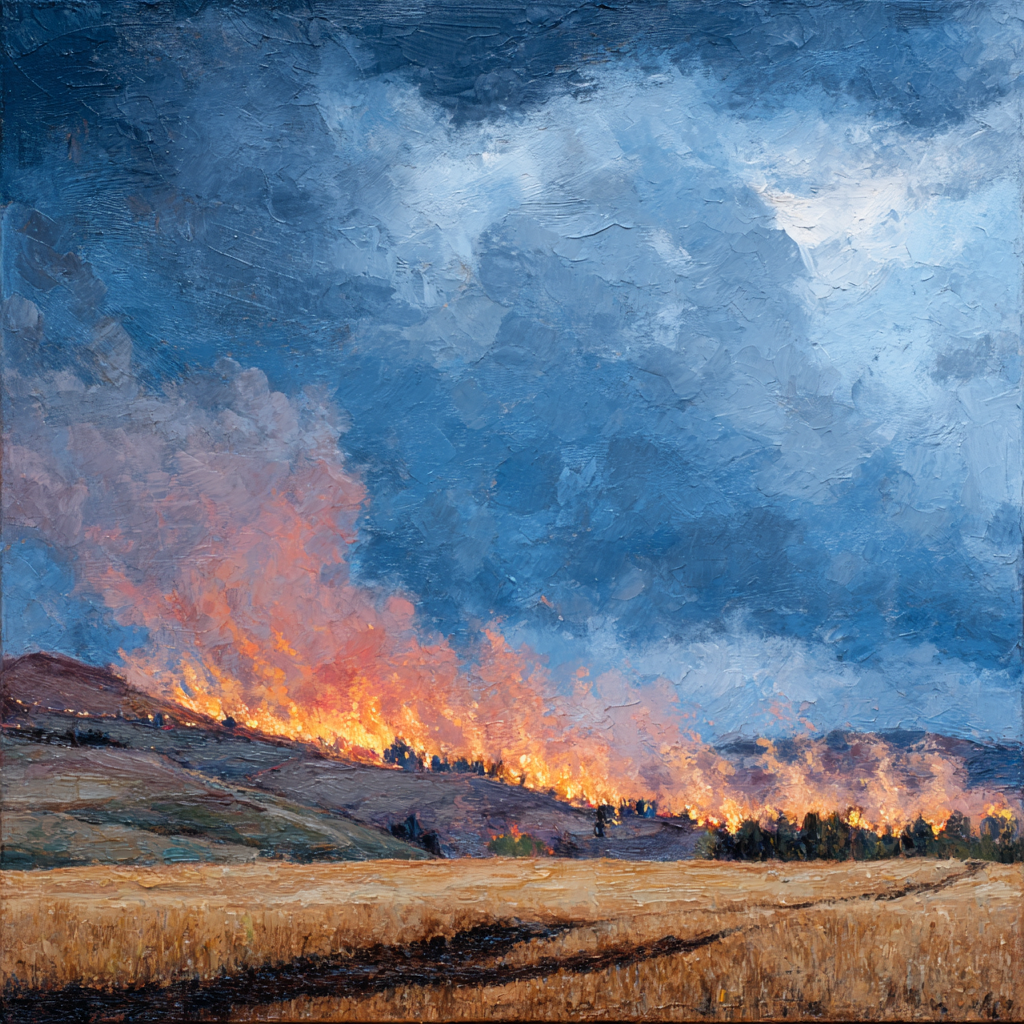
The Western United States has a wildfire problem it built. That phrase is a structural observation, and the distinction matters — because if the problem is built, it can be rebuilt differently.
The forests burning now are burning beyond the precedent of the suppression era — the roughly one hundred years during which total fire exclusion became federal land management doctrine. Before that era, the Western landscape was organized by fire. Low-intensity burning, recurring and intentional, maintained the fuel conditions, plant diversity, and ecological balance that kept catastrophic burning rare. That burning was managed — by the tribal nations whose ancestors designed it, practiced it, and transmitted it across generations.
Total suppression was adaptive. After the fires of 1910 — eighty-five firefighters dead in two days across Idaho and Montana — agencies that extinguished fires received funding. Risk accumulated invisibly in the understory while the machinery for managing visible fires ran with increasing efficiency. The system was built to solve visible fires. It could not perceive the invisible ones it was building.
What it also built was an institutional gate between the knowledge that would have managed these landscapes and the land management system that governed them. The Karuk, Yurok, and Hupa were not silent. They were excluded. Tribal burning was suppressed formally and informally: practitioners were prosecuted, the practice was repositioned as primitive and hazardous, and the epistemological standards of federal land management were constructed in ways that treated relational ecological knowledge — held in practice, in relationship, across generations — as inadmissible. The forest accumulated fuel. The gate held.
That gate is what this solution addresses. And the reason this is worth genuine attention is that where it has begun to move, the evidence is already accumulating.
We are in a dual condition: a land management system that retains institutional authority, and a body of land management knowledge that was never actually lost. The Karuk Tribe’s cultural burning program in northern California has been active for decades. The Yurok and Hupa have maintained and rebuilt burning practice across periods of formal suppression. In California, AB 642 established a modified regulatory framework for tribal cultural burning in 2021, and the documented outcomes — measurable fuel reduction, ecologically verified habitat restoration — are in the literature. In Australia’s Northern Territory, Aboriginal fire management programs were formally reintegrated into land management through co-management agreements beginning in the 1990s. The Arnhem Land program produced a documented reduction of more than fifty percent in the extent of high-intensity late-season fire over a decade of coordinated burning.
The knowledge exists. The practice works. The question is institutional.
What stands between the current fire crisis and the knowledge capable of addressing part of it is a specific structural condition: tribal nations with proven burning capacity are required to operate as permit applicants, advisory consultants, and program participants within a management system built on the suppression logic it is now being asked to abandon. Advisory status is the institutional mechanism for appearing to include knowledge while ensuring it does not change outcomes. The Karuk burned. They also filed for permits, sat in consultation meetings, and produced reports. The distinction between participating in the system and holding authority within it is functional and consequential. The outcome data are different.
The shift the evidence points toward is co-management: tribal nations with active or recovering cultural burning capacity recognized as co-managers of the landscapes they have managed for millennia — with voting membership on planning bodies, with legal authority to burn without requiring the permission of the system that suppressed the practice, with liability frameworks that distribute risk to the entities that benefit from the burning rather than to the practitioners performing it. Australia’s experience is instructive as precedent: the structural move from advisory to operational authority is what changed the outcome data. Consultation without decision power does not move fire across landscapes. Authority does.
The minimum viable version of this is executable now, within existing legal authority, without waiting for federal legislation. Three tribal nations — the Karuk, Yurok, and one Pacific Northwest tribal nation — two National Forest parcels where federal land is genuinely embedded in or adjacent to tribal territory, one burning season under co-management agreements executed at the Secretarial level of the Department of Interior. The standard permit process is suspended for those parcels. The burns happen. The fuel reduction and ecological outcomes are documented. Federal operational data is generated under a new framework before the larger political fight over statutory codification fully arrives.
That first season does not solve the crisis. It does something more foundational: it establishes federal precedent that relational ecological knowledge constitutes legitimate land management authority — and it does so on the ground, in smoke, with measurable outcomes.
The path beyond the first season is already partially cleared. Phase 1 requires no legislation — existing Secretarial authority is sufficient. The regulatory work that follows — EPA reform establishing a distinct cultural burn category separate from industrial emissions standards, tribal knowledge formally integrated into National Forest management plans, voting membership on planning bodies — moves in parallel with the early burns, not in sequence. Burning school programs, investing in intergenerational knowledge transmission so the practice survives past the current generation of elder practitioners, are infrastructure investment. Every dollar there reduces the suppression budget it competes against.
The urgency is real. So is the tractability. Neither cancels the other. Together, they describe a situation where action is possible now, at the scale the current institutional and relational infrastructure can support, while the larger statutory work proceeds on its own timeline. A staged approach is the design that allows urgency to produce something that lasts.
Every repair of this kind carries the risk of becoming a version of the problem it was built to solve. Cultural burning programs that receive federal funding and recognition will face institutional pressure to acquire federal performance standards — quarterly reports, smoke protocols, fuel reduction targets in measurable units. The mechanism designed to restore tribal burning authority can, across years, become the mechanism that institutionalizes it: converting living practice into regulated procedure, ecological relationship into reporting compliance. Burning that serves an agency’s fuel reduction targets and burning that serves a landscape’s ecological intelligence are not always the same act.
The co-optation risk is real. It is also the reason the mechanism requires a built-in test: if tribal practitioners report, in consecutive annual reviews, that the co-management framework constrains rather than enables the practice — that they are burning less, or differently, or with less agency than the land requires — the framework has inverted its purpose and needs to be rebuilt.
The forests burning now are burning because that knowledge has been on the wrong side of an institutional gate for a century. The knowledge itself was not lost. The evidence from California and the Northern Territory is not ambiguous. The tribal practitioners who hold the practice are not hypothetical. The legal authority required to begin is already available. The path from three tribes, two parcels, one burning season — to regulatory reform, to statutory codification — is clear enough that the steps are already named.
What remains is whether the institutions that built the crisis can hold authority alongside the people whose knowledge predates those institutions. Where that has been tried, the land responds.
The knowledge didn’t burn with the forests. The gate is the thing that can move.
═══════════════════════════════════════════════════════════════ DIALECTIC AND DECONSTRUCTION SOLUTIONS (DDS) BLUEPRINT ═══════════════════════════════════════════════════════════════
Problem: A century of federal fire suppression policy built the conditions for catastrophic wildfire by excluding the Indigenous cultural burning practices that would have prevented it.
───────────────────────────────────────────────────────────────
PHASE 1: PROBLEM FRAMING
───────────────────────
The Umbrella Problem
Catastrophic wildfire crisis in the American West, driven by fuel loads, institutional failure, and climate conditions that now interact in ways that no single intervention can reverse.
───────────────────────
The Multiple Drivers
- Accumulated fuel loads from a century of total fire suppression — unnaturally dense forests with understory that no pre-suppression ecosystem ever had to manage
- Institutional exclusion of Indigenous cultural burning knowledge from land management systems
- Climate change extending fire seasons and drying landscapes beyond historical range
- Fragmented jurisdictional authority across federal, state, tribal, and private land — no single entity can authorize landscape-scale burning
- Prescribed burn liability exposure for practitioners operating outside suppression logic
───────────────────────
This Blueprint Addresses:
The institutional exclusion of Indigenous cultural burning knowledge and practice — the epistemic and legal structures that have kept the most durable, landscape-tested fire management system off the table.
───────────────────────
Remaining Components:
- Mechanical and non-tribal prescribed burn fuel reduction programs
- Climate change mitigation and seasonal fire weather adaptation
- Multi-jurisdictional coordination framework for landscape-scale management
- Prescribed burn liability reform for non-tribal practitioners
This blueprint addresses the exclusion of cultural burning authority. It does not attempt to resolve fuel load reduction by mechanical means, climate-driven fire weather, or cross-jurisdictional coordination, which require separate interventions.
───────────────────────────────────────────────────────────────
PHASE 2: DECONSTRUCTION
───────────────────────
The Surface Symptom
The Western United States now experiences megafires — fires that burn hotter, move faster, and destroy more completely than anything in the historical record. Whole towns burn in hours. Watersheds lose their soil. Smoke seasons last months. The scale of destruction has become routine enough that public attention resets between each fire year, while the underlying conditions worsen.
───────────────────────
The False Start
That megafires are primarily a climate problem, and that what’s needed is more suppression capacity, more equipment, more money for the same methods that built the crisis.
The Compassionate Reality
The 1910 fire season killed 85 firefighters in two days across Idaho and Montana. The institutional response was not unreasonable — it was adaptive. Agencies that extinguished fires received funding; agencies that didn’t faced political consequences. Total suppression was measurable, visible, and rewarding by every metric the system was built to track. The land was accumulating risk invisibly, in the understory, in fuel loads that couldn’t be photographed or reported or budgeted against. What we now read as catastrophic incompetence was, for a century, a very effective response to the incentives in front of the people making the decisions. The problem wasn’t malice or ignorance. It was a system designed to solve visible fires that could not perceive the invisible ones it was building.
───────────────────────
The Upstream Drivers
- Suppression Incentive Structure
- Actor(s): USFS, BLM, state fire agencies
- Incentive/Constraint: Agencies are rewarded for fires extinguished, not fires prevented; political accountability attaches to letting fires burn, not to accumulating fuel loads
- Behavior: Total suppression of any fire, including low-intensity beneficial ones; prevention funding consistently underfunded relative to suppression response
- Loop: Suppressed fires add fuel; higher fuel loads produce larger fires; larger fires justify larger suppression budgets; suppression budgets crowd out prevention investment; the system finances its own escalation
- Epistemic Gatekeeping in Land Management
- Actor(s): USFS, BLM, land management agencies, academic and scientific credentialing systems
- Incentive/Constraint: Agencies operate under positivist knowledge standards — evidence must be peer-reviewed, replicable, and quantifiable; traditional ecological knowledge lacks institutional certification
- Behavior: Cultural burning excluded from management planning; tribal burn permit applications denied or rendered structurally unobtainable; tribes required to prove knowledge through frameworks designed under conditions of suppression
- Loop: Knowledge that cannot be institutionally validated cannot enter policy; policy reinforces its own epistemological standards; the standards were designed during the era they are now perpetuating
- Legal and Regulatory Barriers to Burning
- Actor(s): EPA, state air quality regulators, tribal nations seeking burn authority
- Incentive/Constraint: Air quality regulations were designed for industrial emissions; prescribed burns are measured against the same metrics; agencies face civil and political liability for smoke events
- Behavior: Tribal burn permits denied on air quality grounds; tribes face legal exposure for burns that are traditional practice and ecologically sound; no separate regulatory category for cultural burning exists at the federal level
- Loop: No burns generate no data on ecological benefit; no data prevents regulatory reform; no reform prevents burns
- Jurisdictional Fragmentation
- Actor(s): USFS, NPS, BIA, state governments, county governments, tribal nations
- Incentive/Constraint: No single authority can authorize landscape-scale burning across ownership lines; coordination across agencies moves on bureaucratic timelines measured in years
- Behavior: Tribal land, federal land, state land, private land in a single watershed managed under incompatible frameworks with different burn policies
- Loop: Fragmented authority makes comprehensive fire management structurally impossible; failures are attributed to individual agency failure rather than coordination failure; each agency adds protective regulations in response to failures they cannot resolve
- Knowledge Attrition Through Suppression
- Actor(s): Tribal nations, elder knowledge-holders, federal Indian policy apparatus
- Incentive/Constraint: Federal Indian policy during the Termination Era and through BIA assimilation programs actively suppressed cultural burning and the intergenerational transmission of knowledge associated with it; knowledge-holders are aging out
- Behavior: Traditional burning practices disrupted across multiple generations; apprenticeship transmission broken; some tribal nations are rebuilding practices from fragments and memory
- Loop: Each generation without burning widens the knowledge gap; knowledge gaps produce institutional skepticism; skepticism reinforces exclusion
───────────────────────
The Entry Point
The hinge is not the fuel or the fire. It is the question of whose knowledge counts — and by whose authority that question is answered. Fuel loads can be reduced mechanically. Climate conditions cannot be reversed in time for the next fire season. But the institutional gate that has systematically excluded a land management system that worked at landscape scale for thousands of years — that gate can be moved. The Forest Service cannot recover a century of suppression on its own epistemological terms. What is required is a structural redistribution of interpretive authority: formal recognition that relational ecological knowledge, accumulated through millennia of practice and relationship, constitutes a legitimate and — in this context — superior form of land management intelligence. When that recognition changes, the institutional machinery begins to reorient around it.
───────────────────────────────────────────────────────────────
PHASE 3: DIALECTICS
Problem Type Assessment: This problem contains a philosophical and epistemic core that cannot be usefully expressed as percentage weightings without producing false precision. Phase 3 runs in Analysis Mode. Cost and benefit are embedded in extended narrative. Problem-specific tensions are constructed where the Universal Library is insufficient.
───────────────────────
Primary Tension: Certified Knowledge ↔ Embedded Knowledge (problem-specific)
Secondary Tensions:
- Urgency ↔ Sustainability
- Justice ↔ Forward Movement (problem-specific)
───────────────────────
Tension 1: Certified Knowledge ↔ Embedded Knowledge
What each side protects — simultaneously:
Institutional epistemology protects against the failure mode of unchecked claim-making. Standards of verification exist because motivation distorts observation, memory distorts transmission, and tradition can encode error as wisdom. A system that cannot distinguish what works from what is believed to work will eventually fail catastrophically. The peer review process, the randomized trial, the replicable experiment — these are not bureaucratic obstacles. They are hard-won protections against the kind of confident wrongness that has cost lives.
Relational ecological knowledge protects something else: the understanding that comes from inhabiting a system over time, in relationship, across generations, through seasons. This is knowledge that cannot be extracted from the conditions of its production. It lives in the timing of a burn, in the reading of wind and humidity and the behavior of specific plant communities under specific moisture regimes. It knows things that controlled experiments are structurally unable to know, because what it knows is dynamic, contextual, and cumulative in ways that are inseparable from the practice that generates it.
Both goods are essential. The failure is not that either side exists. The failure is the hierarchy.
The origin of the current imbalance:
The imbalance was not primarily philosophical — it was political, and it was designed. The suppression of tribal burning was embedded in the broader project of federal Indian policy, which required Indigenous peoples to be repositioned as incapable of self-governance and land stewardship. To acknowledge cultural burning as sophisticated land management would have been to acknowledge the sophistication of the people practicing it. That acknowledgment was politically incompatible with the project of dispossession. The Forest Service’s positivist epistemological standards were not developed to evaluate cultural burning — they were developed to credential federal expertise and to concentrate interpretive authority in the agency. The knowledge hierarchy served jurisdictional interests. That is not a revisionist reading. It is the mechanism.
The failure modes of each extreme:
If institutional epistemology dominates without constraint: systems become capable only of solving problems their own frameworks can define. They develop exceptional precision within their methods and increasing blindness outside them. The outcome is technically sophisticated land management producing ecologically catastrophic results — which is precisely what a century of total suppression has produced. The machinery runs flawlessly; the forests burn.
If relational knowledge dominates without institutional standards: the category becomes unverifiable and therefore appropriable. Anyone can claim traditional practice. Accountability disappears because there is no shared framework within which outcomes can be evaluated. The protection that institutional epistemology provides — against motivated reasoning, against false tradition, against the abuse of authority — is a real protection, and losing it produces real damage.
The cost of the current position:
The cost is a Western United States that is burning in ways that no pre-suppression record describes. The cost is towns destroyed and watersheds lost and smoke summers that have become climatological fact rather than exceptional event. It is forests that accumulated a century of fuel because the knowledge that would have managed them was politically inadmissible. That is not a rhetorical charge. It is the causal chain, and it is specific: suppression policy excluded burning; excluded burning accumulated fuel; accumulated fuel made fires catastrophic. The Karuk, Yurok, and Hupa did not fail to warn the Forest Service. They were not heard because the institutional standard for hearing them did not exist.
What rebalancing means in practice:
Tribal nations with established or recovering cultural burning programs are recognized as co-managers of land — not permit applicants, not advisory consultants, not program participants. Their knowledge enters planning processes not as testimony to be evaluated by agency scientists but as a parallel knowledge system with equal institutional standing. Liability frameworks are restructured to allow burning without imposing legal risk on tribal practitioners. Funding flows to tribal burning programs not as grants but as contracts for land management services — the structural language of a provider, not a beneficiary.
Who bears the cost:
Federal land management agencies — USFS, BLM, NPS — bear the primary institutional cost. They lose interpretive monopoly over land they manage. Scientific credentialing systems lose their exclusive position as the gate to legitimacy in land management planning. Individual land managers whose careers were built on suppression expertise face genuine professional redefinition — not humiliation, but restructuring. These are real costs. They are not comparable to the cost of the status quo, but that comparison does not make them disappear, and pretending otherwise would undermine the transition.
What DDS holds:
The framework holds that when an epistemological standard consistently excludes knowledge that works — and its exclusion produces catastrophic outcomes — that standard has become a barrier to the very function it claims to protect. Institutional epistemology earns its authority through accountability to outcomes. When the outcomes are a burning West, the question is not whether to doubt the knowledge that was excluded, but whether the institution can do what its own epistemological standards require: follow the evidence wherever it leads, including into territory that destabilizes its own authority.
───────────────────────
Tension 2: Urgency ↔ Sustainability
What each side protects:
Urgency is not impatience. The fire risk that has accumulated over a century is present now, in fuel loads that exist today in forests that will burn in the next high wind and low humidity event. The argument for moving quickly is not rhetorical. People live near these forests. The urgency has earned its authority.
Sustainability protects against a specific failure pattern: the imposition of technically correct interventions onto relational systems without the trust and infrastructure to sustain them. Every top-down intervention in Indigenous land management history has failed for this reason — not because the technical content was wrong, but because the relational substrate required for it to work was absent, or was undermined by the imposition itself. Speed purchased by cutting relational corners tends to produce the same outcome as the original suppression: a system that looks functional and quietly builds new forms of harm.
The origin of the current tension:
The urgency is climate-driven and real. The sustainability risk is historically grounded and specific: federal “cultural burning programs” that are government-administered, using tribal knowledge without tribal authority, funded by crisis dollars that evaporate after five years, producing reports rather than burns. This is not a hypothetical risk. It is a pattern with a documented history in federal Indian land programs.
The failure modes:
Urgency without sustainability produces programs. Sustainability without urgency produces vision documents. Neither burns anything.
What rebalancing means in practice:
Minimum viable interventions — beginning with specific tribal nations that have maintained burning capacity, on parcels where jurisdictional alignment is highest — begin immediately. This is not a reason to move slowly everywhere; it is a design principle for moving effectively. The slower work of institutional restructuring proceeds in parallel with the first burns, not in sequence. The relationship is built by doing the work together, not by waiting until conditions are ideal.
What DDS holds:
The urgency is real and does not require us to choose between speed and integrity. Staged implementation — acting at the scale that the current relational and institutional infrastructure can support, while building the infrastructure for larger action — is not a compromise of urgency. It is the design that allows urgency to produce something that lasts.
───────────────────────
Tension 3: Justice ↔ Forward Movement (problem-specific)
What each side protects:
The call for accountability is not performative. The suppression of cultural burning was not an oversight — it was enacted alongside the suppression of tribal sovereignty, sometimes by the same officials, in the same policy documents, for related reasons. Acknowledging this matters structurally: without it, the partnership that the mechanism requires is being asked to rest on a foundation of unaddressed institutional harm. People do not generally sustain genuine collaboration with institutions that have not named what they did.
Forward movement protects something equally real. Every relationship that has collapsed into accountability performance knows what happens when acknowledgment becomes the primary activity: nothing gets built. The fires do not wait for reparations. The forests require action, not only recognition. The risk of centering justice — to the exclusion of the mechanism itself — is that acknowledgment replaces authority, and the tribes end up with apologies and still need permits.
The origin of the current tension:
Formal acknowledgment processes in federal-tribal relationships have a documented history of producing symbolic gestures without structural consequences. Tribes have been consulted, honored, thanked, and included in ceremonies for decades while their burning permits were denied. The reasonable response to this history is skepticism toward any partnership framing that doesn’t include legal authority. The tension exists because acknowledgment without authority is theater, and authority without acknowledgment produces a partner who is functionally included and symbolically negated.
What each extreme costs:
If justice dominates: the mechanism stalls in process — accountability frameworks, apology requirements, reparations conversations — while the forest burns and the window for effective burning narrows. The urgency is real enough that this is not an abstraction.
If forward movement dominates without acknowledgment: the partnership lacks the relational substrate to sustain disagreement. When conflicts arise — about burn timing, about land management priorities, about what counts as a successful season — there is no foundation of acknowledged history to draw on. Conflicts that could have been navigated become ruptures.
What DDS holds:
Structural authority is the floor. Acknowledgment is the architecture above it. The floor must be built first — not because acknowledgment is less important, but because authority without acknowledgment can be supplemented, while acknowledgment without authority cannot be acted upon. What DDS holds is that both need to move, and the sequencing is not a moral ranking. It is a design constraint.
───────────────────────
Intersection
These three tensions are not independent. They constitute each other in a specific configuration.
The epistemological tension establishes the foundational condition: until certified knowledge and embedded knowledge are granted co-equal institutional standing, neither urgency nor acknowledgment has a functional home. Urgency without epistemic parity produces programs designed by the institution that created the problem, using tribal knowledge as input rather than tribal authority as framework. Acknowledgment without epistemic parity produces apologies delivered to people who are still required to apply for permits to practice what they’re being apologized to for suppressing.
The urgency/sustainability tension asks what the epistemological shift can actually support at this moment. It answers: the minimum viable version — specific tribal nations, specific parcels, first burns — can begin within current authority structures. The full vision requires statutory reform that will move on a different timeline.
The justice/forward movement tension asks what relational condition the mechanism requires to sustain itself across the conflicts that will arise. It answers: enough acknowledged history that the partnership can tolerate disagreement without rupture.
Together, these three tensions describe a situation where the solution must move simultaneously on all three axes: rebuilding epistemic legitimacy, acting at the scale current infrastructure supports, and doing enough acknowledgment work that the collaboration can sustain the friction of real partnership. None of these resolves the others. They are the architecture. The question is not which one to prioritize. It is whether we can hold all three without allowing any one of them to collapse the others.
───────────────────────────────────────────────────────────────
PHASE 4: THE MECHANISM
───────────────────────
Title: The Tribal Burning Authority Protocol (TBAP)
Strategy: A phased federal-tribal co-management framework that grants tribal nations legal authority, institutional standing, and operational support to practice cultural burning on federal and adjacent lands — beginning with jurisdictionally aligned pilots and scaling through regulatory reform and statutory codification.
───────────────────────
Action Steps
Step 1: Jurisdictional Alignment Partnerships
Identify 3-5 tribal nations with active or recovering cultural burning programs — Karuk, Yurok, and Hupa in California; Confederated Salish and Kootenai in Montana; Muscogee Nation in the Southeast — where federal land parcels are embedded in or adjacent to tribal territory. Execute formal co-management agreements that recognize tribal burning authority on those parcels without requiring standard prescribed burn permits. Agreements are executed at the Secretarial level (Interior) to establish federal precedent.
Rationale: The standard permit system was built on suppression logic and will not efficiently authorize the practice it was designed to prevent. Beginning with jurisdictionally aligned sites — where federal land is genuinely inseparable from tribal territory — bypasses the most resistant institutional structures while generating operational data that supports the regulatory reform in Step 3. The agreement is not advisory. It is jurisdictional.
Step 2: Epistemic Integration in Land Management Planning
Require that Forest Management Plans for National Forests within or adjacent to tribal territories include traditional ecological knowledge as co-equal input — not advisory input — in fire management planning. Tribal practitioners hold voting membership on planning bodies. Plans require sign-off from tribal co-managers before adoption. Existing advisory structures are insufficient for this step and must be structurally upgraded.
Rationale: Advisory status is the institutional mechanism for appearing to include knowledge while ensuring it does not change outcomes. Voting membership on planning bodies is the minimum structural change that makes inclusion functional. This step is where the epistemological shift becomes institutional — it is not symbolic, and it is not polite. It is a reallocation of decision authority.
Step 3: Liability and Regulatory Reform
Work with EPA and state air quality agencies to establish a “Cultural Burn” regulatory category distinct from prescribed burns and industrial emissions — one that accounts for the ecological function of these burns rather than measuring them against industrial standards. Federal and state agencies assume liability for smoke events under co-management agreements in exchange for burning authority. Tribal nations operating under TBAP agreements are indemnified.
Rationale: The current structure places legal risk on the people whose practice reduces ecological risk for everyone. That inversion cannot be corrected by goodwill. It requires explicit liability redistribution — the risk must attach to where the benefit accrues. Agencies that benefit from cultural burning on adjacent federal land bear the smoke liability for that burning. This changes the calculus.
Step 4: Knowledge Transmission Investment
Federal funding for tribal burning schools — intergenerational programs that pair elder knowledge-holders with junior practitioners, create knowledge documentation in culturally appropriate formats, and establish tribal members as recognized land management professionals with federal contracting capacity. This is not a cultural preservation program. It is infrastructure investment.
Rationale: A century of suppression disrupted transmission chains that take generations to rebuild. The fire crisis cannot be addressed by knowledge held only by aging practitioners. Investment in transmission is not educational charity — it is the only way the mechanism sustains itself past the first generation of implementation. Every dollar spent here is worth multiple dollars in the suppression budget it reduces.
───────────────────────
The Leadership
Steward: Tribal Nations Fire Management Coordinator — a new role housed within the Office of Tribal Self-Governance, Department of the Interior, with final authority over co-management agreement terms and tribal burning certifications.
Facilitator: Regional Forest Service Tribal Liaison — an existing role with expanded authority to manage inter-agency coordination and serve as the primary federal point of contact for each partnership.
The structural logic of these roles is not incidental. Tribal authority sits within the tribal governance architecture, not the Forest Service. The Facilitator serves the co-management agreement. When those relationships are reversed — when the Forest Service liaison becomes the de facto authority — the mechanism has already failed.
───────────────────────
The Timeline
Phase 1 (Months 0-12): Execute co-management agreements with 3-5 jurisdictionally aligned tribal nations. First burns conducted under the new framework. Agreements use existing Secretarial authority — no legislation required for this phase.
Phase 2 (Months 12-48): EPA regulatory category creation. State air quality reform in California, Oregon, Washington. Tribal knowledge formally integrated into 10 National Forest management plans. Voting membership on planning bodies established. TBAP expanded to additional tribal nations where readiness exists.
Phase 3 (Month 48 onward): Statutory codification of TBAP framework through federal legislation. Annual review cycle institutionalized. Voluntary extension to state and private lands through cooperative agreement structures. Burning school programs graduating second cohorts.
───────────────────────
The Cost Analysis
Financial Cost: $85–120M over five years. Approximate breakdown: $40M for tribal burning school infrastructure and knowledge transmission programs; $25M for co-management agreement support and tribal land management staffing; $15M for the federal liability indemnification fund; $15–40M for regulatory reform compliance and administrative restructuring across agencies.
Opportunity Cost: This funding competes directly with mechanical fuel reduction programs — masticators, hand crews, chipper operations — that are politically simpler and produce visible, photographable short-term results. Budget allocators will face predictable pressure to choose the visible intervention over the relational one. The tradeoff is real: mechanical reduction can be contracted out in months; cultural burning authority requires years of relationship. The choice has a consequence either way.
Human Cost: Forest Service employees whose careers were built on suppression expertise face genuine professional redefinition — not elimination, but restructuring. Their institutional authority over land management decisions is redistributed. This is predictable resistance territory, and it requires explicit acknowledgment and transition support. Not as sentimentality. As practical resistance management. A solution that humiliates a professional class creates backlash that costs more than the original resistance.
───────────────────────
Key Assumptions
- Assumes tribal nations with recovering burning programs have adequate practitioner capacity within a 1–3 year implementation window. If wrong: Knowledge transmission investment must front-load rather than run parallel; the timeline for first burns extends, and the mechanism must be redesigned to build capacity while establishing authority rather than assuming it exists.
- Assumes EPA can create a new “Cultural Burn” regulatory category through administrative rulemaking without full congressional action. If wrong: Phase 2 requires legislation, which extends the timeline by 2–4 years and introduces political vulnerability.
- Assumes Forest Service leadership has sufficient institutional will to accept epistemic co-equality without an executive mandate. If wrong: The mechanism requires a White House or Secretary-level directive rather than agency-level implementation — a higher political bar but not an impossible one.
- Assumes tribal nations with burning capacity want co-management partnership rather than full sovereignty with non-interference. If wrong: The framework must accommodate a spectrum of partnership structures — from full co-management to cooperative agreements to independent burning with explicit federal non-interference — and different tribes will choose different positions on that spectrum.
- Assumes liability indemnification can be legally separated from tribal burning authority through executive agreement. If wrong: Federal indemnification requires legislation, which affects the Phase 1 timeline.
───────────────────────
The Evidence
Primary Analog: California Tribal Cultural Fire Network + AB 642 (2021) — Karuk and Yurok tribal burning programs operating under modified state regulatory frameworks, producing measurable fuel reduction outcomes and ecologically documented habitat restoration in targeted areas.
Secondary Analog: Australia — Aboriginal fire management programs reintegrated into Northern Territory land management through formal co-management agreements beginning in the 1990s. The Arnhem Land fire management program demonstrated that reintegrated cultural burning reduced late-season high-intensity fire extent by over 50% in targeted areas over a decade.
What worked: Jurisdictional clarity, tribal operational authority, dedicated long-term funding. What failed initially: Advisory-only structures that produced inclusion without influence. Early iterations of federal consultation requirements in both the US and Australia consistently failed because consultation without decision authority does not change planning outcomes.
Lesson carried forward: The structural distinction between advisory membership and voting membership is not semantic. The outcome data are different.
───────────────────────
The Emotional Consequence
Relief Profile: For tribal members whose grandparents were prosecuted for burning, whose knowledge was declared illegitimate by the same institutions now requesting it, and who have watched their ancestral landscapes burn catastrophically because the practice they maintained for generations was politically inadmissible — this is not a program or a grant. It is structural recognition. The embodied experience is likely to feel like being met in a room where you have been required for a century to justify your right to speak. There is relief in that. There is also, for many practitioners, something more complicated — grief for what was lost in the interval, and a measured skepticism about whether the institution that created the crisis is capable of genuinely sharing the authority it would take to address it. That ambivalence is reasonable. The mechanism has to earn what it’s asking for.
For Western communities living near at-risk forests — communities that have watched towns burn and evacuation orders expand — this is the experience of a structural problem taking a different shape. One that looks, finally, like it might be responsive to something other than more of the same.
Burden Profile: For Forest Service land managers who have operated for decades under a framework in which their credentialing constituted their authority, this is a redistribution. The interpretive monopoly is gone. Decisions they previously made with institutional finality are now shared decisions. For some, this will register as correction and be manageable. For others, it will register as loss, and the resistance will be real. It is important not to minimize this. The mechanism produces genuine professional disruption for a class of people who were doing the job they were trained to do, under the standards they were told to apply. The resolution is not to pretend the disruption isn’t happening. It is to name it, provide transition support, and hold the line on the structural change at the same time.
───────────────────────
Feasibility Check (Framework Grounding — Analysis Mode)
- What assumption does this framework most depend on? That epistemic co-equality — the formal institutional recognition of relational knowledge alongside credentialed knowledge — can be operationalized within a bureaucracy built on positivist standards. The entire mechanism turns on this. If the institutional resistance runs deeper than a new authority structure can redirect, the mechanism stalls at Step 2.
- What condition would cause it to fail? A single high-profile escape from a cultural burn producing significant property damage or injury. The political economy of fire management is asymmetric: ten thousand successful cultural burns generate modest policy support; one escape creates catastrophic political backlash and legislative response. This is not a technical failure risk. It is an institutional environment in which suppression remains the default definition of safety, and any fire that goes wrong will be used as evidence that the alternative to suppression is irresponsibility.
- What is the minimum viable version? Three tribal nations, two National Forest parcels, one burning season, with documented fuel reduction and ecological outcomes. Enough to generate federal operational data under the new framework before the next significant political transition.
- What precedent or theoretical basis supports it? Adaptive co-management theory (Folke et al., 2005); traditional ecological knowledge integration frameworks (Berkes, 1999); landscape-scale fire ecology (Pyne’s fire history work); epistemic justice theory (Fricker’s analysis of testimonial injustice as applied to institutional knowledge gatekeeping). The theoretical convergence across fire ecology, political ecology, and epistemology is unusual and mutually reinforcing.
───────────────────────────────────────────────────────────────
PHASE 5: READINESS & AUDIT
───────────────────────
Readiness Scores
Psychological/Social Capacity: 6/10 The megafire crisis has shifted public willingness to consider alternatives to total suppression. But the professional identity disruption for Forest Service personnel is real and historically resistant. Tribal nations’ willingness to partner varies significantly — trust is limited by specific documented betrayals, and some nations have chosen full sovereignty over co-management for well-founded reasons. The emotional weight of this shift is uneven across its stakeholders.
Political/Institutional Alignment: 5/10 Aligned at state level in California and several western states where legislation has already moved. Federal alignment is uneven: executive-level support has existed in recent administrations but is electorally volatile. The Forest Service as an institution has moved toward prescribed burn acknowledgment but has not made the epistemic reorientation this mechanism requires. Budget authority in appropriations committees favors suppression funding structurally.
Operational/Resource Feasibility: 6/10 Tribal burning programs with operational capacity exist in several key states. Federal co-management agreements have legal precedent. The coordination requirements across USFS, BLM, EPA, BIA, and state agencies are high but not unprecedented. The principal constraint is personnel bandwidth — the new coordination roles require genuine capacity, not just organizational chart entries.
Cultural/Existential Fit: 7/10 The cultural moment is unusual. Megafire crises have created public openness to alternatives that would have been politically marginal fifteen years ago. Indigenous land stewardship has entered mainstream environmental discourse with a level of seriousness that is qualitatively different from earlier inclusion-as-symbolism. The existential fit score is doing real work here — cultural permission is ahead of political alignment, which is a useful asymmetry.
───────────────────────
Verdict: PROCEED — with staged implementation and explicit political insulation.
───────────────────────
Readiness Narrative
The psychological and political readiness are both middling, but in structurally different ways that the mechanism can navigate. The psychological resistance — professional identity disruption among federal land managers — is addressable through explicit transition support and a clear institutional narrative that frames the shift as correction rather than repudiation. The political resistance is more volatile: tied to electoral cycles and to the asymmetric political economy of fire escapes. The cultural fit score is carrying the mechanism’s viability. Public readiness for this rebalancing is meaningfully ahead of institutional readiness, which is the sequence that allows staged implementation to build evidentiary infrastructure before the full political fight.
The mechanism can proceed because the minimum viable version — three tribal nations, two parcels, one burning season — is executable within existing Secretarial authority. That first phase generates federal operational data before the political conditions that will determine Phase 2 are fully resolved. The staging is not hedging. It is the design that allows the idea to survive long enough to prove itself.
───────────────────────
Minimum Viable Mechanism
- Action: Execute co-management agreements between Karuk, Yurok, and one Pacific Northwest tribal nation and their adjacent National Forest units, authorizing cultural burns on 2–3 specific parcels during the next available burn window. Suspend standard permit requirements for those parcels under existing Secretarial authority.
- Timeline: 60-90 days to execute agreements; first burns within 12 months.
- Success Metric: Burns conducted; fuel reduction measurable; tribal practitioners report the framework as operationally functional rather than bureaucratically constrained.
- Failure Metric: Permits still required in practice; tribal practitioners describe the agreement as advisory; no burns conducted within 18 months of agreement execution.
───────────────────────
The Fractal Audit
The Recursive Loop: Every intervention redistributes pressure, and this one creates a specific new problem: formalization of cultural burning as land management practice generates institutional pressure to standardize it. Programs that receive federal funding and federal recognition tend to develop federal performance standards. Over time, the mechanism that restored tribal burning authority can become the mechanism that institutional-izes it — converting living practice back into regulated procedure, ecological relationship back into reporting protocol. Burning that serves an agency’s fuel reduction targets and burning that serves a landscape’s ecological intelligence are not always the same act. The Forest Service does not know the difference from the inside. Tribal practitioners do.
The New Problem Node: Institutional Co-optation of Relational Practice — the slow conversion of cultural burning into a tribally branded variant of federal prescribed burning, complete with performance metrics, quarterly reports, and standardized smoke protocols.
The Kill Switch: If tribal practitioners in co-management partnerships report in three consecutive annual reviews that the agreement constrains rather than enables their burning practice — that they are burning less, or differently, or with less agency than they would under full tribal authority — the partnership structure has inverted its purpose. Cease the current framework and redesign.
───────────────────────
Capacity Impact Assessment
This blueprint, if it lands with enough structural force to actually shift epistemic authority, builds collective capacity in a specific way. An institution that can formally recognize that it excluded knowledge which worked — and can restructure its authority accordingly — is a more capable institution, not only a fairer one. The broader capacity at stake is the capacity to metabolize institutional error without collapsing into either defensiveness or performance of accountability. That capacity compounds. A federal land management system that learns to hold relational knowledge alongside scientific knowledge is better equipped for the next problem that exceeds its current epistemological framework. If the mechanism fails, the failure itself is instructive — it will reveal whether the barrier was political, structural, or epistemological at a depth that this intervention could not reach, and that information shapes the next attempt.
───────────────────────────────────────────────────────────────
PHASE 6: THE NARRATIVE SYNTHESIS
───────────────────────
The Human Good Made Real
This blueprint serves ecological coherence — the capacity of a land management system to align its methods with the actual intelligence of the landscapes it manages. When it works, land managers and tribal practitioners burn the same hillside with shared authority, and the landscape responds the way it was designed to respond.
───────────────────────
The United States has a wildfire crisis that it built. This is not a figure of speech. The suppression policy adopted after the fires of 1910 was rational under the conditions it faced — visible death, political accountability, agencies rewarded for fires extinguished. It was also, over a century, a mechanism for accumulating catastrophe. The understory grew dense. The fuel loads reached levels no Western ecosystem had evolved to manage. And now the forests burn in ways that no pre-suppression record describes, in ways that suppression cannot contain, because the problem suppression is designed to solve is a small fraction of the problem suppression created.
What has been harder to name clearly is the second thing the suppression policy did. It didn’t only accumulate fuel. It decided whose knowledge counted. The Karuk, Yurok, Hupa, and dozens of other tribal nations had managed these landscapes through intentional, low-intensity burning for millennia. The practice maintained habitat diversity, reduced fuel loads, sustained plant communities that fed both human and non-human populations, and — by keeping fire as a regular, low-intensity presence — prevented the accumulation of conditions for catastrophic burning. That knowledge didn’t disappear when the suppression policy arrived. It was suppressed, formally and informally, alongside the burns themselves. Tribal members were prosecuted for burning. The knowledge was repositioned as primitive, as hazardous, as outside the epistemological standards of modern land management. The institution built its authority, in part, by excluding the knowledge that would have made its primary intervention unnecessary.
The entry point for this blueprint is not the fuel. It is the gate. The specific structural lever is epistemic authority — the question of which knowledge systems are recognized as legitimate within land management institutions, and by whose power that question is answered. This gate has been held by federal land management agencies since the late nineteenth century, and it has been held consistently enough that it is now invisible. It registers as professional standard, as scientific protocol, as normal procedure. What it actually is: a jurisdictional choice about whose expertise governs shared landscapes, made under conditions that had political as well as scientific motivations, and sustained long past the moment when those motivations became visible. Moving this gate does not require abandoning institutional epistemology. It requires making institutional epistemology accountable to its own standard: follow the evidence, including when the evidence leads to knowledge the institution did not certify.
The tension at the heart of this work is not between tradition and progress. It runs between two forms of knowledge, both of which are genuine, both of which are necessary, and only one of which has been allowed in the room. Institutional epistemology protects real things — the capacity to distinguish what works from what is believed to work, to hold practice accountable to outcome, to prevent confident wrongness from accumulating unchecked. Relational ecological knowledge protects different real things — understanding that is inseparable from practice, embodied in relationship over time, capable of knowing things about dynamic living systems that controlled experiments cannot access. The imbalance between them was not produced by a philosophical decision. It was produced by a political one. The restoration is not anti-scientific. It is what scientific accountability, applied honestly, requires.
The path forward begins with the minimum viable version: three tribal nations, two National Forest parcels, one burning season, full operational authority. Not advisory status. Not a grant. A co-management agreement that grants tribal practitioners the legal standing to do what they have been doing on their ancestral landscapes since before the Forest Service existed. That first season generates federal data. More importantly, it generates a working relationship between institutional and relational knowledge systems that has never existed at the federal level before. From that foundation, regulatory reform becomes possible. Epistemic integration into forest planning follows. The burning school programs transmit the practice to the next generation while the first generation of formal co-management is proving itself. The full statutory codification comes later — after the evidence is built, after the relationship is established, after the institution has demonstrated that it can hold shared authority rather than co-opting it.
The honest cost is real, and it belongs primarily to the institution. Federal land management agencies lose interpretive monopoly over land they manage. Forest Service professionals whose careers were built on suppression expertise face genuine professional redefinition. The political economy of fire management means that a single high-profile escape from a cultural burn will generate backlash disproportionate to a thousand successful ones — this is a structural risk that the mechanism cannot eliminate, only design around. These costs are not reasons to avoid the rebalancing. They are the accurate description of what the rebalancing asks. Naming them is not pessimism; it is the condition under which any serious planning can proceed.
And finally: the solution creates a new problem. As cultural burning enters the federal land management system and receives federal funding and federal recognition, it will face institutional pressure to become standardized — to acquire performance metrics, reporting requirements, smoke protocols, and the quiet conversion of living practice into regulated procedure. The co-optation risk is real and historically documented. The mechanism is designed with a kill switch precisely because the thing most likely to undermine it is not external opposition. It is internal institutionalization. Tribal practitioners know the difference between burning that serves the land and burning that serves a quarterly report. The question is whether the federal system can sustain a partnership in which that distinction is allowed to matter.
───────────────────────────────────────────────────────────────
PHASE 7: COMPONENT STATUS
───────────────────────
Umbrella Problem: Catastrophic wildfire crisis in the American West
This blueprint addressed: Institutional exclusion of Indigenous cultural burning knowledge and practice from federal land management systems
Remaining Components:
- Mechanical and non-tribal prescribed burn fuel reduction programs (addressing accumulated fuel loads directly)
- Climate change mitigation and fire season adaptation (addressing the environmental conditions accelerating fire behavior)
- Multi-jurisdictional coordination framework (addressing fragmented authority across federal, state, tribal, and private ownership)
- Prescribed burn liability reform for non-tribal practitioners (addressing the legal barriers that prevent ecologically necessary burning by all practitioners)
Status: Component 2 of 5 complete.
───────────────────────────────────────────────────────────────
PHASE 8: HOW WOULD YOU LIKE TO PROCEED?
[A] Publish This Blueprint (Mark component complete)
[B] Solve Next Component (Begin blueprint for next driver — mechanical fuel reduction, jurisdictional coordination, or liability reform)
[C] Revise This Blueprint
- Deconstruction (Change entry point)
- Dialectics (Shift weighting or add tensions)
- Mechanism (Design a different solution / alternative mechanism)
- Feasibility (Strengthen implementation grounding)
- Narrative (Adjust tone or emphasis)
[D] Clarify Before Proceeding (Ask me questions)
[E] Start Fresh (New umbrella problem)