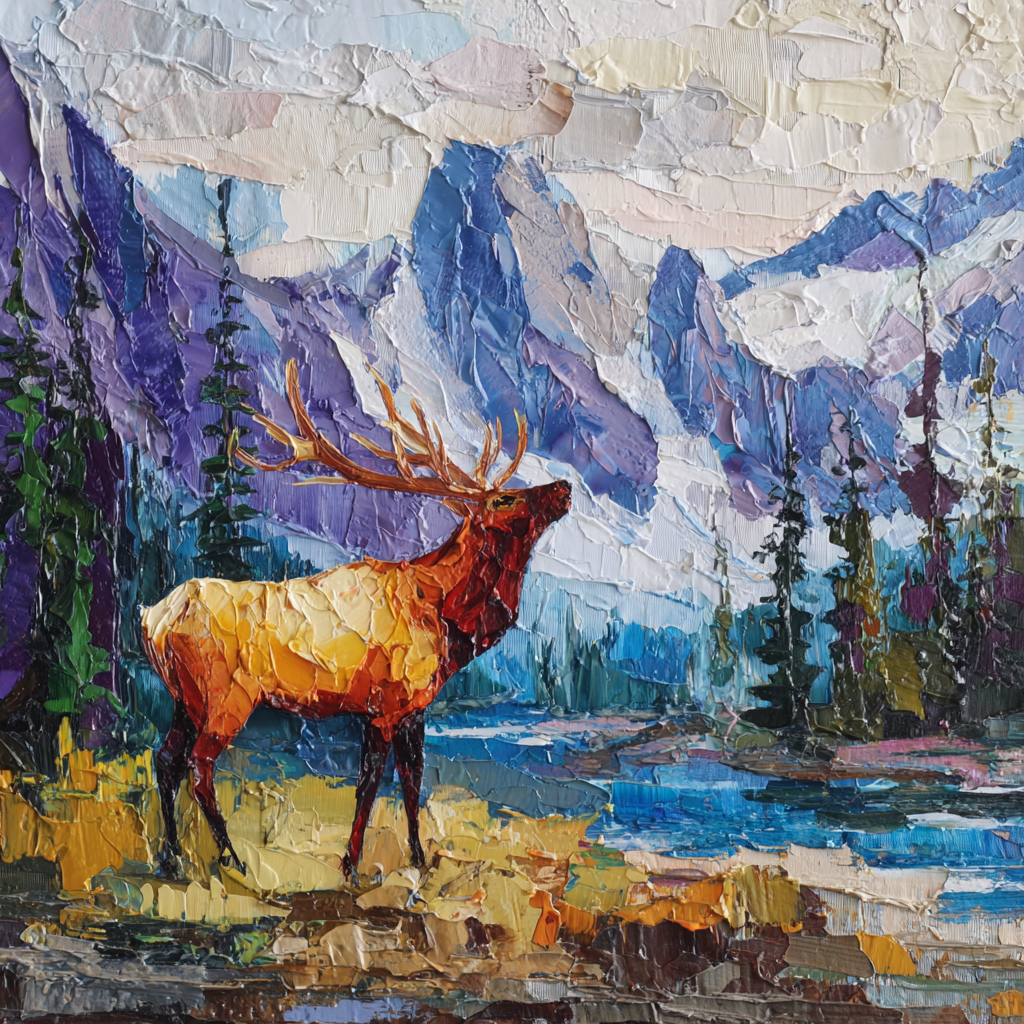
Elk populations in the American West are often described as declining. That description is accurate, but incomplete. What is declining is not simply the number of animals. What is failing is the system those animals depend on to remain whole across seasons.
Winter range carries more pressure than it can hold. Movement routes narrow into bottlenecks. Herds arrive where they can, not where they should.
Herds still exist. Hunting seasons still occur. Wildlife agencies still set population objectives.
But the landscape those herds move through no longer behaves as a connected organism.
That distinction changes the task.
We tend to approach elk decline as a question of cause. Predators. Hunting pressure. Weather. Disease. Each explanation carries some truth. Each can be measured. Each can be debated. Each becomes a complete explanation because it is visible.
But taken alone, they produce a pattern of response that remains fragmented because the animal they are meant to support is not.
Elk are not static populations. They are migratory systems. Their survival depends on movement between seasonal ranges that are geographically distinct and functionally interdependent. Winter range is not interchangeable with summer range. Migration corridors are not optional pathways. They are structural requirements.
When those connections weaken, the system does not collapse all at once. It degrades unevenly. Some herds remain stable. Others begin to show stress. Calf recruitment drops in one area. Body condition declines in another. Conflict increases where animals concentrate in the remaining viable habitat.
The signal is distributed. The underlying condition is not.
The work, then, is to understand decline as a coordination failure in a system that requires continuity to function.
We are in a dual condition: a wildlife management system that still operates with technical competence, and a landscape that has begun to lose the continuity that competence depends on. Agencies can adjust seasons, monitor herds, and respond to disease. But the ecological substrate those decisions rely on is becoming fragmented across ownership, infrastructure, and use.
That gap is where the system loses coherence.
This places us inside a set of pressures that do not resolve cleanly.
On one side is the need for economic continuity and land use. Western landscapes are not empty. They support ranching, transportation, housing, recreation, and energy development. These uses are not incidental. They are the conditions that allow communities to remain viable. The concern that conservation efforts may restrict land use, reduce flexibility, or impose costs is not irrational. For many communities, those constraints register as direct pressure on viability, not abstract inconvenience.
On the other side is the requirement for ecological continuity. Elk do not adapt to fragmentation by becoming something else. They continue to require access to seasonal forage, cover, and movement pathways that allow them to maintain body condition and reproduce. When those pathways are interrupted, the system compensates by concentrating animals into smaller areas, increasing stress, disease risk, and conflict.
Each side protects something essential. Each side, when pursued without the other, produces its own form of failure.
A landscape optimized entirely for human use becomes biologically brittle. Movement breaks down. Forage access narrows. Herds persist, but their resilience erodes. Management shifts from stewardship to maintenance.
A landscape optimized entirely for ecological function without regard for human use loses legitimacy. Participation narrows. Cooperation declines. Enforcement becomes the primary mechanism, and with it, resistance.
Neither pole can carry the system alone.
Holding them in right relation requires accepting that some forms of use will need to be constrained in specific places and times, and that those constraints must be structured in a way that keeps participation intact. That is not a philosophical position. It is a practical condition for continuity.
The pressure between urgency and sustainability sits inside this as well. Decline creates demand for immediate action. Reduce predators. Adjust hunting. Intervene quickly. These responses can stabilize specific herds in the short term. They also risk displacing attention from the slower work of restoring the landscape conditions that make herds resilient in the first place.
The desire for speed reflects a recognition that something is off. But when urgency dominates without structural repair, the system enters a cycle of repeated intervention without cumulative improvement.
We see this pattern in how the problem is experienced on the ground.
A rancher encounters more elk on limited winter range, increasing pressure on forage and fencing. A hunter sees fewer animals in a familiar unit and attributes it to a single visible factor. A wildlife manager adjusts quotas while tracking data that shows uneven herd performance across regions. A community debates predators while a highway corridor continues to interrupt migration.
Each perspective is grounded in reality. Each is also partial.
Animals hold in places longer than expected. Pressure accumulates on the same parcels. Movement becomes irregular rather than seasonal.
What is missing is a shared frame that can hold these experiences as expressions of the same structural condition rather than as competing explanations.
When that frame is absent, coordination fragments. People respond to the part of the system they can see. The system continues to degrade at the level they cannot.
Repair, then, takes on a specific form. It requires re-establishing continuity in the places where the system depends on it most: winter range, migration corridors, and calving habitat. It requires aligning decisions across jurisdictions that do not naturally coordinate. It requires that incentives support cooperation rather than isolation.
In practice, this looks less like a single intervention and more like a pattern of alignment. The unit of repair is not the parcel. It is the pathway between them.
Fences allow movement where movement is required. Road crossings appear where corridors are known to exist. Seasonal disturbance shifts in areas that function as bottlenecks. Land use decisions begin to recognize when a parcel sits inside a system rather than outside of it.
Where this alignment is present, the system begins to regain coherence. Elk move more predictably. Forage access stabilizes. Recruitment improves. Conflict does not disappear, but it becomes more manageable because the underlying conditions are less volatile.
Where it is absent, management becomes reactive. Each year introduces a new point of stress. Each response addresses a symptom. The structure remains unchanged.
But every mechanism of repair carries risk.
Coordination can become control when alignment replaces local judgment rather than supporting it. Incentives can distort behavior if they become ends rather than tools. Habitat protection can shift pressure onto neighboring areas, moving conflict rather than resolving it.
These risks are conditions to be held alongside the work, not reasons to avoid it.
The pattern here is not unique to elk.
When a system depends on continuity, fragmentation produces a similar experience. Each part continues to function in isolation. The whole begins to degrade. Responses focus on visible failures. The underlying structure remains unaddressed.
We see it in organizations where departments optimize locally while the institution loses coherence. We see it in relationships where individual needs are managed without a shared structure to hold them. We see it in civic systems where policy operates on fragments of reality that no longer connect.
The form repeats. The scale changes.
What we are facing with elk in the West is a version of that pattern expressed across a landscape large enough to make the fragmentation visible.
The animals have not changed. Their requirements have not changed. The system around them has.
We are managing herds inside landscapes that no longer function as systems.
That is the condition.
It is built.
DDS Solution Blueprint
PHASE 1: PROBLEM FRAMING
The Umbrella Problem
Elk population decline in parts of the American West is a multi-causal wildlife and land-use coordination problem in which some herds are falling below ecological or management targets because habitat, movement, disease, forage conditions, and management pressures are no longer aligned. State and federal agencies now manage elk in landscapes where migration corridors, winter range, and forage quality are increasingly stressed by development, roads, fences, recreation, drought, and disease.
The Multiple Drivers
● Habitat fragmentation and winter-range degradation
● Migration corridor disruption
● Drought, altered fire regimes, and forage stress
● Disease risk, especially chronic wasting disease (CWD)
● Localized recruitment pressure from predation and herd-specific management mismatch
This Blueprint Addresses:
The primary driver targeted here is habitat and movement-system failure: the decline that occurs when elk cannot reliably access high-quality seasonal range, move safely across mixed-ownership landscapes, and maintain body condition and recruitment under drought and disturbance pressure. This is the most scalable entry point because it improves survival, reproduction, and resilience across many herds at once, while leaving room for herd-specific disease and harvest responses.
Remaining Components
● CWD surveillance and disease containment
● Herd-specific harvest adjustment
● Predator-prey management in low-recruitment areas
● Supplemental feeding reform where relevant
● Local conflict with agriculture, recreation, and development
PHASE 2: DECONSTRUCTION
The Surface Symptom
What people see is fewer elk in some places, weaker calf recruitment in some herds, more unstable herd performance, and rising conflict over hunting opportunity, predators, land use, and disease response. Agencies then face a familiar pattern: some herds remain healthy, while others underperform because the landscape no longer functions as a coherent seasonal system.
The False Start
“Elk are declining because of one thing—predators, hunting, or weather.”
The Compassionate Reality
Smart and caring people have not failed because they lacked concern. They are trying to manage a migratory animal across federal land, private land, state authority, tribal interests, roads, fencing, recreation, ranching, housing growth, and climate volatility at the same time. The pressure is architectural: elk require connected seasonal landscapes, but our institutions are divided by ownership, mandate, and budget. So the system keeps responding in pieces to an animal that lives as a whole.
The Upstream Drivers
● Fragmented Seasonal Habitat
Actor(s): Federal land managers, private landowners, local governments, transportation agencies, recreation users
Incentive/Constraint: Housing growth, access demand, road use, fencing for operations, recreation economies, fragmented authority
Behavior: Development and disturbance accumulate in winter range and travel corridors; habitat treatment is episodic rather than system-level
Loop: As habitat quality drops, elk redistribute unevenly, creating more conflict and pressure for local fixes instead of landscape repair.
● Corridor Impedance
Actor(s): Highway agencies, landowners, fence operators, public-land managers
Incentive/Constraint: Infrastructure permanence, safety concerns, property boundaries, limited retrofit funding
Behavior: Roads, fences, and disturbance interrupt movement between seasonal ranges
Loop: Restricted movement reduces access to forage and cover, which lowers body condition and reproductive success, making herds less resilient to winter and drought.
● Forage Stress Under Drought and Landscape Change
Actor(s): Climate system, land managers, invasive species dynamics, fire-regime conditions
Incentive/Constraint: Drought is not negotiable; restoration is slower than degradation; invasive plants and altered fire patterns change available forage
Behavior: Elk encounter lower-quality or less reliable seasonal forage and cover
Loop: Poor nutrition weakens pregnancy rates, calf survival, and winter survival, which then amplifies the effect of any additional stressor.
● Disease Amplification
Actor(s): Wildlife agencies, feeding programs where relevant, dense aggregations of elk
Incentive/Constraint: Agencies must manage disease without collapsing short-term herd stability or public trust; some legacy practices aggregate animals
Behavior: CWD spreads across more western states, and concentrated animal contact can increase transmission risk
Loop: As prevalence rises, mortality and long-term population decline increase, which can provoke more reactive management and public conflict. CWD is fatal and has no treatment or vaccine.
● Localized Recruitment Suppression
Actor(s): Predators, wildlife agencies, hunters, landscape conditions
Incentive/Constraint: Agencies can influence harvest and some predator management, but weather and habitat heavily shape calf survival
Behavior: In some regions, predation interacts with weather and habitat to lower calf recruitment
Loop: Low recruitment reduces herd recovery capacity, which increases political pressure to treat predators as the sole cause, obscuring habitat and nutrition drivers.
The Entry Point
The structural lever is Western Elk Recovery Zones built around winter range, calving habitat, and mapped migration corridors. This is the hinge in the system because elk decline is often less about the animal in isolation than about whether the landscape still permits seasonal movement, refuge, and nutrition. When that hinge warps, everything above it begins to sag: body condition, calf recruitment, hunter opportunity, and tolerance among stakeholders. We intervene here because habitat and connectivity improvements can reduce multiple downstream stresses at once, while more symbolic fights over a single cause leave the circuit intact.
PHASE 3: DIALECTICS
The Core Tension(s)
Conservation Stability ↔ Human Land Use and Economic Continuity
Secondary: Urgency ↔ Sustainability
Secondary: Efficiency ↔ Humanity
Secondary: Innovation ↔ Tradition
The Weighting
Current State: 70% human land-use continuity / 30% migration-habitat continuity
Target State: 55% human land-use continuity / 45% migration-habitat continuity
Who Benefits: Elk herds in stressed landscapes, hunters seeking durable opportunity, ranchers and agencies that benefit from fewer emergency conflicts, communities that rely on functioning wildlife economies
Who Bears Cost: Some landowners, developers, transportation planners, motorized-recreation users, and agencies that must accept new limits, new coordination duties, or slower permitting in priority zones
What’s Sacrificed: Some short-term flexibility in fencing, routing, siting, recreation timing, and development speed; some immediate expectations for maximum local access
Dialectical Narrative
Neither pole can be abandoned. If we lose economic continuity, local cooperation collapses and the conservation mechanism loses legitimacy. If we lose habitat continuity, elk persist on paper but weaken in practice, and management becomes a cycle of emergency adjustments. The current weighting emerged because Western institutions are built to approve uses parcel by parcel, while elk require continuity across seasons and jurisdictions. Moving toward the target means accepting that some convenience, access, and siting freedom must be traded for corridor function and winter-range integrity. The genuine loss group is people whose land-use discretion narrows in priority areas. The redistributed emotional burden falls onto agencies and local leaders, who must now tell communities plainly that durable elk recovery requires limits, not only restoration slogans.
PHASE 4: MECHANISM & LEGITIMACY
Intervention Name
Western Elk Recovery Zone Compact
Mechanism
- Map priority recovery zones using existing state herd plans, USGS migration maps, winter-range data, and herd performance indicators. Each zone includes winter range, bottlenecks, corridor crossings, and calving-sensitive areas.
- Create zone compacts among the relevant state wildlife agency, federal land managers, tribes where applicable, county governments, transportation agencies, and willing private landowners. Each compact names one lead steward and one shared scorecard.
- Apply a habitat-and-movement first package inside each zone: fence modification or removal, highway crossing priorities, seasonal disturbance buffers, winter-range restoration, invasive-plant treatment, prescribed fire or thinning where ecologically appropriate, and forage/water restoration. Federal and state programs already fund versions of this work.
- Tie herd management to zone condition. When a herd is below objective and zone indicators are failing, antlerless harvest is reduced first, habitat treatment is accelerated, and recruitment is monitored before relying on symbolic blame. Where recruitment data show localized predation pressure, agencies can deploy narrow, time-limited predator actions rather than broad narratives.
- Embed disease triggers. In zones with CWD risk, agencies increase surveillance and adjust aggregation risks. Where supplemental feeding exists, use phased reforms tied to disease thresholds, habitat readiness, and winter severity planning. USGS modeling indicates that continued feeding can produce lower long-term elk populations than no-feeding or phased alternatives because of higher CWD transmission.
- Pay for cooperation, not only restriction. Use conservation easements, habitat grants, working-lands incentives, fence-cost sharing, crossing investments, and performance payments for corridor-friendly land stewardship. This protects legitimacy by distributing burden more fairly.
- Publish a zone dashboard each year: calf:cow ratios, adult survival, body-condition proxies where available, acres restored, corridor permeability, collision rates, CWD detections, and herd status relative to objective.
Authority
Primary authority sits with state wildlife agencies for herd objectives, seasons, and disease management; federal agencies for habitat actions on federal land; tribes for tribal lands and sovereign wildlife interests; counties and transportation agencies for land-use and road decisions; private landowners through voluntary agreements and easements. The compact does not replace authority. It aligns it.
Consent and Enforcement
Consent comes through compact participation, grant agreements, easements, habitat contracts, and formal consultation. Enforcement is mostly regulatory only where existing land-use or transportation authority already exists. The preferred design is incentive-heavy and restriction-light, except in core bottlenecks and calving/winter sanctuaries where seasonal limits may be necessary.
Costs
The cost is moderate to high, but the mechanism uses existing funding architecture: DOI migration-corridor grants, USDA and Forest Service habitat programs, state wildlife funds, transportation mitigation, and nonprofit partnership matching. The deeper cost is political: agencies must prioritize connectivity and winter range before local convenience.
Timeline
0–12 months: identify 10 highest-risk elk recovery zones; sign compacts; launch dashboard; begin fence and crossing triage.
1–3 years: complete priority corridor permeability projects, seasonal buffers, and winter-range restoration.
3–7 years: evaluate recruitment and population response; update harvest, disease, and disturbance rules based on dashboard triggers.
7+ years: institutionalize the compact model across western herds with recurring funding and adaptive thresholds.
Feasibility Check
This is feasible because the scientific basis, mapping tools, and funding precedents already exist. The difficulty is not invention. It is coordination and willingness to constrain certain land uses in the right places. That makes legitimacy the decisive beam: people must see that burdens are compensated, rules are geographically targeted, and trade-offs are being named honestly.
PHASE 5: READINESS & AUDIT
Psychological / Cultural Readiness: 5.5 / 10
Many Western communities support elk, but coalition stability fractures when recovery is translated into limits on access, fencing, development speed, or feeding practices. The culture can support restoration more easily than it can support enduring trade-offs.
Political Readiness: 6 / 10
There is existing federal-state architecture for migration corridor work and grant funding, but the coalition remains vulnerable to local backlash when compacts affect roads, recreation timing, or property discretion.
Operational Readiness: 7 / 10
The West already has herd plans, migration mapping, habitat programs, corridor policy, and research institutions. The operational challenge is integration, not absence of tools.
Institutional Readiness: 6.5 / 10
Agencies can do this, but shared accountability is still thinner than the ecological problem requires. Success depends on one named zone lead, public metrics, and standing agreements rather than ad hoc collaboration.
Audit Signals
● Calf recruitment trends improve in target herds
● Adult female survival stabilizes or rises
● Herd status moves toward objective
● Acres restored and fences modified increase
● Roadkill and corridor bottleneck failure decline
● CWD detection and aggregation risks are tracked and acted upon
● Local conflicts decrease rather than merely shift location
Kill-Switches
● If compacts become unfunded memoranda with no on-the-ground projects for 24 months, reset the zone and reduce scope
● If burden falls mainly on private landowners without compensation, pause expansion and rebalance incentives
● If disease triggers are politically ignored, separate habitat gains from disease claims and reopen the governance design
● If a zone shows no biological response after 5 years, require a driver review rather than doubling down on the same mechanism
Minimum Viable Mechanism
One high-risk herd, one mapped corridor/winter-range zone, one lead steward, one fence-and-crossing package, one seasonal disturbance rule, one shared dashboard, and one compensation mechanism for affected landowners.
PHASE 6: NARRATIVE SYNTHESIS
Elk decline in the West is often argued as though the system were choosing between care and practicality. That frame is too thin. What is actually happening is that we are asking a migratory animal to survive inside a landscape organized for fragmented human use, then wondering why herd performance becomes uneven and conflict intensifies. The problem is not simply too many predators, too little hunting, too much hunting, or bad weather. Those may matter in particular places, but the wider failure is structural continuity.
A workable response does not begin by demanding purity from one side. It begins by restoring the physical and institutional conditions under which elk can still behave like elk: move seasonally, reach forage, retain body condition, avoid chronic bottlenecks, and reproduce with enough stability that management is not trapped in permanent reaction. That requires honesty. Some people will lose flexibility in how they use certain places at certain times. Agencies will absorb more responsibility, more coordination, and more public discomfort. But the alternative is not neutrality. The alternative is continued drift, where habitat frays, disease risk grows, and every stressed herd becomes a new argument about which visible factor deserves blame.
The deeper dignity in this design is that it does not ask Western communities to stop using landscapes they depend on. It asks them to use those landscapes with enough structure that wildlife persistence remains real instead of ceremonial. The goal is not untouched wilderness or managerial control for its own sake. The goal is a landscape that can still hold both elk and people without pretending that no trade-off is being made.
PHASE 7: COMPONENT STATUS
Addressed in This Blueprint
● Habitat fragmentation and winter-range degradation
● Migration corridor disruption
● Drought and forage resilience through habitat restoration
● Governance alignment across jurisdictions
● Partial support for recruitment through habitat-first stabilization
● Partial support for disease management through embedded triggers
Partially Addressed
● CWD containment
● Predation in low-recruitment herds
● Harvest recalibration
● Working-lands conflict
Unresolved
● Full climate-scale drought adaptation across the West
● Broader housing and exurban growth pressure
● Long-horizon disease eradication, which is not currently available
● Political conflict where local legitimacy is too low to sustain place-based limits
PHASE 8: USER CHOICE
Choose one:
A) Re-run this blueprint with CWD as the primary driver
B) Re-run this blueprint with predation and calf recruitment as the primary driver
C) Re-run this blueprint for a specific state or herd
D) Convert this into a policy memo or public presentation
E) Run Dialectic and Deconstruction Solutions (DDS) on a different wildlife or land-use problem