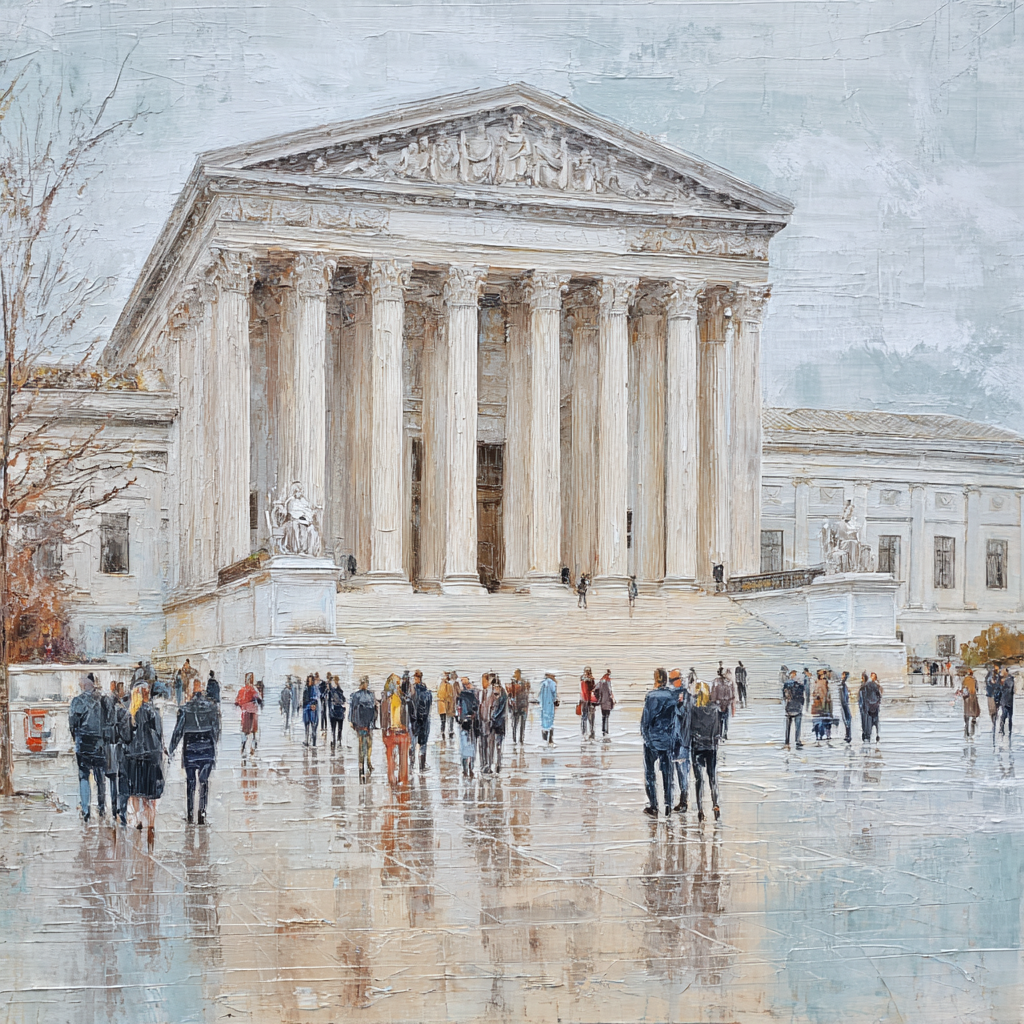
The Supreme Court of the United States is political in exactly the way its structure invites it to be. When constitutional authority is concentrated in nine seats, filled through presidential nomination and Senate contest, politics becomes one of the main pathways through which constitutional meaning is formed.
We can see the pattern clearly. Vacancies become national events. Confirmation hearings carry ideological weight before a justice has written a single opinion. Major rulings are interpreted through anticipated alignments before the reasoning itself has been metabolized. The Court still functions. The authority still holds. But the legitimacy that authority depends on is carrying more strain than the structure was designed to support.
That distinction changes the task.
We often treat the Court as a question of personnel. We debate whether a justice is principled enough, restrained enough, humane enough, or ideological in the right way. Those questions matter. They are also downstream. When a single appointment can shape constitutional doctrine across multiple domains for decades, the nomination process will absorb the full political charge of the society beneath it. The structure guarantees that result.
We are in a dual condition: the Court still provides essential constitutional finality, and the architecture through which it produces that finality no longer carries proportionate legitimacy for a country of this scale and complexity. We still need a final interpreter of law. We also need a broader and more visible field of constitutional reasoning than nine politically selected minds can provide on their own.
That is where the work becomes constructive.
Widening the Field Without Losing Finality
Constitutional law depends on something simple and difficult at the same time. It must be settled enough for a society to function, and open enough to remain aligned with the society it governs. Too much openness produces instability. Too much closure produces rigidity and loss of trust.
The current system protects finality well. It concentrates authority so decisions can land with clarity. That clarity allows lower courts, institutions, and citizens to organize their actions without constantly re-litigating first principles. This function matters. A system that cannot settle disputes cannot serve as law.
At the same time, concentration carries cost. When interpretive authority is held too narrowly, the legitimacy required to sustain that authority has to come from trust in the individuals themselves. As the country becomes larger, more diverse, and more politically saturated, that trust becomes harder to maintain at the scale required.
Both of these realities are valid. Finality must be preserved. Legitimacy must be expanded.
The direction forward is not to replace the Court. It is to expand the field of qualified constitutional reasoning around it, so that final decisions remain clear while the process that produces them becomes broader, more visible, and more accountable.
That is a different architecture of judgment.
A Broader Constitutional Intelligence
We now have the capacity to coordinate expertise at scale. That capacity allows us to build a structured field of constitutional reasoning that did not exist when the Court was designed.
This could take the form of a national pool of highly credentialed legal experts:
- experienced attorneys and jurists
- demonstrated work in constitutional or appellate law
- validated reasoning ability through examination and written analysis
- capacity to argue multiple sides of complex constitutional questions with coherence
From this pool, a large subset—on the order of a thousand reviewers—could be randomly selected for each major Supreme Court case.
Each reviewer would:
- examine the full case record
- produce a ruling
- write a structured legal opinion
These are not informal inputs. They are disciplined, professional judgments.
What changes is not the presence of expertise. It is its scale and visibility.
Making Constitutional Reasoning Visible
The output of this broader review body would be published as a structured public record:
- all opinions available in full
- reasoning clustered into major themes
- minority positions surfaced when they demonstrate strong coherence
This creates something the current system does not provide:
a visible map of how the legal mind of the country actually distributes itself across a constitutional question.
We would no longer only receive a decision.
We would see the reasoning field that surrounds it.
This does not weaken the Court. It strengthens the environment in which its authority operates.
The Court as Final Integrator
The Court remains. Its role becomes more precise.
It issues the final ruling.
It carries the responsibility of constitutional finality.
But it does so in relationship to a broader field of reasoning.
When the Court’s decision aligns with the distributed panel, legitimacy is reinforced through visible convergence.
When it diverges, something important becomes available.
At defined thresholds of divergence, the Court would be required to engage directly with the strongest opposing reasoning emerging from the broader panel:
- identifying major dissent themes
- responding to them explicitly in its written opinion
- clarifying why its interpretation holds in relation to those arguments
At higher levels of divergence, a structured review period could be triggered, allowing the Court to reconsider the ruling in light of the broader reasoning field.
Finality remains intact.
Accountability becomes visible.
That distinction changes how authority is experienced.
Selection and Renewal
If constitutional authority is understood as a function of demonstrated reasoning rather than political inheritance, the pathway into the Court begins to shift.
The current model, in which the President of the United States selects nominees, made sense within an earlier structure. In the present context, it creates a direct pathway for ideological investment into the judiciary.
A more aligned approach would:
- draw candidates from within a validated field of constitutional expertise
- incorporate peer evaluation and demonstrated judicial reasoning over time
- introduce an independent selection mechanism grounded in legal legitimacy
Term limits follow naturally from this same orientation.
Fixed terms maintain continuity while allowing renewal.
They reduce the structural weight of any single appointment.
They bring the Court into closer rhythm with the society it serves.
What This Builds
This is not a shift toward populism. It is a shift toward expanded professional participation.
It preserves expertise.
It increases interpretive bandwidth.
It makes constitutional reasoning more legible to the public.
We already understand this pattern in other domains.
A strong institution does not lose authority by remaining in contact with a broader field of intelligence. It becomes more stable. It becomes more trustworthy. It becomes more capable of adapting without losing coherence.
The same principle applies here.
The Shape of the Next Problem
Every expansion of authority creates a new center that must be held carefully.
A credentialing system introduces questions about who defines qualification.
A synthesis layer introduces questions about how reasoning is grouped and interpreted.
A larger field introduces the challenge of maintaining coherence without collapsing into fragmentation.
These are real design problems.
They are also tractable problems.
They occur at a level where visibility, auditability, and refinement are possible in ways that concentrated authority does not easily allow.
Where This Leaves Us
We are not facing a failure of individuals.
We are encountering the limits of a structure that has outlived the conditions it was designed for.
The Court still carries a necessary function.
The society around it has changed in scale, complexity, and capacity.
A constitutional system does not need to abandon its foundations to evolve.
It needs to extend them.
The question is no longer whether nine justices can decide constitutional questions.
They can.
The question is whether nine justices should be asked to carry the full weight of constitutional meaning for a nation of this size on their own.
That weight can now be shared without losing clarity.
And once that becomes possible, it becomes part of the responsibility of the system itself.
DIALECTIC AND DECONSTRUCTION SOLUTIONS (DDS) BLUEPRINT ═══════════════════════════════════════════════════════════════
Problem: The Supreme Court’s concentrated appointment-based authority has become structurally misaligned with the scale, diversity, and legitimacy demands of a nation it was not designed to govern at this size.
───────────────────────────────────────────────────────────────
PHASE 1: PROBLEM FRAMING ─────────────────────────
The Umbrella Problem
The legitimacy of constitutional interpretation in the United States is eroding because the Court’s authority structure — nine justices, lifetime appointments, Presidential nomination, Senate confirmation — concentrates interpretive power in a way that no longer holds proportionate weight for a nation of 335 million people across an ideologically diverse, high-complexity democracy.
───────────────────────
The Multiple Drivers
- Presidential nomination as a direct pathway for ideological capture of the judiciary
- Lifetime tenure as an independence mechanism with structural distortions not present in the original context
- Concentration of interpretive authority creating an epistemic bandwidth problem
- Senate confirmation dysfunction escalating the political stakes of every vacancy
- No external accountability mechanism obligating engagement with the strongest counter-reasoning available
───────────────────────
This Blueprint Addresses:
The structural architecture of constitutional authority — specifically, whether the Court’s concentrated, appointment-based judgment can be supplemented through a distributed qualified reasoning framework that expands the epistemic basis and accountability structure of constitutional decision-making.
───────────────────────
Remaining Components:
- Senate confirmation dysfunction and process reform
- Lifetime tenure / term limits mechanism design
- Presidential nomination power and executive control of judicial selection
- Lower federal court appointment backlog and pipeline legitimacy
Bounded Ambition Note: This blueprint addresses the architecture of interpretive authority. It does not attempt to resolve Senate confirmation dysfunction, lifetime tenure distortion, or the lower court pipeline, which each require separate interventions.
PHASE 2: DECONSTRUCTION ────────────────────────
The Surface Symptom
Supreme Court confirmation hearings have become high-stakes political battles that dominate news cycles and produce justices perceived as partisan actors before they write a single opinion. Rulings on contested constitutional questions track ideological bench composition reliably enough to be predicted in advance. Legitimacy crises follow major decisions not because the public disagrees with the outcome but because they no longer trust the process that produced it.
───────────────────────
The False Start
The problem is that we have the wrong justices — or that individual justices are insufficiently independent.
The Compassionate Reality
What we are carrying is not a character problem. The people within this system — justices, senators, presidents, legal advocates — are largely responding rationally to the incentives the structure has built around them. A President who declines to use a vacancy strategically leaves political capital on the table. A senator who does not contest an opposing nomination abandons leverage that the next majority will use without hesitation. The norms that once contained these incentives were not neutral — they were holdovers from a less polarized institutional environment that no longer exists. The architecture was not designed to withstand the pressure now being placed on it, and the people inside it cannot repair what the structure itself is producing.
───────────────────────
The Upstream Drivers
- Presidential Nomination as Ideological Investment
- Actor(s): President of the United States
- Incentive/Constraint: Maximize ideological alignment of the Court with executive priorities and coalition commitments; nomination is one of the few durable presidential legacies
- Behavior: Evaluate nominees primarily on anticipated rulings; time nominations to maximize political advantage; treat vacancies as coalition-building opportunities
- Loop: Each appointment raises the stakes of the next → confirmation battles intensify → the Court’s perceived political character deepens → each subsequent vacancy is contested more aggressively
- Senate Confirmation as Identity Conflict
- Actor(s): Senate Majority and Minority
- Incentive/Constraint: Block ideologically opposed nominees; signal coalition loyalty; minimize risk of adverse constitutional precedent for a generation
- Behavior: Transform hearings into ideological vetting processes; deploy procedural tools — filibuster, nuclear option, seat-holding — as political instruments
- Loop: Escalating procedural warfare normalizes each new tactic → institutional norms erode → next majority treats any available tool as legitimate → the confirmation process loses the pretense of judicial evaluation
- Lifetime Tenure as Unintended Distortion
- Actor(s): Sitting Justices
- Incentive/Constraint: Preserve influence; control the conditions of succession; protect legacy and ideological contribution
- Behavior: Time retirements strategically to ensure replacement by an aligned President
- Loop: Strategic retirement reduces judicial independence from executive politics → reinforces public perception of justices as political actors in robes → legitimacy erodes further
- Concentrated Interpretive Authority as Bandwidth Problem
- Actor(s): The constitutional architecture itself (structural driver, not behavioral)
- Incentive/Constraint: Any single appointment reshapes constitutional doctrine for decades across all contested domains simultaneously
- Behavior: Litigants and advocacy organizations strategically select and sequence cases for SCOTUS consideration; the Court becomes the only authoritative arbiter of contested constitutional meaning
- Loop: High stakes concentrate at SCOTUS → no institutional competition on interpretive authority → stakes per appointment rise further with each precedent-setting term
- Legitimacy-by-Finality as Cultural Expectation
- Actor(s): American political culture, legal institutions, media
- Incentive/Constraint: Seek definitive resolution of contested values; reduce interpretive ambiguity; treat SCOTUS as oracle rather than institution
- Behavior: Frame SCOTUS rulings as final constitutional truth regardless of reasoning quality; treat disagreement with outcomes as resistance to law rather than engagement with reasoning
- Loop: Concentrated legitimacy reinforces concentrated authority → society has no framework for evaluating reasoning quality, only outcomes → each contested ruling generates legitimacy crisis without structural mechanism for resolution
───────────────────────
The Entry Point
The selection process is the most visible pressure point, but it is downstream. The structural lever is the concentration of interpretive authority itself — the architecture that makes each appointment so consequential that it cannot help but become a political crisis. When any single vacancy carries the weight of multiple generations of constitutional doctrine across all contested domains simultaneously, the nomination process is not failing to be apolitical. It is doing exactly what that level of concentrated stakes demands. The hinge is not who sits on the Court. It is how many qualified minds constitute constitutional judgment, and whether the reasoning field is visible enough to be contested and trusted.
PHASE 3: DIALECTICS ────────────────────
Problem Type Assessment: Blueprint Mode — concrete institutional actors, resource requirements, policy trade-offs, and implementable mechanisms with identifiable stakeholders. Percentage weighting format applies. Philosophical depth is carried in the dialectical narrative, not the mode classification.
───────────────────────
The Core Tension
Primary: Concentrated Authority ↔ Distributed Legitimacy
Secondary: Finality ↔ Responsiveness
Secondary (Universal Library): Innovation ↔ Tradition
───────────────────────
The Weighting
Concentrated Authority ↔ Distributed Legitimacy Current State: 88% Concentrated / 12% Distributed Target State: 60% Concentrated / 40% Distributed
Who Benefits: Citizens whose trust in constitutional interpretation depends on perceiving the process as broader than nine politically appointed minds; credentialed legal professionals who gain formal civic participation in constitutional reasoning; lower federal court judges who receive precedent grounded in a visible, contested reasoning field Who Bears Cost: Sitting justices (authority dilution); Presidential administrations (loss of nomination leverage); elite legal establishment (prestige and pipeline disruption) What’s Sacrificed: Decisional simplicity and the cultural comfort of a single authoritative source of constitutional meaning
Finality ↔ Responsiveness Current State: 82% Finality / 18% Responsiveness Target State: 68% Finality / 32% Responsiveness
Who Benefits: Litigants and lower courts that need clearer accountability for the reasoning behind rulings, not just the rulings themselves Who Bears Cost: Legal practitioners and institutions that have built practice frameworks around SCOTUS as definitive and stable — divergence protocols add procedural uncertainty What’s Sacrificed: Decisional speed and the clean finality that allows downstream actors to plan around rulings without qualification
Innovation ↔ Tradition Current State: 15% Innovation / 85% Tradition Target State: 42% Innovation / 58% Tradition
Who Benefits: Reform advocates, younger legal professionals, citizens experiencing the current architecture as a structural obstacle to democratic self-governance Who Bears Cost: Legal institutions and practitioners whose authority derives from the stability and continuity of existing constitutional hierarchy What’s Sacrificed: The predictability and coherence that accumulated constitutional tradition provides as a navigational framework
───────────────────────
Dialectical Narrative
Concentrated Authority ↔ Distributed Legitimacy
Concentrated authority protects something that distributed systems routinely fail to provide: finality. Constitutional law is not philosophy seminar — it is the framework within which people organize their lives, institutions organize their operations, and governments act. A system that cannot settle contested questions, even imperfectly, cannot function as law. The Court’s concentrated authority, insulated from electoral pressure, provides the decisional consistency that lower courts, legislators, and citizens need to operate. The independence the concentration enables is not incidental to the rule of law — it is partially constitutive of it.
Distributed legitimacy protects something different: the coherence between constitutional authority and constitutional trust. A system in which nine people hold the definitive interpretation of fundamental rights for 335 million depends on those nine people being perceived as arriving at their conclusions through reasoning that transcends their political formation. When that perception is no longer available — when rulings are predictable from bench composition, when appointments are openly contested as ideological investments — the authority remains but the legitimacy has migrated. Concentrated authority without distributed legitimacy is power wearing the face of law.
The current weighting was not chosen for these reasons. It was designed for a nation of approximately 4 million people in an era of information scarcity and limited coordination capacity, where concentrating authority in a small insulated body was a structural solution to faction and instability. That solution made sense within its constraints. The constraints have changed — the scale, complexity, and ideological diversity of the society the Court now governs have expanded far beyond the architecture’s original load-bearing assumptions. The imbalance did not come from corruption. It came from a design that outlasted its context.
The cost of staying at 88% concentration is the continued erosion of the legitimacy that makes constitutional authority functional rather than merely formal. A court whose rulings are contested not on legal but on political grounds — not “this reasoning is wrong” but “this is what that coalition does” — has lost something that cannot be recovered through better appointments or stronger norms. It can only be recovered through structural change.
Rebalancing to 60/40 means, in practice: a qualified reasoning field large enough to demonstrate that constitutional interpretation is a genuine disciplinary activity rather than a political one; public visibility into how that field distributes across questions; and a Court whose authority is grounded in its demonstrated capacity to engage the strongest available counter-reasoning, not merely to produce final verdicts.
The cost of this shift falls on those whose professional identity and institutional standing are built around the Court’s concentrated mystique. That is a real weight placed on real people for structural rather than personal reasons, and it deserves to be named as such.
What DDS holds: The Court must remain the final integrator — finality is not optional. But the field it integrates must be wider, more visible, and more structurally accountable than nine minds. The goal is not to democratize constitutional interpretation. It is to make the expertise that governs constitutional interpretation honest about its own breadth.
───────────────────────
Finality ↔ Responsiveness
Finality holds up more than it gets credit for. Every stakeholder below the Supreme Court — lower federal courts, state courts, legislators, litigants, legal counsel — depends on settled constitutional doctrine to operate. A system that cannot produce binding resolution of contested questions does not produce more democracy; it produces more litigation, more uncertainty, and more of the paralysis that makes governance impossible. The Court’s capacity to say “this question is answered” is not merely a power claim — it is a load-bearing function of the legal system.
Responsiveness protects something that finality, pushed too far, destroys: the capacity of constitutional doctrine to track the evolving understanding of the society it governs. Rights that were once narrow have been expanded. Doctrines once considered settled have been overturned. The living quality of constitutional interpretation — its ability to develop over time in response to new legal argument, new evidence, and new social context — is not a flaw in the design. It is what distinguishes a constitutional system from a fixed code. The problem is not that doctrine changes; it is that the current structure provides no mechanism for distinguishing between change that reflects deeper constitutional reasoning and change that reflects bench replacement.
The current imbalance toward finality was not incidental. It was a deliberate design choice rooted in the Founders’ fear of perpetual instability — a legal system that can always be relitigated is not a legal system, it is an ongoing political process. That logic remains valid. But finality without responsiveness produces its own instability: doctrine that cannot adapt becomes doctrine that is overtly contested, and contested doctrine without a legitimate mechanism for revision becomes doctrine that is simply resisted.
The divergence protocols in this framework are the mechanism for responsible responsiveness — not overriding finality, but ensuring that when the Court departs significantly from the distributed field of qualified reasoning, it must account for that departure rather than issue it without engagement. This shifts the balance modestly toward responsiveness without abandoning finality’s essential function.
What DDS holds: Finality is a structural requirement, not a value preference. The question is not whether the Court should have the final word — it should. The question is whether “final” can mean “accountable” rather than “uncontestable.”
───────────────────────
Innovation ↔ Tradition
Constitutional tradition holds up a form of continuity that is not nostalgic — it is functional. Legal stability depends on actors being able to predict how constitutional doctrine will be applied. The rule of law is not just the rules; it is the reasonable expectation that rules mean what they said last time. Accumulated constitutional precedent, whatever its flaws, provides the navigational framework that allows a complex society to operate without adjudicating first principles from scratch in every dispute. Tradition here is not conservatism; it is the carrying capacity of established legal meaning.
Innovation holds up the corresponding truth: tradition that insulates structural failure is not stability — it is lag. Constitutional design optimized for the constraints of 1787 is not wisdom applied to 2026; it is the application of one century’s solutions to another century’s problems. The distributed review framework is not a rejection of constitutional tradition. It is a recognition that the tradition was always oriented toward legitimate, durable, reasoned constitutional authority — and that the structural means of achieving that goal must be updated as the conditions change.
The current weighting toward tradition is not irrational. Legal systems are inherently conservative — they are supposed to be resistant to rapid change, because rapid constitutional change destabilizes everything built on top of it. The challenge is distinguishing between tradition that preserves legitimate constitutional continuity and tradition that preserves a structural arrangement past the point where it serves its own stated values.
What DDS holds: This is a reorientation within the tradition’s own logic, not a departure from it. The constitutional tradition has always held that interpretive authority must be legitimate to be binding. If the existing structure no longer produces that legitimacy reliably, reform is not innovation — it is the tradition maintaining itself.
───────────────────────
Intersection
These three tensions are not parallel. They amplify each other in a specific configuration. The Innovation ↔ Tradition tension determines whether structural reform is even legible as a legitimate option — if tradition is treated as sacrosanct, the Concentrated Authority ↔ Distributed Legitimacy tension cannot be addressed through structural means at all. The Finality ↔ Responsiveness tension determines the specific mechanism of any reform — because any distribution of authority must still produce final, actionable constitutional decisions, the degree to which the distributed framework can bind or constrain the Court is bounded by finality’s requirements. What this means in practice is that the innovation question must be resolved first (reform is constitutional tradition maintaining itself), which opens the authority question (distribution is a legitimate structural adjustment), which then shapes the finality question (the distributed framework supplements, does not replace, the Court’s binding authority). The tensions are layered, not parallel, and the sequence of resolution matters.
PHASE 4: THE MECHANISM ──────────────────────
Title: The Constitutional Distributed Review Protocol (CDRP) Strategy: Establish a federally chartered Constitutional Review Pool of credentialed legal experts who generate parallel constitutional judgments for SCOTUS cases, synthesized through an auditable public reasoning layer, with divergence accountability protocols that reframe the Court from sole generator to final integrator of constitutional reasoning.
───────────────────────
Action Steps
Step 1: Charter the Constitutional Review Pool Congress establishes the Constitutional Review Board (CRB) through enabling legislation, housed within the Administrative Office of the United States Courts. The CRB develops and administers a national constitutional certification process: active bar membership, 10+ years legal experience, significant constitutional or appellate work, bar examination performance metrics, written judicial opinions on landmark cases scored by blind review for coherence and legal grounding, and a cognitive flexibility assessment requiring applicants to argue both sides of complex constitutional questions with sustained accuracy and depth. Target pool size: 20,000 credentialed members. Pool composition is publicly reported on an annual basis, disaggregated by interpretive tradition using a validated classification rubric.
Rationale: The pool’s legitimacy depends entirely on its credentialing architecture. A large body of unverified participants produces noise; a large body of verified participants with demonstrated capacity to hold interpretive tension produces the broader reasoning field the mechanism requires. The cognitive flexibility test is the structural center — it is not a political neutrality test, which is neither achievable nor desirable. It is a test of whether someone can reason beyond their immediate alignment, which is the minimum condition for participation in genuine constitutional deliberation.
Step 2: Deploy the Distributed Case Review Process For each SCOTUS case following cert grant, the CRB randomly selects 1,000 pool members, screens for conflicts of interest, and provides access to full case materials. Each participant submits a formal ruling and written opinion within a defined submission window. Participation is compensated at professional rates (estimated $500 per case review). Non-submission without documented cause triggers a pool status review.
Rationale: Compensation and accountability structures are not peripheral — they determine whether participation is substantive or performative. An unfunded civic duty generates perfunctory submissions. A compensated professional obligation generates the quality of reasoning the mechanism requires. The random selection preserves independence; the conflict screening preserves integrity; the submission window preserves operability within the Court’s existing schedule.
Step 3: Build the AI-Assisted Synthesis and Public Reasoning Database A government-contracted AI synthesis platform aggregates the 1,000 opinions per case, identifies dominant reasoning clusters, surfaces minority positions with strong coherence scores, and maps thematic patterns across the full body of work. The synthesis methodology is publicly auditable, with source code and classification logic available for independent review. All 1,000 opinions are published in full in a searchable public database organized by legal logic, case type, and interpretive tradition. The synthesis platform is operated by the Federal Judicial Center; the public database is published as a federal open-data resource.
Rationale: The synthesis layer is the highest-risk component of the framework. Deciding what counts as “dominant reasoning” is an interpretive act with constitutional weight, and embedding that act in a proprietary algorithm removes it from democratic accountability. Auditable methodology is not optional — it is the condition under which the synthesis layer’s outputs can be contested, refined, and trusted. The database, separately, generates value independent of the synthesis: it is the first publicly visible record of what the qualified legal mind of the country actually produces in response to contested constitutional questions.
Step 4: Establish Divergence Accountability Protocols When the Court’s ruling diverges significantly from the distributed panel — operationalized as the Court ruling against 65% or more of the 1,000-member panel — the Court must formally address the dominant opposing reasoning clusters in its published opinion. At a 75% divergence threshold, the Court’s opinion must identify and respond directly to the top three coherence-scored dissent clusters from the distributed panel. At 80% divergence, the Judicial Conference is notified and a mandatory six-month review period is triggered, during which the case may be reconsidered with a formal panel response process. These protocols apply in advisory form initially (requiring engagement, not binding reconsideration); binding reconsideration authority requires constitutional amendment.
Rationale: The divergence protocol is the accountability mechanism that transforms the distributed panel from a transparency exercise into a structural check. Without it, the Court can note the panel’s conclusions and proceed unchanged — which would validate the framework’s appearance while nullifying its function. With it, the Court’s reasoning must engage the strongest available counter-arguments, not merely produce verdicts. This shifts “final” from “unaccountable” to “accountable to the strongest opposing reasoning available.”
Step 5: Reform Judicial Selection Through an Independent Judicial Commission Simultaneously with pool establishment, introduce legislation creating an Independent Judicial Commission (IJC) with authority to evaluate and recommend SCOTUS nominees based on demonstrated performance in constitutional reasoning, peer evaluation within the legal community, and quality of judicial work over time. The IJC is composed of retired federal judges, law school deans (selected by peer vote, not appointment), and bar association representatives — with no serving elected official eligible for membership. Presidential nomination is retained in the near term (requires constitutional amendment to remove); the IJC functions as a formal credentialing and vetting body whose recommendations carry statutory weight in the confirmation process. Constitutional amendment to transfer full selection authority to the IJC is pursued through Stage 2.
Rationale: Selection reform and pool reform are structurally interdependent. A distributed review panel supplements the Court’s reasoning; selection reform addresses the composition of the nine minds doing the final integration. Both are necessary. Separating them into sequential rather than parallel initiatives slows the structural change without improving the sequencing logic.
───────────────────────
The Leadership
Steward: Director of the Constitutional Review Board (new Senate-confirmed position within the Administrative Office of the United States Courts)
Facilitator: Director of the Federal Judicial Center (existing position; the FJC is the research and education agency of the federal judiciary, with established relationships across the judiciary and legal academy)
The CRB Director carries ultimate accountability for pool integrity, credentialing standards, and divergence protocol administration. The FJC Director manages the synthesis platform, public database, and coordination with SCOTUS case scheduling. These roles are not interchangeable — pool integrity and public communication are distinct functions that benefit from separate institutional homes with clear accountability lines.
───────────────────────
The Timeline
Phase 1 (Stabilization): Months 0-24 Congressional authorization; CRB establishment; credentialing protocol design and external validation; cognitive flexibility test development and bias audit; one-term voluntary pilot with 500 attorneys reviewing all cert-granted cases in advisory capacity; FJC synthesis platform prototype deployed; public database launched with pilot opinions.
Phase 2 (Implementation): Months 24-60 Full 20,000-person pool operational; 1,000-reviewer per case process active for all SCOTUS cases; AI synthesis platform at full scale; divergence accountability protocols in advisory effect; IJC legislation introduced; annual Divergence Report published; pool composition audit released.
Phase 3 (Review): Month 60 First structural audit of pool composition, participation quality, and divergence patterns; independent assessment of synthesis methodology; Congressional oversight hearing; determination of amendment pathway viability for binding divergence protocols and IJC selection authority.
───────────────────────
The Cost Analysis
Financial Cost: One-term voluntary pilot: approximately $32,500 in review compensation (500 reviewers × 65 cases × $500). Full implementation: 1,000 reviewers × 65 cases × $500 = $32.5M annually in review compensation. Total annual operating budget including AI synthesis platform, administrative overhead, FJC integration, database infrastructure, and CRB staffing: estimated $80-120M per year. For reference, the federal judiciary’s total FY2024 appropriation was approximately $8.6 billion; this represents approximately 1% of that budget.
Opportunity Cost: The political capital invested in building the coalition for this framework is capital not spent on the narrower near-term reform of term limits, which has broader bipartisan support and a shorter implementation arc. These are not mutually exclusive, but they compete for the same advocacy infrastructure and legislative bandwidth.
Human Cost: CRB and FJC administrators absorb substantially increased coordination demands. Pool members carry significant new civic and professional responsibility — their rulings become public record and are subject to synthesis, classification, and public scrutiny. SCOTUS justices writing divergence responses face new institutional pressure that affects the conditions of deliberation.
───────────────────────
Key Assumptions
- Cognitive flexibility can be reliably tested through argumentation exercises without introducing scoring bias that systematically favors particular interpretive traditions If wrong: Replace single-examination selection with multi-round structured deliberation cohorts, accepting longer credentialing timelines
- Random selection from a qualified 20,000-person pool produces genuine ideological diversity over time without organized manipulation If wrong: Move to stratified random selection with diversity parameters built into the pool structure; impose disclosure requirements on coordinated application campaigns
- AI synthesis methodology can be made sufficiently auditable to be publicly contested and corrected If wrong: Replace AI synthesis with rotating human editorial panels drawn from the pool, accepting reduced scalability and increased coordination cost
- Legal professionals will participate substantively for financial compensation without excessive professional reputational risk If wrong: Pool participation must be formalized as federal civic service with explicit employment protections and confidentiality options for intermediate deliberative work
- Congress has authority to establish an advisory constitutional review panel without constitutional amendment, under Article III’s “inferior courts” language and Article I’s “necessary and proper” clause If wrong: The full framework proceeds via constitutional amendment; advisory components with no binding effect on the Court may still proceed by statute pending clarification
- The divergence protocol, in advisory form, generates sufficient reputational pressure to meaningfully affect the Court’s reasoning processes If wrong: Binding divergence authority must be constitutionally grounded before the protocol achieves its intended function; advisory-only version requires longer legitimacy arc
───────────────────────
The Evidence
Primary Analog: None (Novel Intervention)
Theoretical Basis:
- Condorcet’s Jury Theorem (Marquis de Condorcet, 1785) — groups of independently competent decision-makers outperform smaller groups in accuracy under independence conditions; the theorem predicts that a 1,000-person panel of individually competent legal reasoners will produce more accurate constitutional judgments than a 9-person panel, provided independence is maintained
- James Fishkin’s Deliberative Polling methodology (Stanford Center for Deliberative Democracy, 1988–present) — structured engagement of randomly selected groups produces more nuanced and convergent judgments than unstructured aggregation or elite selection; demonstrates that process design, not just participant selection, determines output quality
Why it applies: The Constitutional Review Pool is designed to aggregate independent qualified judgment at scale under structured conditions — precisely the domain both models address. Neither analog is constitutional in scale or legal in domain; both are theoretically load-bearing for the mechanism’s core logic. The absence of a direct precedent is acknowledged, not concealed.
───────────────────────
The Emotional Consequence
Relief Profile: Citizens who have experienced constitutional rulings as arriving from a remote, insulated authority — handed down rather than arrived at — would encounter the public reasoning database as a form of inclusion. Not a vote, but visibility: the capacity to locate their own legal reasoning within a documented national field of qualified thought. What changes is the phenomenology of constitutional decision-making. Rather than receiving judgment, citizens can see where the country’s legal mind distributed itself on the same question — where convergence was strong, where it fractured, and why. For legal professionals outside the elite pipeline, the pool represents a form of civic standing within constitutional interpretation that has not previously existed. This is not symbolic. It is a structural reallocation of participation.
Burden Profile: Sitting justices and the elite federal judiciary would experience this as structural diminishment — and that experience would be accurate. The authority that currently flows entirely through nine minds, and through the narrow pipeline of elite law schools, clerkship programs, and Presidential selection processes, would be distributed into a larger, less controllable, less exclusively prestigious field. The loss is real: professional identity, institutional standing, and the particular form of authority that comes from being one of nine people whose word is final on questions of fundamental constitutional meaning. If the divergence protocols create accountability pressure on opinion-writing, the conditions of deliberation change in ways that are not costless. Preserving dignity in this transition requires naming the loss honestly rather than insisting it is merely procedural.
───────────────────────
Feasibility Check
Authority & Hiring
- Who has the power to create the CRB Director position? Congress, through enabling legislation; position requires Senate confirmation under Article II’s “inferior officers” clause
- New position: requires a new appropriations line within the federal judiciary budget, housed under the Administrative Office of the United States Courts
- FJC facilitation role uses an existing position; pool administration demands require dedicated staffing additions within FJC, not displacement of existing programs
Enforcement Teeth
- What happens if the CRB Director doesn’t follow through? Senate oversight, annual appropriations review, Judicial Conference administrative intervention
- What leverage does the FJC Director have when stakeholders resist? Initially, reputational and convening authority only — the advisory framework has no binding compulsion. Resistance from the legal establishment is containable in advisory phase; binding authority requires subsequent legislation or amendment
- Who can cancel this program if it fails? Congress (defunding); Judicial Conference (administrative restructuring); CRB Director (operational pause and redesign trigger)
Coordination Reality
- How many meetings per month? Approximately 8-12 coordination meetings per month at the CRB/FJC level during active case cycles; asynchronous reviewer participation ongoing throughout term
- What existing structure gets replaced or absorbed? FJC’s existing amicus analysis and judicial education research functions can be partially integrated; no existing committee is eliminated
- Who owns the shared data/reporting system? CRB Director holds policy authority; FJC serves as technical administrator and public-facing operator of the reasoning database
Decision Authority
- Who makes the final call when operational conflict arises? CRB Director for day-to-day operations; Judicial Conference for structural/institutional disputes; Congressional oversight committees for statutory interpretation questions
- Escalation pathway: CRB Director → Judicial Conference → Senate Judiciary Committee
- Where does budget authority sit? House and Senate Appropriations Subcommittees on the Judiciary
PHASE 5: READINESS & AUDIT ───────────────────────────
Readiness Scores
Psychological/Social Capacity: 4/10 The legal profession carries deep investment in the prestige architecture of concentrated judicial authority. Accepting distributed judgment as legitimate — rather than diluted — requires a professional reorientation that conflicts with identity structures built over careers. Public capacity for this shift is higher (legitimacy crisis has already unseated some deference), but it is not organized into the coalition form reform requires.
Political/Institutional Alignment: 2/10 The binding components require constitutional amendment for their most consequential provisions. No existing political coalition supports this framework at scale. Presidential administrations of both parties have structural interest in preserving nomination power. Senate leadership has structural interest in preserving confirmation leverage. These are not incidental obstacles; they are load-bearing features of the current political architecture.
Operational/Resource Feasibility: 5/10 The advisory pilot is operationally feasible with existing federal infrastructure. The FJC and Administrative Office have the institutional scaffolding to absorb advisory program coordination. AI synthesis at the required quality level is technically achievable. The full binding mechanism requires infrastructure that does not yet exist and legal authority that has not yet been established.
Cultural/Existential Fit: 3/10 American legal culture treats SCOTUS as a quasi-constitutional oracle — an institution whose authority derives partly from its mystique as the singular voice of constitutional meaning. The distributed panel challenges that cultural script at a fundamental level. Reframing the Court as final integrator rather than sole generator is a significant cultural shift, not a procedural update, and cultural shifts of this depth require demonstrated legitimacy before adoption, not adoption to generate legitimacy.
───────────────────────
Verdict: PAUSE
───────────────────────
Readiness Narrative
The structural legitimacy crisis this framework addresses is real and deepening. But the implementation pathway for its binding components runs directly through constitutional amendment — the highest-friction political mechanism in American governance — at a moment when institutional trust is near historic lows and political polarization makes amendment-level coalition-building extraordinarily difficult. The legal establishment that would need to carry early implementation has strong identity and economic incentives to resist. The political coalitions required for the heavier constitutional work do not currently exist in any organized form. The PAUSE verdict is not a rejection of the framework’s logic. It is a recognition that the demonstration layer must precede the structural layer — not as a compromise, but because structural reform of this scope requires an evidentiary record, a professional coalition, and public familiarity that do not exist yet and cannot be assumed into existence.
───────────────────────
Minimum Viable Mechanism
- Action: Commission a one-term voluntary advisory pilot — recruit 500 credentialed attorneys to review all cert-granted SCOTUS cases during a single term, submit formal rulings and written opinions, and publish results in a structured public database alongside actual Court decisions, with no binding effect on the Court
- Timeline: 18-24 months from congressional authorization
- Success Metric: ≥80% submission rate among recruited reviewers; minimum 25% representation across major interpretive traditions in pool rulings on contested cases; ≥50,000 substantive public interactions with the reasoning database within six months of launch
- Failure Metric: Submission rate below 60%; pool rulings clustering above 75% within a single interpretive tradition; evidence of organized coordinated manipulation of volunteer recruitment; no measurable divergence from actual Court outcomes (indicating the pool is not independently reasoning but following rather than generating constitutional judgment)
───────────────────────
The Fractal Audit
The Recursive Loop: Every mechanism for distributing power creates a new center of power. The constitutional review pool was designed to address the problem of too few minds holding too much interpretive authority — and in doing so, it creates a credentialing architecture that holds precisely the same kind of authority, less visibly. Whoever designs the cognitive flexibility test is deciding what constitutional intelligence looks like. Whoever builds the synthesis layer is deciding what counts as dominant reasoning. The AI that surfaces the “three most coherent dissent clusters” is making interpretive choices with constitutional weight and no public accountability for those choices. The problem does not disappear in this framework; it migrates to a level that is harder to see, harder to contest, and potentially more consequential than nine justices in a hearing room. This is not a reason to abandon the structure. It is a reason to design the credentialing and synthesis layers with the same structural scrutiny — the same insistence on visibility, contestability, and accountability — that the framework applies to the Court itself.
The New Problem Node: The Credentialing Capture Problem — the entity responsible for designing and scoring the pool’s admission process holds a new form of concentrated constitutional influence, less visible and more technically obscured than Presidential nomination, and potentially more durable.
The Kill Switch: If, within five years of full pool implementation, the ideological distribution of pool rulings on a validated 25-case test set — stratified across originalist, textualist, and living constitutionalist frameworks — shows clustering below 25% representation of any major interpretive tradition, halt pool operations and trigger an independent audit of the credentialing, examination, and synthesis architecture. The mechanism exists to distribute constitutional judgment. If it concentrates it, it has failed its stated purpose regardless of what it looks like from the outside.
───────────────────────
Capacity Impact Assessment
This framework, well-designed, builds collective capacity across all three dimensions rather than trading one for another. It develops future problem-solving capacity by establishing a precedent that institutional legitimacy can be earned through demonstrated reasoning rather than structural authority — a template applicable to other governance problems where concentrated expert authority has outgrown its legitimacy base. It builds dialectical maturity by making visible the genuine plurality of qualified constitutional interpretation: when citizens can see not just what the Court decided but what 1,000 credentialed legal minds produced on the same question, the cultural assumption that any ruling is self-evidently correct becomes harder to sustain — which is not destabilization but maturation. It strengthens relational responsibility by redistributing the burden of constitutional legitimacy from a small, insulated group to a large, professionally accountable field, creating structural conditions for citizenship-as-participation rather than citizenship-as-deference. The risk is that public accessibility to a 1,000-opinion dataset, without corresponding civic education infrastructure, produces overwhelm and fragmentation rather than capacity. The database and the capacity to use it must be built together. One without the other produces either opacity or noise.
PHASE 6: THE NARRATIVE SYNTHESIS ─────────────────────────────────
The Human Good Made Real
This blueprint serves constitutional legitimacy — not as an abstract principle but as the lived experience that the rules structuring collective life emerged from a process honest enough to be trusted, broad enough to be seen, and rigorous enough to be respected.
───────────────────────
We have not built a broken system. We have built a functioning system around a premise that no longer holds — that nine people, selected through a political process and holding lifetime appointments, can carry the full weight of constitutional meaning for a nation of 335 million people across the full range of contested rights, values, and powers without the architecture itself becoming a source of conflict. The appointment battles, the ideological tracking of rulings, the legitimacy crises that follow major decisions — these are not failures of the individuals within the system. They are the system working correctly within an architecture designed for a different century, a different scale, and a different information environment.
The entry point is not the people. It is the concentration. When any single vacancy carries the weight of multiple generations of constitutional doctrine across every contested domain simultaneously, it cannot help but become a proxy war for the full range of contested political values in the society. The nomination process is not failing to be apolitical. It is doing exactly what that level of concentrated structural stakes demands. The hinge is not who sits on the Court. It is the number of qualified minds that constitute constitutional judgment — and whether the reasoning field producing that judgment is visible enough to be contested and durable enough to be trusted.
Two things are genuinely true here, and neither can be abandoned without real cost. Constitutional authority needs concentration to produce finality — the clarity that settles disputes, guides lower courts, and allows a society to act collectively rather than indefinitely re-litigate fundamental questions. And constitutional authority needs to be wider than nine minds if it is to carry the legitimacy that finality requires at this scale. We arrived at the current imbalance through a different calculation — the Framers understood concentration as protection from faction, and in the world they were designing for, that logic held. What has changed is not the value of independence. It is the mismatch between the load the concentrated structure is asked to carry and the legitimacy that structure can produce for a society this large and this diverse.
The Constitutional Distributed Review Protocol does not replace the Court. It reframes the Court from sole generator of constitutional judgment to final integrator of a much larger, more visible reasoning field. What changes first, without constitutional amendment, is visibility. Citizens begin to see not just what the Court decided, but what 1,000 credentialed legal minds across the country produced in response to the same question — where they converged, where they fractured, and why. Divergence between the panel and the Court becomes data rather than scandal. Over time, as the advisory record builds, the political conditions for deeper structural reform become tractable: binding divergence protocols, independent judicial selection, term limits constitutionally secured. This is a long arc. It is also the only honest one, because structural change of this depth requires a demonstrated record before it can be institutionalized, not institutionalization before there is a record to justify it.
The framework imposes real weight on real people. Sitting justices would experience distributed judgment as a dilution of the authority that defines their role. The elite legal establishment — law schools, clerkship pipelines, appellate bar — carries a prestige architecture built partly on the Court’s concentrated mystique, and restructuring that concentration redistributes institutional capital in ways that are not merely procedural. Presidential administrations lose nomination leverage; Senates lose confirmation leverage. These are structural interests with structural capacity to resist, and naming them honestly is not cynicism — it is the minimum condition for designing a reform process that accounts for what it is actually asking people to give up. What makes this rebalancing worth the weight it places on those shoulders is not that they have done something wrong. It is that the structure they occupy is no longer adequate to the problem it was designed to solve — and that maintaining constitutional legitimacy now requires accepting the cost of its own reform.
And the new challenge will not be smaller than the old one. We will have traded the problem of nine minds holding too much visible authority for the problem of a credentialing architecture holding too much invisible power over who counts as constitutionally qualified. The synthesis layer will carry interpretive influence that is harder to see than nine justices in a courtroom. This is not a reason to resist the framework. It is the nature of structural progress: it moves problems to a more manageable level, not to an easier one. The measure of success is not whether the new structure is perfect. It is whether it is more visible, more contestable, and more honest about its own limits than the one it replaces.
PHASE 7: COMPONENT STATUS ──────────────────────────
Umbrella Problem: The legitimacy crisis of concentrated constitutional authority in the Supreme Court of the United States
This blueprint addressed: The structural architecture of interpretive authority — whether the concentration of constitutional judgment in nine appointed justices can be supplemented through a distributed qualified reasoning framework to broaden the epistemic basis and accountability structure of constitutional decision-making
Remaining Components:
- Senate confirmation dysfunction and process reform
- Lifetime tenure / term limits mechanism design
- Presidential nomination power and executive control of judicial selection
- Lower federal court appointment backlog and pipeline legitimacy
Status: Component 1 of 4 complete.
PHASE 8: HOW WOULD YOU LIKE TO PROCEED?
[A] Publish This Blueprint (Mark component complete)
[B] Solve Next Component (Term limits mechanism design — the most politically viable remaining driver)
[C] Revise This Blueprint
- Deconstruction (Change entry point)
- Dialectics (Shift weighting or add tensions)
- Mechanism (Design a different solution / alternative mechanism)
- Feasibility (Strengthen implementation grounding)
- Narrative (Adjust tone or emphasis)
[D] Clarify Before Proceeding
[E] Start Fresh (New umbrella problem)