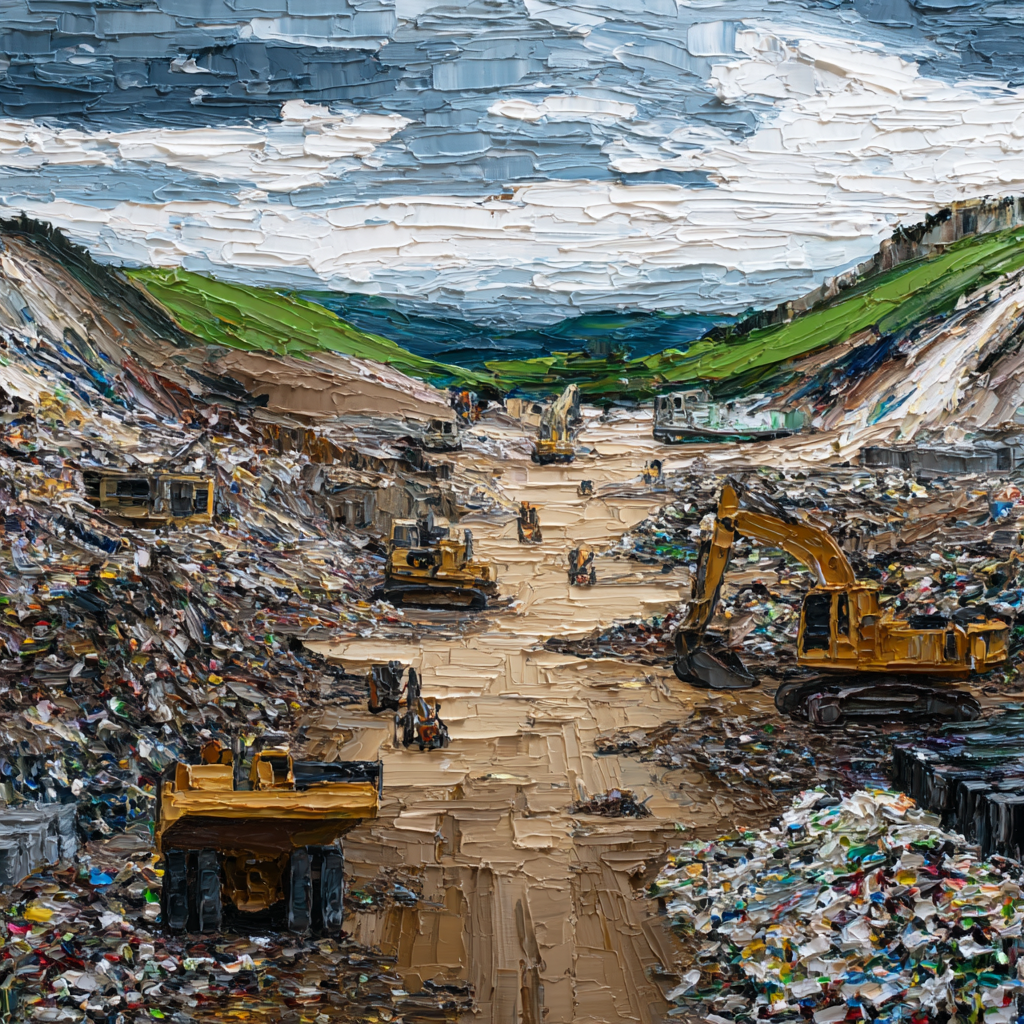
The United States has the technical capacity to manage waste far more intelligently than it currently does. Each year, roughly 292 million tons of solid waste move through our systems — close to five pounds per person per day. The overall performance grade lands around C+, which sounds tolerable until we notice what that grade is really describing: not excellence, but a workable equilibrium held together by legacy infrastructure and political inertia.
What we call “the waste problem” is rarely a question of missing technology. It’s a question of governance architecture — the rules, incentives, and permissions that decide which options can be tried, where, and at what scale.
We are still arguing nationally over what should be designed regionally.
The Real Driver: Strategy Fragmentation Disguised as a Single National Argument
Our waste debate tends to collapse into a false binary: recycling vs. incineration vs. landfilling. But those are not competing moral identities. They are tools. And tools have conditions.
Dense cities with limited land face different constraints than rural regions with space. Coastal metro areas have different environmental and logistical pressures than landlocked states. Regions with heavy manufacturing have different upstream leverage than regions dominated by services and tourism.
When a single national conversation tries to govern radically different contexts, the result is predictable: stall, compromise, and default. The default in the U.S. is still heavily landfill-centered, not because it is optimal, but because it is already built.
This blueprint names the active driver clearly:
- Nationally centralized policy debate prevents regionally optimized waste-to-asset strategies.
That is a governance problem, not a disposal problem.
Deconstruction: Why the System Keeps Reproducing Itself
Three reinforcing loops hold the status quo in place:
- Regulatory uniformity loop: federal frameworks prize standardization because it reduces complexity and prevents “race to the bottom” dynamics. But when uniform rules fit some regions poorly, compliance becomes expensive or performative, and the mismatch intensifies.
- Sunk-cost economic loop: waste companies profit most from existing contracts and existing landfills. Large strategy shifts require capital reinvestment, so lobbying pressure often favors continuity.
- Local resistance loop: new waste infrastructure triggers fear and opposition across political lines. Incineration raises health anxieties. Sorting facilities raise traffic concerns. Landfills trigger property value and contamination fears. Projects stall, nothing changes, and landfills remain the path of least resistance.
None of these behaviors are irrational in isolation. Together they create a stable form of dysfunction: the system persists because the incentives and permissions are aligned for persistence.
Dialectics: A Federal Floor That Protects, and Regional Freedom That Adapts
Primary tension: Regional autonomy ↔ Federal uniformity
The original purpose of federal environmental standards was legitimate: in the 1970s, state-level governance failures were severe and visible. National floors prevented externalization of harm and enforced baseline public health protections.
The problem now is developmental. The strength of uniformity has become a constraint on adaptation.
The shift this blueprint proposes is not “less regulation.” It is different regulation:
- Current weighting: 25% regional autonomy / 75% federal uniformity
- Target weighting: 55% regional autonomy / 45% federal floor
In practice, that means:
- Federal government sets minimum outcome standards (air, water, safety, public health, environmental justice thresholds).
- Regions gain permission to exceed those floors through context-appropriate strategy (waste-to-energy, ultra-fine sorting, producer responsibility, landfill mining, or hybrids).
- Performance is evaluated by outcomes, not ideology.
Secondary tension: Urgency ↔ Sustainability
Landfills win in the short term because they solve disposal quickly and cheaply. That creates permanent urgency — we keep generating waste, we keep burying it, and the architecture never evolves.
- Current weighting: 85% urgency / 15% sustainability
- Target weighting: 40% urgency / 60% sustainability
The developmental move is treating landfills as transitional infrastructure and potential future resource reserves, rather than default endpoints.
Mechanism: Regional Waste Strategy Authorization Framework
The mechanism here is clean and credible: a voluntary certification pathway.
Regions (states or metro areas above a population threshold) can submit strategies demonstrating they will meet or exceed federal environmental floors. Certified regions receive:
- Regulatory flexibility (methods can differ)
- Access to competitive federal infrastructure grants
- A shift toward outcome monitoring rather than method enforcement
Key design features matter:
- Independent technical review panels (engineers, public health experts, environmental economists)
- Environmental justice analysis as a required condition, not an optional add-on
- Quarterly outcome reporting with revocation if standards are missed
- A default option for non-participating regions to remain under current federal rules
This is a governance design that preserves legitimacy: federal protection remains intact, while readiness and capacity gain somewhere to go.
What Gets Better if This Works
If the mechanism functions, we gain several structural improvements:
- Regions can match strategy to geography, rather than forcing every place into the same argument.
- Innovation becomes visible, not theoretical — early adopters demonstrate what’s possible.
- Federal standards can evolve upward over time based on proven regional success, rather than political debate alone.
- Waste becomes a recovery stream, not only a liability — energy, materials, and long-term value become achievable outputs.
This is not utopian. It is operational.
Where the Real Difficulty Lives: Trust and Siting
The readiness assessment in your blueprint is honest: political will is modest, and social trust is low. Facility siting remains the main bottleneck, especially where communities have historical reasons to distrust environmental promises.
This is the part worth stating plainly:
Even the best governance design will fail if communities don’t believe the burden will be shared fairly.
So the pilot model is not just pragmatic; it is ethically necessary. A small cohort of early-adopter regions, with elevated federal match and technical assistance, gives the system a chance to build credibility before scaling.
Practice precedes legitimacy.
Fractal Risks: What This Creates Next
This blueprint also names its own shadow clearly:
- Regional autonomy can amplify inequality unless capital and technical assistance are intentionally redistributive.
- Successful regionalization could erode federal authority in other environmental domains if floors weaken.
- Industry may demand federal preemption if producer responsibility becomes too fragmented.
- NIMBY backlash could stall the entire pipeline, regardless of technical merit.
These are not deal-breakers. They are design requirements. They tell us where governance must be sturdy: floor-setting, equity enforcement, interstate coordination, and community trust mechanisms.
The DDS Principle Beneath the Waste Problem
This is a governance literacy problem in disguise.
Can we build a system that allows multiple evidence-based strategies to coexist while holding shared standards?
Can we permit adaptation without permitting abandonment?
Can we protect the commons while still allowing context to shape methods?
A mature system doesn’t resolve complexity by simplifying the world. It resolves complexity by building structures that can hold it.
Waste is not only what we throw away. It is a daily measure of how capable we are of designing what happens next.
DIALECTIC AND DECONSTRUCTION SOLUTIONS (DDS) BLUEPRINT
Problem: U.S. Solid Waste System — Regional Strategy Fragmentation
Component: Waste governance structure (single-approach national debate vs. context-differentiated regional strategies)
Date: February 2026
PHASE 1: PROBLEM FRAMING
The U.S. solid waste system grades C+ on performance but masks structural dysfunction. We generate 292 million tons of waste annually—4.9 pounds per person per day, the highest rate globally. Half goes to landfills, a third gets recycled, and twelve percent is incinerated. This distribution reflects not evidence-based strategy but historical inertia and political stalemate.
Meanwhile, proven alternatives exist at scale. Singapore incinerates ninety percent of waste, generates electricity for 125,000 homes, uses ash to build islands, and operates virtually zero landfills. Germany eliminated municipal waste landfilling in 2005 and achieves a sixty-seven percent recycling rate through producer responsibility laws. Some Japanese towns reach eighty percent recycling through ultra-fine sorting systems with forty-five categories. Landfill mining studies from 2023 show single sites recovering 34,000 metric tons of metal worth $7.4 million while extending landfill life by thirty years.
The core problem is not lack of technical solutions but governance architecture. The U.S. waste debate operates as a false binary—recycle vs. incinerate vs. landfill—when geography and context demand differentiated regional strategies. Dense cities need different solutions than rural areas. Coastal regions face different constraints than landlocked states. We treat waste as a disposal problem rather than a resource recovery opportunity, and we debate nationally what should be decided regionally.
Umbrella Problem: Waste management inefficiency and environmental harm
Active Driver (this blueprint): Nationally centralized policy debate preventing regionally appropriate waste-to-asset strategies
Underlying Question: How do we shift from debating “which single solution” to implementing regionally appropriate waste-to-asset strategies that match solutions to contexts?
PHASE 2: DECONSTRUCTION
The sustaining driver is structural: federal environmental frameworks prioritize uniformity over adaptability, creating incentive misalignment between national regulation and regional optimization.
Actor: Federal EPA and state environmental agencies
Incentive/Constraint: Uniformity reduces regulatory complexity and prevents “race to the bottom” dynamics where states compete by weakening environmental standards
Behavior: Design one-size-fits-all standards (recycling targets, landfill regulations, incineration emissions limits) that apply regardless of population density, geography, or existing infrastructure
Loop: When standards don’t fit regional context, compliance becomes expensive or impossible → localities seek exemptions or ignore standards → federal authority weakens → EPA tightens uniformity to maintain control → regional mismatch intensifies
Secondary Loop (Economic):
Actor: Waste management companies
Incentive: Maximize profit through existing infrastructure (landfills already built, contracts already signed)
Behavior: Lobby against policy changes that would require capital reinvestment in new technologies (incineration with energy recovery, advanced sorting facilities)
Loop: Regulatory inertia protects sunk costs → companies continue landfilling → waste-to-asset infrastructure never scales → economic case for transition weakens → political will collapses
Tertiary Loop (Cultural):
Actor: Local communities
Constraint: NIMBY dynamics (not in my backyard)
Behavior: Oppose waste infrastructure regardless of type (incinerators trigger health fears, recycling facilities trigger truck traffic concerns, landfill expansion triggers property value anxiety)
Loop: Every solution faces local opposition → permitting stalls → projects die → waste continues to landfills → problem persists but remains invisible (out of sight) → political pressure never builds for alternatives
These three loops reinforce national paralysis. Federal uniformity prevents regional experimentation. Economic interests protect status quo. Local resistance blocks new infrastructure. The result is a system stuck in 1970s waste management paradigm while global best practices evolve past us.
PHASE 3: DIALECTICS
Primary Tension: INDIVIDUAL ↔ COLLECTIVE (Autonomy ↔ Belonging)
Current Weighting: 25% Individual (Regional Autonomy) / 75% Collective (Federal Uniformity)
How We Got Here:
Federal environmental law emerged in the 1970s in response to egregious state-level failures—rivers catching fire, toxic dumps poisoning communities, municipalities shipping waste across state lines to avoid regulation. The federal government asserted primacy to prevent states from externalizing environmental harm. This was not arbitrary control but a response to documented governance failure at regional scales.
Cost of Staying Here:
Singapore-style solutions cannot emerge in dense coastal cities because federal incineration standards were written for worst-case rural scenarios. German-style producer responsibility cannot be piloted in California because federal packaging laws preempt state experimentation. Japanese-style ultra-fine sorting cannot scale in Vermont because federal recycling definitions are too coarse to recognize forty-five waste categories. The collective protection (uniform standards) now prevents the individual adaptation (regional optimization) that current conditions require.
Target Weighting: 55% Individual (Regional Autonomy) / 45% Collective (Federal Floor)
What This Means in Practice:
Federal government sets minimum environmental performance standards (emissions limits, contamination thresholds, safety protocols) but allows states and metro regions to exceed these floors through context-appropriate strategies. Dense cities can pursue Singapore-model incineration with energy recovery. Moderate-density states can pursue Germany-model producer responsibility. Rural regions with land availability can pursue enhanced landfilling with methane capture and eventual mining.
Who Bears the Cost:
Federal regulators lose uniformity (harder to enforce, requires monitoring diverse approaches). Incumbent waste companies lose regulatory protection (states can now demand infrastructure upgrades). Environmental advocacy groups lose simplicity (can no longer campaign for single national solution). Rural states gain flexibility but lose ability to externalize costs through cheap landfilling.
Relief Profile:
Metro regions gain agency to solve waste crises using density-appropriate tools. States with high environmental commitment gain permission to lead rather than wait for federal consensus. Future generations inherit asset-recovery infrastructure rather than perpetual landfill liabilities.
Burden Profile:
Federal agencies must build capacity to audit outcomes rather than dictate methods. Poor states risk falling behind if they lack capital for infrastructure transition (requires federal investment support, not just regulatory freedom). Communities near new facilities (incinerators, sorting plants) bear localized environmental burden even if regional outcomes improve.
Secondary Tension: URGENCY ↔ SUSTAINABILITY (Relief ↔ Root Cause)
Current Weighting: 85% Urgency / 15% Sustainability
We continue landfilling because it solves the immediate disposal problem cheaply. We delay infrastructure investment because root-cause solutions (waste-to-energy plants, advanced sorting facilities) require upfront capital and multi-year timelines. The result is permanent urgency—every week we generate waste, every week we landfill, nothing changes.
Target Weighting: 40% Urgency / 60% Sustainability
Transition period allows continued landfilling where no alternative exists, but policy architecture shifts incentives toward asset-recovery infrastructure. Landfills gradually become strategic reserves (sites for future mining) rather than permanent disposal endpoints.
PHASE 4: MECHANISM
Core Intervention: Regional Waste Strategy Authorization Framework
Federal EPA maintains minimum environmental performance standards (air quality, water contamination, public health) but authorizes states and metro regions to design waste strategies optimized for their density, geography, and economic context. Regions submit strategy proposals demonstrating how their approach meets or exceeds federal environmental floors. Approved regions receive regulatory flexibility plus competitive federal infrastructure grants. Non-participating regions default to current federal standards.
Mechanism Components:
Strategy Certification Process:
States or metro regions (population 500,000+) submit waste strategy proposals to EPA showing: (1) how approach meets federal environmental minimums, (2) evidence from analogous jurisdictions (Singapore for density, Germany for producer responsibility, etc.), (3) ten-year infrastructure investment plan, (4) community engagement documentation showing local support exceeds threshold, (5) environmental justice analysis proving burden distribution doesn’t concentrate harm in vulnerable communities.
EPA reviews proposals using independent technical panel (waste engineers, public health experts, environmental economists). Certification granted if environmental performance equals or exceeds federal baseline. Regions can pursue any strategy—incineration with energy recovery, advanced sorting, producer responsibility mandates, landfill mining, or hybrid approaches—as long as air, water, and safety standards hold.
Federal Infrastructure Investment:
Certified regions access competitive federal grants (50% match for capital infrastructure). Priority given to regions demonstrating: waste-to-asset conversion (energy generation, materials recovery), environmental justice gains (reducing burden on historically impacted communities), cross-regional coordination (multi-state compacts for economies of scale).
Investment structured as loans for wealthy regions, grants for poor regions, ensuring capital access doesn’t correlate with existing wealth. Facilities must meet prevailing wage requirements and include community benefit agreements.
Monitoring and Enforcement:
EPA shifts from input control (dictating methods) to outcome monitoring (measuring results). Regions report quarterly on: waste diversion rates, emissions levels, contamination incidents, energy generation (if applicable), community health indicators, cost per ton processed.
If region falls below federal environmental floor for two consecutive quarters, certification revoked and region returns to federal default standards. This creates accountability without micromanagement—regions innovate freely but face consequences if performance deteriorates.
Default Federal Standards:
Regions that don’t pursue certification continue under existing federal waste regulations. No region forced to participate, but status quo regions lose access to infrastructure grants and cannot exceed federal standards even if they want to (prevents free-riding).
Analogs:
- Regional Clean Air Strategy (California): California received federal waiver to set stricter vehicle emissions standards than EPA baseline. Other states can adopt California standards or federal baseline. Model demonstrates federal floor + regional exceeding works without creating regulatory chaos. California’s approach drove national automotive innovation while protecting state autonomy.
- Renewable Energy Portfolio Standards (State-Level): No federal renewable mandate, but twenty-nine states set their own targets ranging from 10% to 100% renewable electricity. Demonstrates diversity of approaches based on geography (solar in Southwest, wind in Plains states, hydro in Pacific Northwest). Outcomes vary but innovation accelerates when regions optimize for context.
- Singapore Waste-to-Energy Model (1979-present): Shifted from 100% landfilling to 90% incineration with energy recovery over twenty years. Four incineration plants generate electricity for 125,000 homes. Ash used for island reclamation (creating land from waste). Virtually zero landfills despite being tiny island nation. Key success factor: government authority to override local NIMBY resistance through centralized planning. Not directly replicable in U.S. federal system, but proves density-appropriate solutions work at scale.
- Germany Extended Producer Responsibility (1991-present): Manufacturers responsible for packaging waste. Created private recycling infrastructure (Der Grüne Punkt system). Recycling rate rose from 3% (1991) to 67% (2020). Eliminated municipal waste landfilling by 2005. Key success factor: uniform national mandate within single country. Harder to replicate across U.S. states unless federal government sets producer responsibility floor.
Leadership Structure:
- Steward (Decision Authority): State environmental agency director or metro regional waste authority board. Holds final approval on regional strategy and accountability for outcomes.
- Facilitator (Process Management): Regional planning commissions coordinate multi-stakeholder input, manage community engagement, oversee strategy development timeline.
- Subject Matter Experts: Waste engineers, environmental economists, public health researchers provide technical analysis on feasibility, cost, and environmental performance.
- Community Representatives: Environmental justice organizations, neighborhood councils, labor unions ensure vulnerable communities have voice in facility siting and burden distribution decisions.
Timeline:
- Months 1-6 (Strategy Development): Regions conduct stakeholder engagement, analyze existing infrastructure, model different approaches (incineration, advanced sorting, producer responsibility), prepare certification proposals.
- Months 7-12 (Federal Review): EPA technical panels evaluate proposals, request revisions, issue certifications. First cohort of early-adopter regions approved.
- Years 1-3 (Infrastructure Investment): Certified regions access federal grants, begin capital projects (building incineration plants, upgrading sorting facilities, retrofitting landfills for methane capture). Continued landfilling occurs during transition but with declining trajectory.
- Years 3-10 (Implementation & Iteration): New infrastructure comes online. Waste diversion increases. EPA monitors outcomes quarterly. High-performing regions become models for others. Underperforming regions receive technical assistance or lose certification.
- Years 10+ (Maturity & Evolution): Regional approaches stabilize. Gestalt effects emerge (regions learn from each other, technologies improve through competition, best practices compound). Federal standards evolve based on highest-performing regional outcomes becoming new floor.
Cost Analysis:
- Financial (Federal): $15-20 billion over ten years for competitive infrastructure grants. Revenue partially offset by reducing EPA enforcement bureaucracy (fewer compliance disputes when regions design own strategies). Cost comparable to single federal infrastructure mandate but generates regional ownership rather than resentment.
- Financial (Regional): Varies by strategy. Singapore-style incineration plant costs $500M-$1B (serves metro area 1-2 million). Germany-style producer responsibility shifts costs to manufacturers. Landfill mining generates revenue from recovered metals. Regions choose based on their cost-benefit analysis, not federal diktat.
- Human (Regulatory): EPA retrains enforcement staff from compliance auditing to outcome monitoring. States build capacity for strategy design and stakeholder engagement. Industry retrains workforce from landfill operation to advanced sorting or plant operation (requires managed transition to avoid job losses).
- Opportunity Cost: Federal resources go to waste infrastructure instead of other environmental priorities (clean water, habitat restoration). Attention goes to waste governance instead of other policy areas. Trade-off justified if waste-to-asset conversion generates electricity, reduces methane emissions, and recovers valuable materials.
Feasibility Check:
- Authority: EPA has existing authority under Clean Air Act and Resource Conservation and Recovery Act to set environmental standards and grant waivers. California vehicle emissions waiver proves federal government can authorize regional exceeding of federal baseline. Mechanism requires EPA rule-making, not new legislation (though congressional appropriation needed for infrastructure grants).
- What Gets Deprioritized: EPA’s uniform command-and-control enforcement. Current federal waste regulations assume one-size-fits-all approach. This shifts to performance-based standards with regional flexibility. Industry loses regulatory predictability (must adapt to different state rules) but gains opportunity to influence regional design processes.
- Key Assumptions:
- Regions have capacity to design competent strategies (not all states have technical expertise—may require federal technical assistance funding)
- Federal environmental floors are meaningful (if floors too low, creates race to bottom; if too high, eliminates regional flexibility)
- Community engagement prevents NIMBY collapse (facility siting remains hardest political challenge)
- Infrastructure investment generates economic returns (waste-to-energy, materials recovery must prove financially viable at scale)
- Regional competition drives innovation rather than inequality (wealthy regions don’t pull ahead while poor regions fall behind—requires equity mechanisms)
If regional capacity assumption wrong → federal government provides more technical assistance rather than mandate uniformity.
If environmental floor assumption wrong → iterate standards based on data from early-adopter regions.
If NIMBY assumption wrong → federal government may need override authority for critical facilities (politically difficult).
If economic viability assumption wrong → some regions may need sustained subsidy rather than one-time infrastructure grants.
Success Metrics (Kill Switch):
If after five years:
- Average regional waste-to-landfill rate has not decreased by at least 15% from baseline, OR
- Air quality violations increase in certified regions compared to non-certified regions, OR
- Environmental justice communities experience statistically significant health impacts from new facilities, OR
- Less than ten regions pursue certification (indicating mechanism isn’t attractive or feasible),
THEN: Pause regional authorization, conduct independent evaluation, either redesign mechanism or revert to strengthened federal standards.
PHASE 5: READINESS & AUDIT
Readiness Scores (1-10 scale):
Political Will: 4/10
Waste is low-salience issue until crisis (garbage strikes, landfill contamination). Environmental groups divided (some favor federal strength, others favor regional experimentation). Industry opposes change due to sunk costs in existing infrastructure. Public awareness low until problem becomes visible. Regional autonomy politically popular in red states, federal standards popular in blue states—creates coalition-building challenge.
Technical Capacity: 7/10
Engineering solutions proven (Singapore, Germany, Japan all demonstrate viability). U.S. has expertise in waste management, incineration technology, materials science. Gap is deployment capacity, not knowledge. Some states (California, Massachusetts, Oregon) have technical staff to design strategies. Others (Mississippi, Wyoming) would need federal assistance. Overall capacity exists but distributed unevenly.
Economic Feasibility: 6/10
Upfront capital costs high ($500M-$1B per major facility) but long-term economics favorable (energy generation, materials recovery, avoided landfill liability). Current low landfill tipping fees ($30-50/ton) make alternatives seem expensive, but this ignores externalities (methane emissions, land use, groundwater risk). If carbon pricing or methane regulations tighten, economics shift decisively toward waste-to-asset. Federal infrastructure grants reduce regional financial burden. Main risk: poor regions lack matching funds for 50% match requirement.
Social Trust: 3/10
NIMBY resistance remains severe obstacle. Incineration triggers health anxiety (even though modern plants meet strict emissions standards). Recycling facilities trigger traffic concerns. Landfill mining triggers contamination fears. Environmental justice communities have legitimate distrust from historical burden (waste facilities disproportionately sited near poor/minority neighborhoods). Community benefit agreements and environmental justice analysis help but don’t eliminate resistance. Facility siting will be hardest political lift.
Regulatory Flexibility: 5/10
EPA has legal authority to grant waivers and set performance standards but institutional culture favors uniformity. California vehicle emissions waiver proves flexibility possible, but waste regulation more fragmented across federal, state, local levels. Current political environment (2026) makes federal regulatory action difficult. Republican administration might support state autonomy, Democratic administration might support regional experimentation if environmental floors strong. Bipartisan appeal exists but execution depends on administration priorities.
Implementation Capacity: 4/10
States vary wildly in capacity. California could design and execute sophisticated strategy within two years. Mississippi would need extensive federal technical assistance and longer timeline. EPA would need to build outcome-monitoring infrastructure (quarterly reporting systems, technical review panels, community complaint mechanisms). Industry would need to retrain workforce from landfill operation to advanced waste processing. Overall: possible but requires sustained federal support and multi-year ramp-up.
Equity Safeguards: 6/10
Mechanism includes environmental justice analysis requirement, community benefit agreements, and grant structure favoring poor regions. These reduce but don’t eliminate disparity risk. Wealthy regions can self-fund infrastructure if federal grants insufficient. Poor regions remain dependent on federal support. Facility siting still concentrates burden geographically even if regional outcomes improve overall. Equity mechanisms are present but will require vigilant enforcement to prevent wealthy regions pulling ahead.
Gestalt Potential: 8/10
Regional experimentation allows learning to compound rather than disperse. High-performing regions become models (as California became for vehicle emissions). Technologies improve through competition (incineration efficiency, sorting accuracy, methane capture). Federal standards can evolve upward as regional best practices prove viable at scale. Failure in one region doesn’t collapse entire system (unlike single national mandate). Over time, diversity of approaches generates more robust knowledge than uniform national strategy would.
Average Readiness: 5.4/10 (Moderate)
Readiness Interpretation:
This is not ready for immediate national rollout but viable as pilot program with early-adopter regions. Political will and social trust are weakest dimensions—facility siting and NIMBY resistance will determine success more than technical or economic factors. Mechanism requires sustained federal commitment (multi-year funding, technical assistance, outcome monitoring) to prevent collapse during implementation difficulties.
Minimum Viable Mechanism (Pilot):
Given moderate readiness, recommend starting with voluntary pilot: EPA invites five early-adopter regions (mix of density types, political orientations, geographic diversity) to develop and test regional strategies over three years. Federal government provides 75% grant match (higher than proposed 50%) plus dedicated technical assistance to reduce capacity barriers. Pilot regions serve as laboratories. If successful, expand to additional regions. If failures emerge, contain damage and iterate design before scaling.
Fractal Audit (New Problem This Creates):
Regional Inequality Intensification:
Allowing regional autonomy risks wealthy, high-capacity states pulling ahead while poor, low-capacity states fall behind. California builds cutting-edge waste-to-energy infrastructure while Mississippi continues landfilling. Over time, disparity in environmental quality, economic opportunity, and public health outcomes widens. Federal government must actively counterbalance through targeted investment and technical assistance, or regional flexibility becomes mechanism for inequality.
Federal Authority Erosion:
If regional approaches succeed, pressure will build to extend regional autonomy to other environmental domains (water quality, air standards, habitat protection). This could fragment federal environmental protection and allow states to weaken standards under guise of “regional optimization.” Mechanism must maintain strong federal floor and outcome accountability to prevent this drift, but political pressure to weaken oversight will be constant.
Facility Siting Backlash:
Even with community engagement and benefit agreements, new waste infrastructure will trigger local opposition. If enough projects stall due to NIMBY resistance, mechanism fails regardless of technical or economic soundness. May require federal override authority (as Singapore used) to site critical facilities over local objection—but this contradicts regional autonomy principle and creates political firestorm. Unresolved tension that will surface during implementation.
Producer Responsibility Fragmentation:
If states pursue different producer responsibility mandates (California requires manufacturers take back packaging, Texas doesn’t), companies face compliance chaos. National manufacturers may lobby for federal preemption to avoid fifty different state rules. This could collapse regional experimentation and return system to federal uniformity. Requires coordination mechanism (interstate compacts, regional harmonization) to prevent business backlash.
PHASE 6: NARRATIVE SYNTHESIS
We are living through the Competence Paradox in waste management. We tolerate governance architecture designed for 1970s environmental crisis—uniform federal standards protecting against state-level failure—long after conditions have changed. Singapore, Germany, and Japan have moved past us not because they possess superior technology or greater commitment, but because their governance structures allow them to match solutions to contexts. We remain paralyzed by false choice between federal uniformity and state chaos, unable to imagine federal floor with regional exceeding.
The question is not whether incineration is better than recycling, or whether landfills are acceptable. The question is how we create architecture that allows dense coastal cities to pursue Singapore-style waste-to-energy while rural states with abundant land pursue different optimal strategies. We debate nationally what should be decided regionally, and we regulate uniformly what should be differentiated by density, geography, and economic context.
This mechanism shifts federal government from dictating methods to monitoring outcomes. Regions that demonstrate they can meet or exceed environmental performance standards gain authority to design context-appropriate strategies. Regions that cannot or choose not to participate continue under existing federal rules. No one forced to innovate, but innovation becomes possible where capacity and political will align.
The dialectical cost is real. Federal regulators lose the simplicity of uniform enforcement. Incumbent waste companies lose regulatory protection for sunk infrastructure investments. Environmental advocates lose the clarity of single national campaign. Rural states lose the ability to externalize costs through cheap landfilling. These losses are not incidental—they are the price of shifting from 75% federal uniformity to 55% regional autonomy.
But the relief is structural. Metro regions gain permission to solve waste crises using tools appropriate to their density. States with environmental commitment gain authority to lead rather than wait for federal consensus. Future generations inherit asset-recovery infrastructure—waste-to-energy plants, advanced sorting facilities, strategically managed landfills as materials banks—rather than perpetual disposal liabilities.
The readiness assessment shows this is not ready for immediate national rollout. Political will remains weak, social trust low, implementation capacity uneven. NIMBY resistance to facility siting will determine success more than technical or economic factors. But it is viable as pilot program with early-adopter regions serving as laboratories. If California, Massachusetts, and Oregon demonstrate that regional strategies can exceed federal environmental performance while optimizing for local context, political case for broader authorization strengthens. If pilots fail, damage is contained and mechanism can be redesigned before scaling.
The fractal audit warns us what comes next. Regional autonomy risks intensifying inequality between high-capacity and low-capacity states. Success may erode federal environmental authority more broadly. Facility siting will trigger backlash regardless of community engagement quality. Producer responsibility fragmentation may provoke industry demand for federal preemption. These are not reasons to abandon the approach but signals about where attention must go during implementation.
This blueprint protects a fundamental good: the right of communities to solve problems using strategies that fit their conditions rather than being trapped in lowest-common-denominator national compromise. It assumes mixed motives—that states pursue regional autonomy partly for genuine optimization and partly to avoid federal oversight. It preserves dignity by allowing regions to learn from failure without being humiliated by federal micromanagement. It increases collective capacity by making governance architecture match the complexity of the problem rather than pretending uniformity can substitute for adaptation.
The human cost of staying in current architecture is invisible but real. Every year we landfill waste that could generate electricity, we compound future liability. Every year we debate nationally what should be decided regionally, we delay solutions that already exist elsewhere. The cost of transition is visible and concentrated—capital investment, regulatory complexity, facility siting conflicts. The benefit is diffuse and long-term—resource recovery, reduced environmental harm, regional agency.
Whether this mechanism succeeds depends less on its technical elegance than on whether we can tolerate the loss of simplicity. Federal uniformity feels safer even when it produces worse outcomes. Regional autonomy feels chaotic even when properly bounded by federal floors and outcome accountability. The dialectical maturity this requires is not trivial—it asks federal regulators to trust regional capacity, asks regions to accept responsibility for outcomes, asks communities to accept that solutions require infrastructure somewhere. Not everyone is ready for that trade. But readiness builds through practice, not through waiting for perfect conditions. The pilot program is the practice.
PHASE 7: COMPONENT STATUS
Fully Specified:
- Umbrella problem and active driver clearly distinguished
- Sustaining feedback loops identified with actor/incentive/behavior/loop structure
- Primary and secondary dialectical tensions named with current and target weightings
- Core mechanism described with regional certification process, federal infrastructure investment, and outcome monitoring
- Analogs cited (California air waiver, state renewable portfolios, Singapore waste-to-energy, Germany producer responsibility)
- Leadership structure defined by function (steward, facilitator, subject matter experts, community representatives)
- Timeline differentiated across strategy development, federal review, infrastructure investment, implementation, maturity phases
- Cost analysis includes financial, human, and opportunity costs at federal and regional levels
- Success metrics provide concrete kill switch conditions
- Readiness scores calibrated across eight dimensions with interpretation
- Fractal audit identifies four downstream problems this mechanism creates
Needs Iteration:
- Community engagement protocol (what counts as meaningful participation vs. performative consultation?)
- Federal environmental floor specifications (what are minimum air quality, water contamination, safety standards regions must meet?)
- Interstate coordination mechanisms (how do regions sharing airshed or watershed coordinate strategies to prevent externalities?)
- Equity enforcement mechanisms (how does federal government prevent wealthy regions pulling ahead beyond general grant structure?)
- Producer responsibility harmonization (if states pursue different packaging mandates, how do we prevent fragmentation collapse?)
- Facility siting override authority (does federal government have power to site critical infrastructure over local objection, and under what conditions?)
- Workforce transition support (what happens to landfill workers when regions shift to incineration or advanced sorting?)
Open Questions:
- Is voluntary pilot sufficient or does mechanism require mandatory participation threshold to prevent free-riding?
- Should federal grants be loans for wealthy regions (repaid from facility revenues) or grants for all (simpler but more expensive)?
- Can environmental justice communities trust process enough to accept facilities even with benefit agreements, or does historical burden make any new siting impossible?
- Will industry lobby for federal preemption if state rules diverge, and can mechanism survive that political pressure?
- Does this approach work better under Republican administration (favors state autonomy) or Democratic administration (favors environmental floors), or does it require bipartisan stability to survive transitions?
PHASE 8: HOW WOULD YOU LIKE TO PROCEED?
[A] Publish This Blueprint (Mark component complete)
[B] Solve Next Component (Begin blueprint for next driver—could address secondary loops like economic incentive misalignment or NIMBY resistance patterns)
[C] Revise This Blueprint
- Deconstruction (Change entry point—focus on economic rather than regulatory drivers)
- Dialectics (Shift weighting or add tensions—consider Freedom ↔ Safety tension around incineration health concerns, or Innovation ↔ Tradition tension around moving past landfilling paradigm)
- Mechanism (Design a different solution / alternative mechanism—federal mandate rather than regional flexibility, or pure market-based approach through waste disposal taxes)
- Feasibility (Strengthen implementation grounding—specify community engagement protocols, environmental floor standards, interstate coordination mechanisms)
- Narrative (Adjust tone or emphasis—less focus on competence paradox framing, more focus on economic opportunity in waste-to-asset transition)
[D] Clarify Before Proceeding (Ask me questions)
[E] Start Fresh (New umbrella problem)
This blueprint was produced with Dialectic and Deconstruction Solutions (DDS), a method created by William Hambleton Bishop. The method, the book, and the public archive of worked blueprints are free at SolveSomething.com.