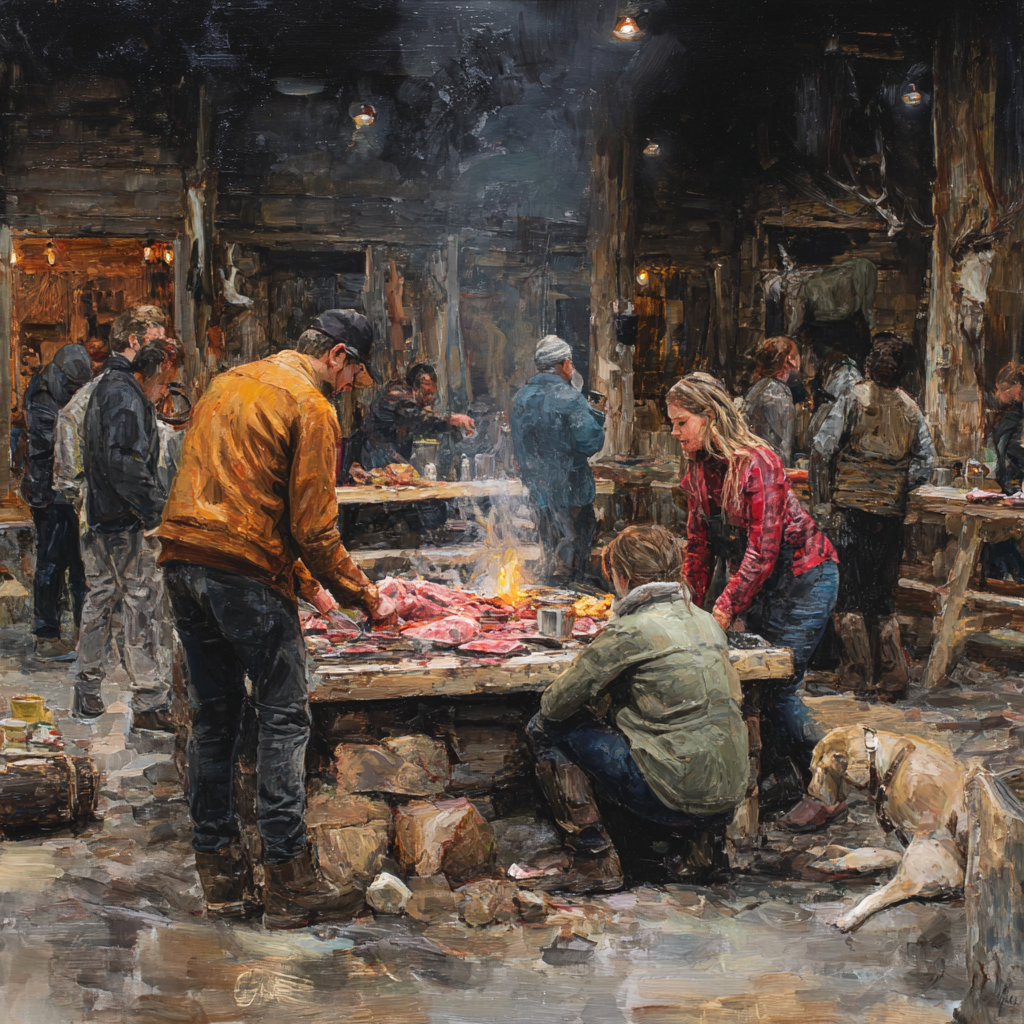
Wild protein already moves through many American landscapes as a fact of ecological management. What it does not do is move through our food systems with the same degree of coordination. That is the real condition.
Deer damage crops. Herds contribute to collision risk. Wildlife agencies monitor disease pressure with increasing concern. Nearby communities still buy protein through industrial chains that originate far beyond the places they live. The ecological surplus is local. The food dependence is distant.
That distinction changes the task.
We often describe this as a question of hunting, regulation, or cultural preference. None of those frames reaches the structural problem. The issue is not whether animals exist, whether hunters are willing, or whether regulators care about local food. The issue is that wildlife management and food safety infrastructure were built to solve different problems and were never given a shared interface.
One system manages population, habitat, and disease. The other manages contamination, traceability, and outbreak prevention.
They operate in parallel. The gap between them is where the incoherence lives.
We are in a dual condition: a country with abundant technical capacity for food safety, and a regional food system that cannot lawfully metabolize a category of protein already being managed on the landscape. Wildlife agencies are doing what their mandates require. Public health agencies are doing what their mandates require. Processors and food banks are doing what liability architecture has trained them to do.
The absence is not concern. It is coordination.
That gap produces a particular form of fragility. A community can live beside overabundant deer, absorb crop loss and vehicle damage, track chronic wasting disease in nearby herds, and still remain almost entirely dependent on distant industrial protein. The ecological burden is local. The nourishment remains external.
Both of these realities carry weight, and neither is available without cost.
On one side is public health protection. That concern is not bureaucratic overreach. It protects something real. Food safety systems exist because distributed contamination can produce mass harm, and because the people eating a product usually have no independent way to verify the conditions under which it was handled. Standardization, inspection, traceability, and documented chain of custody are not ornamental features. They are the institutional memory of what happens when those things are absent.
On the other side is local food sovereignty. That position also protects something real. It protects the capacity of a community to participate in its own nourishment rather than receiving food only as a distant commodity. It protects resilience when supply chains fail, slow, or price people out. It protects a relationship to land in which consequence remains visible. A community that can connect ecological management to food access develops a different form of agency than one that experiences both only as remote systems.
Each position becomes dangerous when it dominates without its counterweight.
Public health protection, when built around a single model of industrial consistency, begins to exclude inputs that do not behave like the system it was built to oversee. Field-harvested protein then becomes structurally invisible. It does not disappear. It moves outside formal channels of accountability or remains unused altogether. Uniform standards applied to non-uniform conditions do not create universal safety. They create exclusion.
Local food sovereignty, when detached from public health rigor, becomes romanticism. It treats proximity as proof of safety. It assumes community trust can substitute for documented oversight. It cannot. Distributed risk that is harder to trace is not a more humane system. It is a less legible one.
The work is to hold them in right relation.
That requires another distinction. Wild protein is variable by nature. A field-harvested animal is shaped by temperature, terrain, timing, species, transport, and anatomical conditions that do not exist in slaughterhouse environments. Standardization protects accountability. Variability is the condition of the input. The task is not to erase the variability. The task is to build a framework that can absorb it without losing the safety floor.
That is why the missing piece is not persuasion. It is a county-scale processing and routing interface.
A lawful food system pathway for wild protein depends on a specific kind of bridge: documented field protocols, controlled receiving conditions, chain-of-custody tracking, disease testing integrated into routing decisions, and contained distribution matched to actual risk. The point is not to weaken oversight. The point is to make oversight possible for the category as it actually exists.
Maui Nui Venison showed that this bridge can be built under favorable conditions. That matters less as a model to copy than as proof that the interface is constructible. The larger continental question is how to adapt that principle for counties dealing with different geographies, different species, different disease densities, and different public institutions.
The county is the right scale for this work because it is small enough for containment and monitoring and large enough to generate meaningful evidence. People can see the system operating. Agencies can coordinate around a real geography rather than an abstract jurisdictional map. If something fails, the boundary of the failure is legible. If something works, the data are local enough to matter.
Repair, then, is not abstract.
It looks like pilot counties where wildlife, health, and agricultural authorities operate inside a single legal container. It looks like field protocols that define time-to-cooling, transport, documentation, and receiving requirements clearly enough to support inspection. It looks like a routing structure that distinguishes between protein eligible for full distribution, protein appropriate only for contained channels, and protein that cannot enter circulation at all. In active chronic wasting disease zones, it means testing and exclusion thresholds built into the architecture itself rather than treated as discretionary judgment.
It also looks like distribution designed for communities rather than boutiques.
This concern is not secondary. A system built in the name of food access can drift toward premium retail because those incentives are clearer and more profitable than community distribution. The result is a familiar distortion: the appearance of local food sovereignty without the substance of local nourishment. Wild protein becomes another specialty market while the community infrastructure used to justify the system remains thin.
Purpose has to be written into authorization. Market signals alone will not hold it.
We can see the lived pattern already. Hunters produce food for private households while their civic role remains structurally unrecognized. Food banks in many states can legally accept donated game under limited pathways yet often decline because liability remains unresolved. Wildlife managers calibrate harvest against habitat and herd conditions without any formal relationship to the food system. Public health agencies carry real responsibility for safety without an adapted framework for this input category. Each institution remains rational inside its own mandate. The overall system remains irrational.
That is what fragmentation looks like in practice. Competence at the part. Incoherence at the whole.
But every mechanism of repair carries risk.
A successful county pilot will generate pressure to scale faster than its monitoring, testing, and coordination density can be replicated. That is where these systems become fragile. Demonstration succeeds. Expansion compresses the infrastructure that made success possible. The first well-documented incident then becomes the public meaning of the entire project.
The danger is not only failure. It is premature expansion.
A resilient system knows its stopping condition in advance. If distribution produces a traceable illness cluster, operations halt. The framework is audited publicly. Redesign comes before restart. That kind of constraint is not weak commitment. It is the condition that makes public trust possible.
What is at stake here is larger than a new protein channel. A community that can trace food back to a landscape it knows, through a system it can observe, begins to relate to consequence differently. The deer population, the food assistance network, the local processor, the county health office, and the wildlife agency stop appearing as parallel categories. They begin to register as parts of the same civic ecology.
That is a different kind of food system. More visible. More demanding. More accountable.
And more coherent.
DIALECTIC AND DECONSTRUCTION SOLUTIONS (DDS) BLUEPRINT ═══════════════════════════════════════════════════════════════
Problem: Wildlife management systems and local food systems operate in parallel rather than in coordination, leaving wild protein ecologically disruptive in many regions while adjacent communities remain dependent on distant industrial food supply chains.
───────────────────────────────────────────────────────────────
PHASE 1: PROBLEM FRAMING ─────────────────────────
The Umbrella Problem
Regional food systems in the United States lack a coordinating layer between wildlife management and food safety infrastructure, producing the structural incoherence where abundant wild protein moves through local landscapes as an ecological liability while communities remain fully dependent on industrial supply chains thousands of miles away.
───────────────────────
The Multiple Drivers
- Inspection infrastructure designed for controlled industrial slaughter — technically incompatible with field harvest conditions
- Disease surveillance systems that monitor wildlife but do not integrate with food safety or use-based routing decisions
- Liability architecture that penalizes processors, distributors, and food banks from handling wild game even where regulations technically permit it
- Wildlife management systems operating under conservation mandates with no coordination authority over food systems
- No county-level or regional legal mechanism for cross-agency coordination between wildlife, public health, and food distribution
───────────────────────
This Blueprint Addresses:
The field-to-processing interface — specifically, whether a tiered county-scale inspection, routing, and local distribution model can create legal and operational pathways for wild protein to enter local food systems safely.
───────────────────────
Remaining Components:
- CWD surveillance investment and prion research (requires federal NIH/USDA research funding and mandate)
- Predator-prey dynamics restoration as upstream disease mitigation (separate ecological intervention)
- Hunter education and certification pipeline for food-safety-oriented harvest
- Federal FSIS regulatory framework adaptation for national scaling beyond county pilots
Bounded Ambition Note: This blueprint addresses the field-to-processing interface at county scale. It does not attempt to resolve the federal inspection framework for interstate commerce, the national CWD research deficit, or the broader ecological restoration of predator-prey dynamics, which each require separate interventions.
PHASE 2: DECONSTRUCTION ────────────────────────
The Surface Symptom
In many regions of the country, deer, elk, and other game animals appear in numbers that damage crops, increase vehicle collision rates, and — in areas where chronic wasting disease has established itself — create sustained disease pressure on herd health. These same regions contain communities purchasing protein that has traveled through industrial chains originating hundreds or thousands of miles away. The ecological problem and the food access problem coexist in the same geography. The systems charged with managing each operate in entirely separate administrative universes.
───────────────────────
The False Start
The problem is that food safety regulations are too restrictive, or that there isn’t enough cultural support for hunting as a food source.
The Compassionate Reality
The barriers here were not built out of ignorance or hostility toward local food systems. They were built to solve different problems, and each set of actors is doing exactly what their system was designed to do. Public health regulators are protecting against outbreak risk at a scale that can cause documented, mass harm. Wildlife managers are balancing habitat health, species stability, and hunter engagement — food system access is genuinely outside their mandate. Processors and food banks are managing liability in a framework that assigns consequences to them when something goes wrong downstream. The gap between these systems is not negligence. It is the absence of a coordinating layer that has never been built because no single level of government has had the authority, the political incentive, or the administrative architecture to build it.
───────────────────────
The Upstream Drivers
- Inspection Infrastructure Designed for Industrial Slaughter
- Actor(s): USDA Food Safety and Inspection Service (FSIS), state departments of agriculture
- Incentive/Constraint: Prevent foodborne illness at scale; maintain consistent, auditable standards; manage institutional liability across the full food system
- Behavior: Apply slaughterhouse-designed inspection protocols to all meat entering legal distribution; field-harvested game cannot meet temperature, handling, or facility requirements in most cases
- Loop: Inspectors trained for controlled environments → field conditions structurally ineligible → no alternative infrastructure develops → field harvest remains outside legal food distribution → inspectors remain trained only for controlled environments
- Disease Surveillance Siloed from Food-Use Decisions
- Actor(s): State wildlife agencies, USDA APHIS Wildlife Services, state public health departments
- Incentive/Constraint: Track and contain CWD and other wildlife diseases; issue advisories; prevent human exposure; maintain public confidence in wildlife management
- Behavior: Collect and report disease data, restrict carcass transport across zone lines, issue hunter guidance — without connecting surveillance outputs to food safety routing or tiered use decisions
- Loop: Disease data remains in wildlife management systems → food safety systems have no mechanism to receive or act on it → disease becomes a blanket disqualifier rather than a managed variable → testing investment doesn’t produce food-use benefit → no incentive to build the connection
- Liability Architecture That Penalizes Innovation
- Actor(s): State and county governments, food processors, nonprofit food banks, distributors
- Incentive/Constraint: Avoid legal exposure from foodborne illness under a liability framework that assumes traceable, standardized supply chains
- Behavior: Decline to handle wild game even where regulations technically permit it; food banks in approximately 35 states have legal authority to accept game meat donations but frequently cite liability as the operative barrier to doing so
- Loop: Liability risk → institutional refusal → no operational experience with game handling → no case law or regulatory clarity → liability risk sustained or increased
- Wildlife Management Siloed from Food System Planning
- Actor(s): State wildlife agencies, county conservation districts, game wardens
- Incentive/Constraint: Manage populations for ecological balance and sustainable hunting; food system outcomes are outside mandate and outside performance metrics
- Behavior: Issue harvest quotas, tag structures, and season timing based on population and habitat data, without coordination with food safety or distribution infrastructure
- Loop: Wildlife data stays in wildlife systems → harvest levels calibrated without food system input → ecological surplus not translated into food access → the two systems remain structurally parallel
- No County-Level Coordinating Authority
- Actor(s): County governments, state legislatures, federal agencies
- Incentive/Constraint: Jurisdictional fragmentation — food safety is partially federal, wildlife is primarily state, food distribution is local; no single level of government holds authority over all relevant systems simultaneously
- Behavior: Each agency optimizes within its own mandate; inter-agency coordination requires agreements that are administratively costly, politically low-priority, and structurally unsupported
- Loop: No coordinating authority → no pilot design framework → no demonstration data → no political case for creating coordinating authority → no coordinating authority
───────────────────────
The Entry Point
The problem is not the presence of animals, the willingness of hunters, or the legitimacy of food safety standards. The structural lever is the gap between field harvest and lawful food processing — the point where ecological surplus meets regulatory exclusion. The Maui Nui Venison model demonstrates that this gap is closeable: a purpose-built handling, transport, and inspection system can bridge wild harvest and USDA compliance without eliminating oversight. What the Hawaii model reveals is not that the problem is solved but that it is solvable — and that the barrier is not conceptual but architectural. The entry point is the interface itself: the specific legal authorization, physical infrastructure, and operational protocol that allows a field-harvested animal to move from landscape to food system through a documented, testable, accountable pathway. Everything else in this framework depends on whether that interface can be built.
PHASE 3: DIALECTICS ────────────────────
Problem Type Assessment: Blueprint Mode — concrete institutional actors, resource requirements (mobile inspection units, testing infrastructure, processing capacity), policy trade-offs across public health and local food access, and implementable mechanisms at county scale. Percentage weighting format applies.
───────────────────────
The Core Tension(s)
Primary: Local Food Sovereignty ↔ Public Health Protection
Secondary: Wild Variability ↔ System Standardization
Secondary (Universal Library): Urgency ↔ Sustainability
───────────────────────
The Weighting
Local Food Sovereignty ↔ Public Health Protection Current State: 12% Sovereignty / 88% Public Health Target State: 38% Sovereignty / 62% Public Health
Who Benefits: Rural and semi-rural communities with geographic or economic distance from industrial food access; low-income communities reliant on food assistance; wildlife managers bearing the costs of overabundant populations Who Bears Cost: Public health infrastructure absorbing increased monitoring and testing demands; regulatory agencies designing new frameworks with no existing template; communities in active CWD zones where disease risk is most proximate What’s Sacrificed: Administrative simplicity and the regulatory uniformity that makes large-scale outbreak response predictable
Wild Variability ↔ System Standardization Current State: 7% Variability / 93% Standardization Target State: 28% Variability / 72% Standardization
Who Benefits: Small-scale processors willing to handle non-standard inputs; food systems serving ecologically diverse regions; communities whose local ecology doesn’t produce standardized outputs Who Bears Cost: FSIS and state inspection agencies absorbing the complexity of variable-condition inputs; insurance underwriters pricing genuinely new risk categories without actuarial history
Urgency ↔ Sustainability Current State: 18% Urgency / 82% Sustainability (in the wrong direction — system inertia produces neither urgency nor sustainability but chronic exclusion) Target State: 35% Urgency / 65% Sustainability
Who Benefits: Communities experiencing food insecurity now; ecologies accumulating damage from unmanaged overpopulation Who Bears Cost: Regulatory bodies that need time to build infrastructure carefully enough to withstand the first safety incident; public trust that requires demonstrated safety records before expanding access
───────────────────────
Dialectical Narrative
Local Food Sovereignty ↔ Public Health Protection
Local food sovereignty protects something that doesn’t appear on supply chain efficiency charts: the capacity of a community to participate in its own nourishment. This is not primarily a nutritional argument. It is a resilience argument and a psychological one. Communities that produce some portion of their own food develop a different relationship to land — not as scenery or resource but as something they are responsible to. They develop a different relationship to consequence, because the consequences of mismanagement are visible and local rather than diffused across a global supply chain. They carry a different form of agency. And practically, communities wholly dependent on industrial systems are structurally exposed when those systems fail, slow, or price them out. The local sovereignty argument here is not nostalgia. It is a design position about fragility.
Public health protection carries a different kind of weight — the kind earned through hard learning. The regulatory architecture that excludes field-harvested game from most legal food distribution channels was not built from abstraction or bureaucratic momentum. It was built in response to documented harm at scale — contamination events, outbreak clusters, preventable deaths — and it reflects a genuine institutional responsibility to protect people who have no individual mechanism for verifying the safety of what they eat. Distributed food systems without consistent oversight don’t just carry distributed risk; they carry risk that is harder to trace, harder to contain, and harder to attribute when something goes wrong. The standards are not obstacles. They are the institutional memory of what happens without them.
The current imbalance — 88% public health, 12% sovereignty — was not designed as a rejection of local food systems. It was produced by a regulatory architecture built around one model of food production: industrial, centralized, consistent. That architecture solved real problems at scale, and it works. But it was designed to regulate a specific input type, and that input type was treated as the only type rather than as one of several. The exclusion of field harvest from legal food distribution is a byproduct of contextual mismatch, not deliberate policy. This matters for how reform is pursued: this is not a fight against regulators. It is a design problem the regulators themselves have an interest in solving, if the design is sound.
The cost of staying at the current weighting is measurable. Across approximately 30 million white-tailed deer in North America, documented annual crop and vehicle collision damage runs into billions of dollars. CWD has now been detected in at least 32 states and 4 Canadian provinces. Overabundant deer populations are not a stable background condition; they are a compounding one. Meanwhile, the food insecurity that makes local protein access meaningful is also not stable — it grows with industrial food system disruptions, regional economic decline, and the increasing cost of inputs at every level of the chain. The two problems worsen together. The case for movement is not that the current system has failed. It is that the current system is accumulating costs faster than it is acknowledging them.
Rebalancing to 38/62 means, in practice: county-level regulatory sandboxes with adapted inspection protocols; tiered routing frameworks that manage risk proportionate to end use; contained distribution with public health monitoring; and legal liability protections that allow processors and food banks to participate without absorbing disproportionate institutional risk. It does not mean lowering standards. It means designing standards appropriate to the conditions of field harvest rather than applying standards designed for slaughterhouse conditions to a fundamentally different input.
What DDS holds: Public health protection is the non-negotiable load-bearing element. Local food sovereignty is the legitimate value being suppressed by architectural mismatch rather than genuine risk. The work is to build inspection and routing frameworks that achieve the former through adapted methods — not to choose between them, and not to pretend the choice doesn’t exist.
───────────────────────
Wild Variability ↔ System Standardization
Standardization protects the predictability that makes food safety infrastructure function. An inspector working within a standardized system knows what to look for, what deviations signal, and how to intervene. Traceability depends on consistency — when a contaminated batch is identified, the ability to recall it, trace its origin, and contain the damage requires that the inputs moved through documented, consistent channels. A food distribution system that absorbs highly variable inputs without a framework for managing that variability doesn’t just create inspection challenges; it creates accountability gaps that become liability voids.
Wild variability is not a flaw to be engineered away. It is the condition of food produced in ecological systems. An animal harvested in November after a hard frost in a northern hardwood forest is not the same input as one harvested in August in a coastal estuary. Field conditions, harvest method, ambient temperature, time to processing, and anatomical variation across species and individuals all affect the handling requirements. The nutritional and ecological value of wild protein is inseparable from those conditions — which means a regulatory system that can only accommodate inputs that behave like industrial inputs cannot incorporate wild protein without either falsifying the conditions or excluding the category entirely.
The current imbalance toward standardization was not arbitrary. It was the correct design response to the problem regulators were solving: large-scale, repeatable, auditable oversight of a high-volume consistent input stream. The category error is applying that solution to a fundamentally different input category — one where variability is inherent, permanent, and in some respects a marker of quality rather than a defect. Forcing wild protein into industrial standardization requires pretending the variability doesn’t exist, which generates the real risk the framework was supposed to prevent.
The cost of staying: either wild protein moves through informal, untracked channels — generating real but invisible risk — or it is excluded entirely, generating the ecological and food system incoherence already described. Neither path is without consequence. Informal distribution is not safer because it is invisible; it is just differently dangerous.
Target weighting in practice means tiered routing: developing safety frameworks that match processing requirements to variability conditions rather than applying uniform standards to non-uniform inputs. Protein that meets full field inspection protocols moves through Tier 1 to full retail. Protein with documented handling and test results but not qualifying for full retail moves through Tier 2 to contained local distribution. Protein that doesn’t qualify for either moves through Tier 3 to mandatory heat processing for institutional use. The tiers don’t lower standards — they calibrate standards to risk profiles.
What DDS holds: Uniform standards applied to non-uniform inputs do not produce uniform safety — they produce exclusion. The goal is not to eliminate standards but to build standards that are correctly calibrated to the actual conditions of the input category. Where those standards don’t yet exist, building them is the work.
───────────────────────
Urgency ↔ Sustainability
This tension operates differently in food ecology than in most civic problems. The urgency is not acute — there is no visible crisis demanding immediate mass harvest. It is structural and accumulating. Overabundant deer populations cause compounding ecological damage. CWD spreads in herd conditions that include overcrowding and habitat fragmentation. Food insecurity in rural communities is chronic rather than catastrophic. The argument for urgency is real but invisible in the way that slow structural problems are always invisible — until a threshold is crossed and the cost becomes undeniable.
The risk of moving too fast is more visible than the risk of moving too slowly. A pilot program that generates a safety incident — or that generates the appearance of regulatory compromise before sufficient infrastructure is in place — produces the kind of public trust failure that can set the broader project back by years. Food safety is one of the domains where a single well-documented failure has outsized and lasting effects on public perception. The costs of an inadequately designed pilot are not evenly distributed — they fall most heavily on the communities and the regulatory bodies that took the risk.
Sustainable pace here means something specific: moving at the rate at which safety and ecological data can be generated, evaluated, and used to improve the framework. That is not the same as moving slowly out of institutional inertia. It is the honest acknowledgment that the demonstration layer must come before the expansion layer, and that compressing that sequence trades long-term legitimacy for short-term momentum.
What DDS holds: The pace of this work should be determined by the rate at which evidence can be generated and trusted — not by urgency to demonstrate progress or by institutional reluctance to move. County-scale pilots designed for learning are not a compromise. They are the correct unit of work given what we currently do and don’t know.
───────────────────────
Intersection
These three tensions are not independent. They are layered in a specific sequence that determines what is possible and in what order.
The Variability ↔ Standardization tension determines what is technically constructible: whether inspection frameworks can be adapted to field harvest inputs at all, and what the minimum viable safety architecture looks like. The Urgency ↔ Sustainability tension determines the pace and scale of construction: how fast to pilot, when to expand, what evidence threshold justifies the next stage. But neither of these can be resolved without first navigating Local Food Sovereignty ↔ Public Health Protection, because that tension governs the political and legal legitimacy of the entire project. No tiered inspection framework will receive authorization. No county-level pilot will find regulatory sponsorship. No processor or food bank will absorb the operational risk of participation. Unless the public health protection case is made as rigorously and visibly as the food access case. The sovereignty/health tension is the gate. The other two are the design work that follows once the gate is open.
PHASE 4: THE MECHANISM ──────────────────────
Title: The County-Scale Wild Protein Integration Protocol (CWPIP) Strategy: Establish time-limited, geographically contained county-level pilot programs that coordinate wildlife management data, field harvest protocols, tiered inspection and routing, and local distribution infrastructure into a legally authorized, publicly monitored food system component.
───────────────────────
Action Steps
Step 1: Ecological Qualification and County Selection Develop a county selection rubric through a state-level inter-agency working group (wildlife, agriculture, and public health) assessing: game population overabundance relative to habitat carrying capacity; existing wildlife management infrastructure and personnel capacity; CWD status and surveillance density; existing food distribution infrastructure (food banks, processors, direct distribution networks). Priority counties are those where ecological disruption is documented, disease surveillance is active and dense, and some food distribution infrastructure already exists. Pilot counties are designated for a defined term (three to five years) with renewal contingent on safety and ecological outcome data.
Rationale: Pilot selection is not logistical — it is the first safety decision the framework makes. Counties without adequate surveillance density or existing distribution infrastructure are not ready to absorb the coordination demands of a first-generation pilot, and a failed first pilot has system-wide consequences. The selection rubric is the mechanism that keeps ambition from outrunning capacity.
Step 2: Build the Field-to-Processing Interface Design and deploy mobile or regional inspection infrastructure capable of FSIS-equivalent documentation and safety assessment under field harvest conditions. This includes: mobile or purpose-built receiving stations with temperature control and chain-of-custody documentation; field protocol certification for participating hunters (rapid field dressing, core temperature management, harvest-to-transport timelines); trained inspection staff with field-harvest-specific protocols; and rapid transport systems to licensed processing facilities. The Maui Nui Venison model’s handling protocols — helicopter transport, rapid cooling, custom inspection facility — provide a proof-of-concept; the continental challenge is to adapt that architecture for larger, more geographically variable landscapes at lower per-unit cost.
Rationale: Everything else in this framework depends on whether this interface functions. Tiered routing, disease testing, and community distribution are downstream of the field-to-processing bridge. If the bridge doesn’t work — if animals arrive outside temperature parameters, if chain-of-custody documentation fails, if trained inspection capacity is insufficient — the system cannot route safely or account for what it has processed. Building the interface first, at smaller scale, is the only sequence that generates trustworthy data.
Step 3: Deploy the Tiered Safety Routing System Operate a three-tier use-based routing model. Tier 1 — Full Inspection Pathway: animals that meet all field protocol requirements and pass initial inspection qualify for raw retail distribution within the pilot county or region; subject to full FSIS-equivalent documentation. Tier 2 — Controlled Local Distribution: animals with complete handling documentation and species/zone-appropriate disease testing that don’t qualify for Tier 1 may enter contained local distribution to community kitchens, food banks, and institutional channels within clearly defined geographic boundaries with mandatory labeling and traceability. Tier 3 — Mandatory Processing Pathway: animals that don’t qualify for either raw distribution tier are routed to heat processing for fully cooked institutional products; batch-level oversight required; no raw distribution. A critical design constraint applies across all tiers: prion risk from CWD-positive zones is not neutralized through standard heat processing. In active CWD zones, CWD testing must precede routing at every tier, not just Tier 1. A positive test or an untested animal in an active zone cannot enter any distribution channel regardless of tier.
Rationale: The tiered model is the mechanism that allows ecological variability to be absorbed without compromising the safety floor. By matching processing requirements to the actual risk profile of each animal — rather than treating all field harvest as either fully compliant or fully excluded — the system can expand access without pretending the variability doesn’t exist. The CWD caveat is not a caveat — it is a structural constraint that must be written into the routing architecture itself, not treated as an exception to manage case by case.
Step 4: Establish Local Distribution and Community Access Infrastructure Build distribution channels that reach communities rather than boutiques as a condition of pilot authorization. This requires writing community food access requirements into the pilot framework directly: minimum percentage of processed volume directed to food assistance channels (suggested 40% in initial pilots); prohibition on exclusive restaurant or premium retail supply agreements during pilot phase; partnership requirements with existing food bank networks; and transparent pricing structures that do not price community recipients out of access. This infrastructure also includes: cold storage capacity at distribution points; labeling and traceability systems for every batch; community education on handling and preparation; and a mechanism for community feedback on product quality and distribution experience.
Rationale: The boutique capture risk is not hypothetical. Systems designed for community access that generate premium-market demand often drift toward the market that pays more, because the market signals are louder and more consistent than the community access mandate. Writing the access requirement into the authorization conditions — not the aspirational language — is the structural response to this drift.
Step 5: Implement Public Monitoring and Traceability Dashboard Deploy a publicly accessible monitoring system at the county level documenting: harvest volume by species, zone, and date; disease test results by batch; routing decisions by tier; distribution recipients by channel; and any safety incidents or protocol deviations. The dashboard serves public trust, regulatory oversight, and pilot evaluation simultaneously. Monitoring is designed for transparency without being designed for enforcement against individual hunters — batch-level and geographic aggregation protects individual participation while preserving systemic accountability. Annual independent audits of safety outcomes, ecological outcomes, and community access metrics are a condition of pilot continuation.
Rationale: The monitoring system is not a surveillance apparatus — it is the mechanism through which a novel food system component earns and maintains public trust. The difference between a pilot that scales and a pilot that collapses is not usually technical; it is whether the public record of outcomes is honest enough to be trusted when something goes wrong, and clear enough to demonstrate value when things go right.
───────────────────────
The Leadership
Steward: County Health Officer (or a designated County Food System Coordinator — a new position authorized under state enabling legislation, jointly accountable to county health and county administration)
Facilitator: State Wildlife Agency Regional Director, operating under a formal inter-agency memorandum of understanding with the County Health Officer and state Department of Agriculture
The County Health Officer carries ultimate accountability for food safety outcomes within the pilot, including routing decisions and safety incident response. The State Wildlife Agency Director provides ecological and disease data, harvest coordination, and wildlife management capacity. These roles are not interchangeable. Ecological expertise and public health authority are distinct functions, and the framework functions because both are present and formally coordinated — not because one has absorbed the other.
───────────────────────
The Timeline
Phase 1 (Stabilization): Months 0-18 State enabling legislation drafted and passed authorizing county-level food system pilots; state inter-agency working group convened; county selection rubric developed and applied; two to three pilot counties designated; field protocol developed and field inspection training completed; mobile receiving infrastructure procured or contracted; disease testing protocols and turnaround standards established; inter-agency MOU executed; liability protection framework enacted for participating processors and distributors.
Phase 2 (Implementation): Months 18-36 First full harvest season under pilot framework; tiered routing operational; disease testing integrated into routing decisions; local distribution channels active; public traceability dashboard live; community access requirements enforced; monthly inter-agency coordination meetings active; any safety incidents handled under pre-established response protocol.
Phase 3 (Review): Month 36 Full independent audit of safety outcomes, ecological outcomes, community food access metrics, cost per pound delivered, disease incident rate, and routing system performance; results published publicly; determination of pilot continuation, modification, or expansion; regulatory bodies review authorization framework.
───────────────────────
The Cost Analysis
Financial Cost: State enabling legislation and inter-agency working group: approximately $200,000-400,000 in staff time, legal development, and coordination. Per-county first-year costs: mobile receiving infrastructure ($150,000-300,000 capital); field protocol training and certification ($50,000-100,000); disease testing integration ($75,000-200,000 depending on CWD zone density and turnaround infrastructure); distribution and traceability systems ($100,000-200,000). Total estimated first-year cost per pilot county: $375,000-800,000. Across two to three pilot counties: $750,000-2.4 million. For context, white-tailed deer alone cause an estimated $2.1 billion in vehicle collision costs and $1 billion in agricultural damage nationally per year; county-level costs from overabundant populations are meaningful and partially offset the pilot investment.
Opportunity Cost: State political capital invested in enabling legislation for this framework is capital not invested in the narrower near-term reform of venison donation program expansion, which has fewer structural barriers and lower liability exposure. The pilot framework sacrifices faster incremental gains for a more comprehensive architecture.
Human Cost: Game wardens absorb new reporting and coordination demands alongside existing population management work. County health department staff require training in field-harvest-specific inspection protocols they have not previously encountered. Hunters participating in the certified harvest framework must complete new documentation and protocol requirements. Processors accepting pilot-framework meat absorb new liability exposure even with statutory protection, because statutory protection doesn’t eliminate the operational and reputational risk of a first-generation system.
───────────────────────
Key Assumptions
- State governments can authorize county-level food safety pilots without triggering federal FSIS preemption of intrastate distribution If wrong: Need explicit federal regulatory sandbox pathway for wild game pilots, requiring USDA coordination and potentially congressional authorization before any state pilot can operate legally
- Mobile inspection infrastructure can achieve documentation and safety assessment equivalent to fixed-facility inspection for intrastate distribution purposes If wrong: Regional fixed-facility receiving stations become the minimum viable infrastructure — higher capital cost, reduced geographic flexibility, but more defensible for regulatory authorization
- CWD testing turnaround can be reduced to a window compatible with food distribution timelines without requiring extended cold-hold storage If wrong: Pilot requires dedicated frozen-hold infrastructure during test wait periods, significantly increasing per-unit cost and logistical complexity, with potential animal quality impacts
- Hunter participation in certified field protocols will produce sufficient volume to make the pilot food-system-meaningful rather than merely symbolic If wrong: Need supplementary paid professional harvester program operating alongside recreational hunting — similar to the Maui Nui professional harvesting model — to reach minimum viable distribution volume
- The tiered routing system can be maintained with sufficient oversight to prevent prion-risk animals from entering any distribution channel in active CWD zones If wrong: The entire three-tier structure requires mandatory pre-routing CWD screening for all animals regardless of harvest zone, significantly increasing testing infrastructure requirements and costs before any distribution occurs
───────────────────────
The Evidence
Primary Analog: Maui Nui Venison (Maui, Hawaii, operational since approximately 2017) — a coordinated commercial harvesting program targeting invasive axis deer, achieving USDA inspection compliance through purpose-built field handling protocols, rapid helicopter transport, and a dedicated USDA-inspected facility; produces commercially distributed venison while managing a documented ecological disruption; demonstrates that the field-to-inspection interface is constructible under favorable conditions
Secondary Analog: State Venison Donation Programs operating under Share the Harvest frameworks in approximately 35 states — allow hunters to donate processed game meat to food banks through licensed processors; demonstrate that regulatory pathways for wild game distribution exist and function; currently limited to processed donations through licensed facilities with no tiered routing or community distribution infrastructure, but provide existing legal and operational precedent within the framework
Additional Analog: Regulatory sandbox frameworks applied to food system innovation in several European contexts, including Scotland’s Game Assurance program and Denmark’s regulated wild game meat distribution systems — provide partial precedent for adapted inspection frameworks at regional scale, though direct U.S. regulatory translation is limited by different federal/state jurisdictional structures
Theoretical Basis (novel components): Regulatory sandbox theory applied to food systems — time-limited geographic pilot frameworks with adapted regulatory standards and mandatory independent evaluation; precedents from financial services (fintech sandboxes) and pharmaceutical (conditional approval) sectors support the design logic, though food safety regulatory culture is more conservative than either
───────────────────────
The Emotional Consequence
Relief Profile: For communities that have experienced both food insecurity and the visible ecological costs of overabundant deer populations, a functioning county-level integration protocol offers something more than additional protein. It offers coherence — the experience of a system that recognizes the relationship between landscape, food, and community rather than administering each as a separate problem domain. Hunters who have long operated in a cultural space where their practice is valued personally but treated as socially inert — generating food for their own households but excluded from any broader food system function — would find their participation acknowledged as a legitimate civic contribution. The relief here is partly relational: it is the experience of a local system that works, is visible, and is trusted enough to participate in. For rural communities specifically, this represents a form of agency within the food system that most have not experienced within living memory.
Burden Profile: Rural counties selected for pilots would absorb new administrative complexity at a moment when many rural governments are already understaffed and managing competing demands. The burden is not abstract — it is additional FTE requirements, new coordination meetings, new documentation systems, and new institutional liability exposure that falls on local governments regardless of how well the state protective framework is designed. Perhaps most structurally difficult: communities in active CWD zones — where the ecological disruption may be greatest, and where protein access need may be most acute — face a harder version of the design problem and may find themselves excluded from early pilots precisely because the safety architecture in their context is most complex to build. The differential creates a real equity concern that the selection framework must name rather than obscure.
───────────────────────
Feasibility Check
Authority & Hiring
- Who has the power to create the County Food System Coordinator position? State enabling legislation authorizing counties to establish and fund this role; likely requires a state pilot grant program providing matching funds
- New position: requires a state appropriations line for the pilot grant program; counties must provide matching resources through health department budget reallocation or county general fund
- What gets deprioritized at county health departments to absorb coordination demands? Existing food establishment inspection staff would require supplementation — the field harvest context is distinct from restaurant and retail inspection; net new staff time is required for any county with meaningful harvest volume, not absorbed from existing capacity
Enforcement Teeth
- What happens if the County Health Officer doesn’t ensure protocol compliance? State pilot oversight board can suspend or revoke county’s pilot authorization and associated funding; state health department retains inspection authority and can halt distribution independently
- What leverage does the State Wildlife Agency Regional Director have when inter-agency coordination stalls? Limited without statutory mandate — the inter-agency MOU is the operative mechanism, making leverage reputational and relational rather than legal; this is a genuine structural weakness requiring explicit attention in MOU design
- Who can cancel this program? State pilot oversight board (authorization revocation); county commissioners (budget authority withdrawal); USDA FSIS (federal preemption if protocols are found non-compliant with intrastate food safety standards)
Coordination Reality
- How many meetings per month does this require? Minimum of one monthly inter-agency coordination meeting (health, wildlife, county administration) plus weekly operational check-ins during active harvest seasons — approximately six to eight scheduled coordination events per month during peak periods
- What existing committee or meeting gets replaced or absorbed? In counties with active wildlife damage management committees or agricultural extension coordination groups, those structures can be formally expanded and rechartered; no existing committee is eliminated, but some are formalized and given new cross-mandate authority
- Who owns the shared data and reporting system? County Health Officer owns public-facing safety and distribution reporting; State Wildlife Agency owns ecological and disease data; a shared dashboard requires a formal data-sharing agreement between the two, with the county traceability system as the integration point
Decision Authority
- Who makes the final call when routing disputes arise (e.g., whether a specific batch qualifies for Tier 2 or requires Tier 3)? County Food System Coordinator, with mandatory documentation of routing rationale and appeal to State Department of Agriculture within 48 hours if contested
- Escalation pathway: County Coordinator → State Department of Agriculture → State Pilot Oversight Board → FSIS (for federal compliance questions)
- Where does budget authority sit? County commissioners for local expenditures; State Pilot Program office for grant disbursements; FSIS retains authority over any interstate commerce issues
PHASE 5: READINESS & AUDIT ───────────────────────────
Readiness Scores
Psychological/Social Capacity: 5/10 Rural communities with active hunting traditions carry genuine cultural readiness for expanded harvest as food production — the practice exists, the knowledge exists, and the motivation exists. The more difficult psychological shift is within public health institutions asked to accept novel inspection frameworks, and within urban-adjacent constituencies asked to accept game meat in public food channels. Political polarization around anything involving hunting, firearms, and food regulation means the cultural framing of this work is as operationally important as its technical design. A system perceived as a hunting-rights project will fail in public health institutions. A system perceived as deregulation will fail in urban constituencies. Maintaining structural neutrality in framing is both genuinely difficult and non-negotiable.
Political/Institutional Alignment: 4/10 Several states have functional infrastructure that provides partial foundation — venison donation programs, active CWD surveillance networks, state wildlife management capacity, and some form of inter-agency food system planning. The cross-mandate coordination required has no existing legal structure in most states. Federal FSIS jurisdiction over food safety creates a ceiling on what state-level pilots can accomplish without explicit federal engagement or determination of intrastate scope. State enabling legislation faces competing legislative priorities and lacks an organized advocacy constituency with the political weight to move it.
Operational/Resource Feasibility: 5/10 The mechanisms are achievable. Mobile inspection technology, rapid field transport, tiered processing, and traceability systems are real capabilities that exist and function. The constraint is the cost of building them reliably in diverse continental geographies without the specific structural advantages that made Maui Nui viable — island containment, single invasive species, year-round mild climate, close proximity between harvest sites and processing facility. CWD testing turnaround remains a meaningful operational constraint in many regions, requiring either investment in rapid testing infrastructure or cold-hold capacity that adds significant cost per unit.
Cultural/Existential Fit: 6/10 This is the highest-scoring dimension because the cultural raw material — hunting practice, local food consciousness, ecological concern — is genuine and present across a wide range of communities. The cultural gap is not in hunting culture but in connecting hunting practice to food system function in a way that is publicly trusted and institutionally recognized. The risk of cultural capture is real in both directions: the project being absorbed into a hunting-rights framing on one side, or into a performative food justice framing on the other, both of which damage it with constituencies it needs.
───────────────────────
Verdict: PAUSE
───────────────────────
Readiness Narrative
The operational components of this framework are more feasible than the legal and political components. Mobile inspection technology works. Tiered routing logic is sound. The Maui Nui precedent is real. What is not in place is the cross-mandate legal container — the formal, enforceable authority for county health, state wildlife, and state agriculture agencies to operate within a shared pilot framework with defined accountability and liability protection. Without that container, individual pilot attempts are stopped not by technical failure but by institutional liability concerns and jurisdictional ambiguity. The preparatory work is primarily legal: state enabling legislation, federal FSIS engagement on the intrastate scope of county pilots, inter-agency MOU frameworks, and statutory liability protection for participating processors and distributors. A system this novel needs the legal architecture before the logistical architecture, because the logistical architecture will not survive without authorization that is explicit rather than assumed.
───────────────────────
Minimum Viable Mechanism
- Action: In one state with an active venison donation program and functioning CWD surveillance, convene a formal inter-agency working group — state wildlife, state health, state agriculture, and one volunteer county — tasked with designing the specific legal and operational adaptations required for a one-season pilot; produce a formal pilot protocol document and regulatory determination request within 12 months
- Timeline: 12 months to completed pilot protocol; 24-30 months to first harvest season under pilot authorization
- Success Metric: Pilot protocol accepted by state regulatory bodies and by at least one county; a minimum of 10,000 pounds of wild protein processed and distributed under documented pilot conditions in the first authorized season with no confirmed safety incidents; public traceability dashboard operational
- Failure Metric: No regulatory authorization achieved within 24 months; state enabling legislation fails without pathway for reintroduction; any confirmed safety incident during pilot season without a pre-established response protocol in place before harvest begins
───────────────────────
The Fractal Audit
The Recursive Loop: Every expansion of access creates a new surface for failure. A county-level pilot that works — that processes safe food, manages disease testing, reaches communities, and generates clean public data — will create political pressure to expand before the monitoring, testing, and coordination infrastructure that made the pilot function has been replicated in the new locations. This is the specific pattern that produces food safety failures in novel systems: the demonstration succeeds, the expansion compresses the careful infrastructure it relied on, and the incident that results becomes the story that forecloses the project for years. The success of the first pilot is not the solution. It is the beginning of the problem of scaling without infrastructure degradation, which is the harder design problem.
The New Problem Node: The Scaling-Without-Infrastructure Problem — successful county pilots generate political and community pressure to expand the framework before the inspection, testing, and coordination density that made the pilot safe has been replicated in new locations; expansion without proportional infrastructure investment produces the safety incident that collapses public trust.
The Kill Switch: If, within three full harvest seasons of pilot operation, any batch processed through Tier 2 or Tier 3 routing produces a confirmed foodborne illness cluster with traceable connection to the pilot program, halt all pilot distribution operations immediately, initiate a full independent protocol audit, and do not resume without a redesigned routing and testing architecture reviewed by an independent food safety panel with public release of findings. The kill switch is not a failure provision — it is the commitment that makes public trust in the system credible. A system that cannot name its own stopping condition has not earned the trust it is asking for.
───────────────────────
Capacity Impact Assessment
At its best, this framework builds a specific form of collective capacity that distributed food systems are uniquely positioned to develop: the experience of ecological consequence. When a community can trace protein on its table back to a landscape it knows, managed through a system it can observe and contest, something shifts in how that community relates to both land and responsibility. The deer population that needs managing and the food that feeds people become the same fact rather than parallel administrative categories. This is not a romantic claim about the virtue of hunting. It is a structural observation about what visibility and participation do to ecological consciousness: they make consequences real and local rather than distant and diffused. That shift in orientation — from passive recipient of distant supply chains to active participant in local ecology — is the kind of relational capacity that makes communities more capable of navigating future food and ecological challenges, not less. The risk is the inverse: a pilot that generates premium-market capture, that serves boutiques rather than communities, builds the appearance of the framework while producing a different psychological outcome entirely — confirmation that local food systems are luxury goods rather than community infrastructure. The distribution architecture must hold the purpose to hold the capacity-building.
PHASE 6: THE NARRATIVE SYNTHESIS ─────────────────────────────────
The Human Good Made Real
This blueprint serves ecological coherence — the condition in which the relationship between a landscape, the people who live within it, and the food they eat is visible, participatory, and structurally grounded rather than invisible, distant, and fragile.
───────────────────────
Something structurally strange is operating in many American rural landscapes. Deer move through them in numbers that damage crops, increase vehicle collisions, and in regions where chronic wasting disease has gained purchase, sustain disease pressure that wildlife managers track with growing concern. Vehicle collision costs and agricultural losses accumulate quietly in the ledger of normal rural life. Meanwhile, within driving distance of many of these landscapes, communities purchase protein that originated in industrial systems hundreds or thousands of miles away. The ecological problem and the food access problem share geography. The systems charged with managing each — wildlife agencies, public health departments, food distribution networks — operate in entirely separate administrative worlds. It is not that no one has noticed the proximity. It is that no institutional architecture has existed to act on it.
The gap is not conceptual. The idea that well-managed, ecologically motivated hunting can produce safe, inspected food for local communities is not hypothetical. Maui Nui Venison demonstrated it. That system did not bypass regulation — it engineered a handling and processing architecture capable of meeting USDA inspection standards under field harvest conditions. What it revealed is not that the problem has been solved but that it is solvable. The barrier is not the biology. It is the interface: the specific legal authorization, physical infrastructure, and operational protocol that allows a field-harvested animal to move from landscape into a food system through a documented, testable, accountable chain. That interface does not currently exist in most of the country. Building it is the work.
The tensions involved are real and cannot be collapsed without cost. Public health protection is structurally load-bearing — the regulations that currently exclude field-harvested game from most legal food distribution channels were not built from ignorance or hostility. They are the institutional memory of documented harm at scale, and they reflect a genuine responsibility to people who have no individual mechanism for verifying the safety of what they eat. Local food sovereignty is equally real — the capacity of a community to participate in its own nourishment is a form of resilience, not a preference, and communities that have lost it are structurally exposed in ways that efficiency gains elsewhere do not repair. Chronic wasting disease sits squarely at the intersection of these tensions: a genuine prion risk, incompletely understood, with no confirmed human cases but enough biological uncertainty to require structural caution rather than dismissal. The work is not to resolve these tensions but to design within them — to build inspection frameworks that protect public health through adapted methods, routing systems that manage disease risk through testing and containment rather than blanket exclusion, and distribution structures that reach communities rather than becoming premium supply chains.
The county is the correct unit for this work, and that is not a compromise — it is the right design choice given what we know and don’t know. Counties are small enough for genuine containment and monitoring if something goes wrong. They are large enough to generate meaningful ecological and food system data. They are administratively legible: people can see the system operating, contest its decisions, and hold the people running it accountable in ways that are not possible with state or federal programs. The first county pilot won’t feed a region. It will generate the evidence that the framework currently lacks: real safety data from real field conditions, real ecological outcomes from real harvest seasons, and real community access results from real distribution channels. That evidence is what scales the model — not the elegance of its design on paper.
The system will not be free, fast, or easy to keep oriented toward its stated purpose. The boutique capture risk is not hypothetical — a framework designed for community food access that generates premium-market demand often drifts toward the market that pays more, because the economic signal is louder and more persistent than the equity mandate. Writing the community access requirement into the authorization condition, not the aspirational language, is the structural response. The administrative burden falls heaviest on rural counties that are already carrying more than they have capacity for. Communities in active CWD zones — where the ecological disruption may be greatest and the food access need may be most acute — face the most complex safety architecture and may find themselves excluded from early pilots precisely because the system isn’t ready to serve them yet. These are real costs placed on real communities, and they warrant more than acknowledgment — they warrant explicit design attention in the selection framework and explicit equity provisions in the expansion sequence.
And the system’s success will create its next challenge. A working county pilot generates pressure to expand before the infrastructure that made it work has been replicated. That gap — between demonstrated possibility and scalable reality — is where novel food system reforms most frequently produce the incident that forecloses them. The kill switch built into this framework is not a concession to pessimism. It is the structural acknowledgment that a system premised on public trust can only maintain that trust by treating its own safety failures as redesign events rather than as information to manage. A resilient food system is not one that never fails. It is one that knows what to do when it does, and has the institutional commitment to do it publicly.
PHASE 7: COMPONENT STATUS ──────────────────────────
Umbrella Problem: Regional food systems lack a coordinating layer between wildlife management and food safety infrastructure, leaving wild protein ecologically disruptive in many landscapes while communities remain dependent on distant industrial supply chains.
This blueprint addressed: The field-to-processing interface — specifically, whether a tiered county-scale inspection, routing, and local distribution model can create legal and operational pathways for wild protein to enter local food systems safely under public health oversight.
Remaining Components:
- CWD surveillance investment and prion research (requires federal NIH/USDA research mandate and funding)
- Predator-prey dynamics restoration as upstream disease mitigation (separate ecological intervention)
- Hunter education and certification pipeline for food-safety-oriented harvest protocols
- Federal FSIS regulatory framework adaptation for scaling beyond intrastate county pilots
Status: Component 1 of 4 complete.
PHASE 8: HOW WOULD YOU LIKE TO PROCEED?
[A] Publish This Blueprint (Mark component complete)
[B] Solve Next Component (CWD surveillance and disease mitigation as upstream system design)
[C] Revise This Blueprint
- Deconstruction (Change entry point)
- Dialectics (Shift weighting or add tensions)
- Mechanism (Design a different solution / alternative mechanism)
- Feasibility (Strengthen implementation grounding)
- Narrative (Adjust tone or emphasis)
[D] Clarify Before Proceeding
[E] Start Fresh (New umbrella problem)
This blueprint was produced with Dialectic and Deconstruction Solutions (DDS), a method created by William Hambleton Bishop. The method, the book, and the public archive of worked blueprints are free at SolveSomething.com.