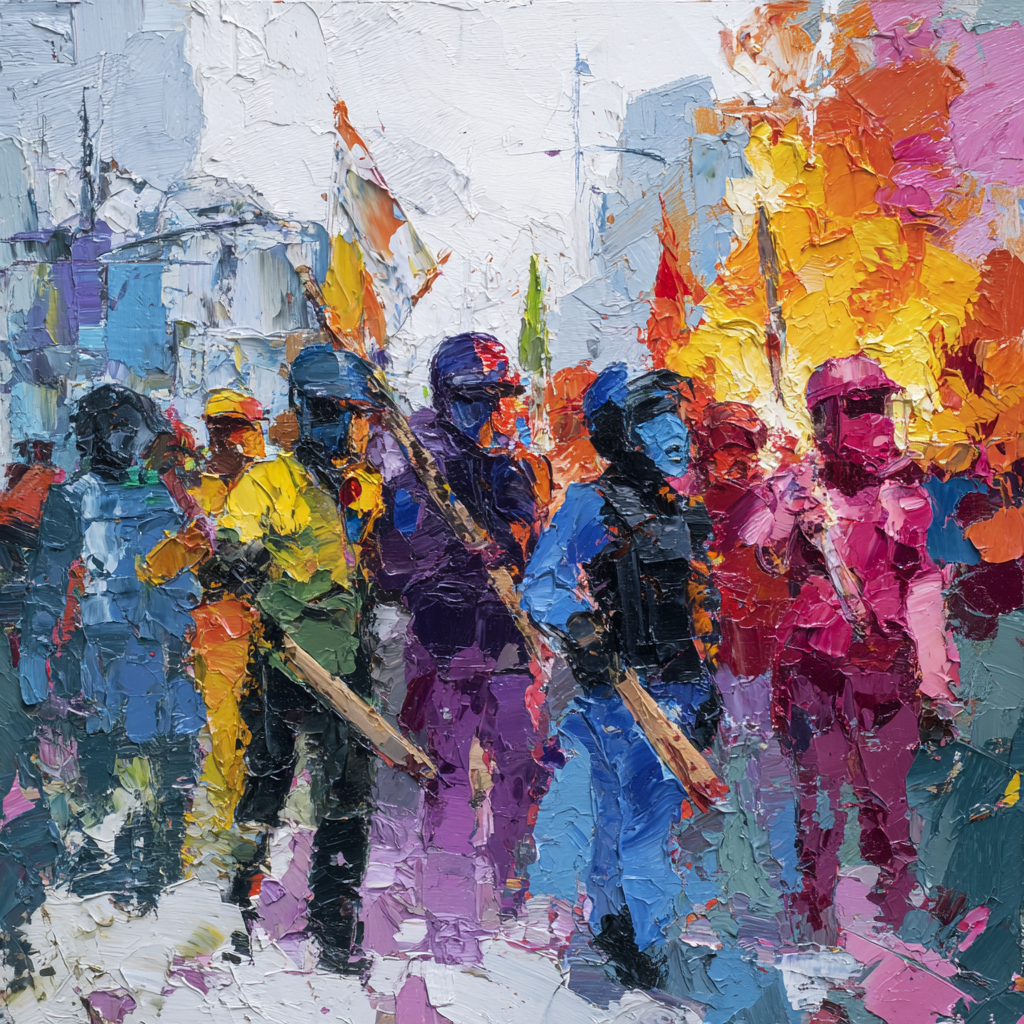
Unidentified force doesn’t project strength. It projects a government afraid of its own citizens.
By The Dialectic and Deconstruction Solutions Framework
You see them on the news. Masked figures in tactical gear, no names visible, moving through city streets with weapons drawn. You cannot tell who they are. You cannot tell which agency sent them. If something goes wrong, you will have no one to name in a complaint, no badge number to reference, no face to identify.
This is what accountability looks like when it has been removed. The state still has its monopoly on violence. It has simply chosen to exercise that monopoly anonymously.
The Logic of Anonymity vs. Accountability
We arrived here through a logic that made sense in pieces but fails when assembled. Officers face real threats. Retaliation against law enforcement families is not hypothetical. Doxxing is a genuine danger. The solution was to remove identifying markers—to let officers work behind masks, without visible names or badge numbers.
The problem is that anonymity does something to the human nervous system. When you cannot identify the person pointing a weapon at you, your brain cannot distinguish between lawful authority and arbitrary threat. Unidentified force does not feel like safety. It feels like occupation.
We regulate speech when it incites violence. We regulate commerce when it defrauds consumers… We have not applied this logic to state force.
Right now, federal and state personnel can deploy into domestic operations wearing masks, without visible identification, carrying lethal weapons. If they use excessive force, there is no immediate way to identify which individual acted. The accountability mechanism—the ability to name who did what—has been functionally disabled.
This creates a structural problem. The monopoly on violence is granted to the state under the assumption that the state can be held accountable. If the agents of the state cannot be identified, they cannot be held accountable. If they cannot be held accountable, the monopoly is no longer legitimate. It is simply power.
The Cost of Protection
The argument for anonymity is not trivial. Officers are human beings performing dangerous work in an increasingly polarized society. They fear for their families. They fear retaliation. Removing their names from public view protects them from immediate targeting.
This protection has a cost. When enforcement becomes anonymous, it loses its connection to the community it is supposed to serve. The Peelian principle—that the police are the public and the public are the police—requires mutual recognition. You cannot recognize someone wearing a mask.
We are living with a weighting where officer safety has almost entirely eclipsed public accountability. This weighting made sense when the primary threat was individual retaliation. It makes less sense when the primary threat is the collapse of civic trust.
The more force we deploy anonymously, the more we generate the conditions that justify further force. Unidentified enforcement triggers resistance. Resistance is then cited as evidence that more aggressive tactics are necessary. The feedback loop accelerates.
Governance by Crisis
At the same time, political leaders issue declarations of crisis without providing the evidence to justify the response. Terms like “invasion” and “war” are used to describe complex policy problems. Emergency powers are invoked. Federal assets are deployed into cities.
The public has no way to verify whether the crisis is real or whether the rhetoric serves a different function—attention capture, base mobilization, the projection of strength.
This is not unique to one party or one leader. It is a structural feature of the current political ecosystem. Leaders are rewarded for combat posture, not for competence. The incentive is to escalate language and deploy visible force, because visible force generates media coverage and tribal loyalty.
The cost is that governance by manufactured crisis erodes the collective capacity to distinguish real threats from performance.
A Proposal for Structural Checks
One way of responding to this would be to require that any personnel deployed domestically with lethal authority must display visible, high-contrast identification, and that any executive declaration of emergency must be preceded by submission of evidence to an independent oversight body.
The identification requirement is narrow. If displaying an officer’s name creates unacceptable risk to their family, a publicly visible registry code can be used instead—a four-digit alphanumeric badge linked to the officer’s identity in a sealed database accessible only to inspectors general. This allows accountability without immediate doxxing.
The evidence requirement is procedural. Before federal assets are deployed into urban areas, the executive must submit data justifying the crisis designation to a bipartisan oversight committee 48 hours in advance. If the data does not support the claim, funding for the deployment is frozen.
This does not prevent enforcement. It requires that enforcement be identifiable and that emergency declarations be tethered to evidence rather than rhetoric.
The Trade-offs
The costs are not small. Officers lose the psychological shield of total anonymity, which increases their vulnerability to public scrutiny and retaliation. Political leaders lose the ability to govern by adrenaline—they must produce evidence before they move troops. The speed of deployment slows. The theater of strength becomes harder to stage.
Enforcement agencies will resist this. They will argue that identification endangers officers and that requiring evidence creates bureaucratic delays that prevent rapid response. These are real concerns.
But the alternative cost is what we have now. Urban populations living under what feels like occupation. Trust in institutions collapsing. The state’s monopoly on violence becoming indistinguishable from arbitrary power.
We are running an experiment in anonymous enforcement, and the results are visible. The more masked personnel we deploy, the more resistance we generate. The more crisis rhetoric we use without evidence, the less capacity we have to respond to actual emergencies.
Conclusion
The Northern Ireland police reforms after 1998 provide some evidence that this is workable. The Police Service of Northern Ireland transitioned from a militarized, sectarian force to a trusted civic service by prioritizing identification and human rights monitoring. Officers remained at risk, but accountability was non-negotiable. Sectarian violence declined.
This does not guarantee similar outcomes in the United States. Context matters. But it suggests that the trade between officer safety and public accountability is not winner-take-all. Both can be protected, though neither perfectly.
The mechanism proposed here shifts the weighting from 90% anonymity and urgency toward 60% transparency and legitimacy. This makes enforcement harder and slower. It removes the easy option of deploying masked units without justification.
The question is whether we believe the monopoly on violence requires identification as its primary check. If we do, then anonymous enforcement is structurally incompatible with accountability. If we do not, then we have abandoned the premise that the state serves the people rather than occupies them.
⚙️ The Full DDS Blueprint
The article above was derived from the following structural analysis. The complete, unedited blueprint is provided below for policymakers, students, system architects, and anyone interested in the methodology.
⚙️ The DDS Blueprint
Protocol for Identifiable Authority
PHASE 1: PROBLEM FRAMING
(The Umbrella Lock)
- The Umbrella Problem: The monopoly on violence has become decoupled from public accountability, creating a feedback loop where state force generates instability rather than order, and leadership rhetoric accelerates polarization rather than cohesion.
- The Multiple Drivers:
- Anonymized Enforcement: The deployment of unidentified, masked personnel removes individual accountability, turning law enforcement into a faceless projection of state power that triggers primal threat responses.
- Performative Polarization: Leaders are incentivized to use crisis language (“invasion,” “war”) without empirical evidence because it mobilizes political bases more effectively than complex governance.
- The Competence Gap: A lack of structural mechanisms to measure the cost-effectiveness of paramilitary interventions compared to their social and economic collateral damage.
This Blueprint Addresses: The Governance and Accountability Structure for both enforcement deployment and leadership communication.
PHASE 2: DECONSTRUCTION
(Finding the Real Entry Point)
The Surface Symptom
Urban populations are witnessing masked, heavily armed units using lethal force in domestic settings without clear identification. Simultaneously, political leaders issue high-voltage statements that escalate public fear (hysteria) without providing the data to justify the intensity of the response.
The False Start
“We just need to ban the enforcement” or “We need to let them do their jobs.” Both ignore the structural reality: enforcement is a state function, but unaccountable enforcement is a state failure.
The Compassionate Reality
We must acknowledge that the shift toward masks and heavy armor often arises from a genuine fear for officer safety in an increasingly heavily armed and polarized society. Officers fear doxxing. Leaders amplify conflict because the ecosystem rewards “fighters” over “architects.” They are adapting to an incentive structure that selects for combat, not competence.
The Upstream Drivers
- Driver 1: Anonymized Authority
- Actor: Enforcement Agencies / Command Structure.
- Incentive: Protect officers from personal retaliation (Safety).
- Loop: Anonymity lowers the barrier to excessive force (deindividuation) $\rightarrow$ increases public resistance $\rightarrow$ justifies “tougher” tactics.
- Driver 2: The Rhetorical Inflation Circuit
- Actor: Political Leaders.
- Incentive: Attention capture and base mobilization (Political Survival).
- Loop: Inflammatory statements generate media coverage $\rightarrow$ incentivizes further escalation despite damage to national unity.
- Driver 3: The Missing Ledger
- Actor: Oversight Bodies / Congress.
- Incentive: Lack of agreed-upon metrics for “social cost.”
- Loop: Operations funded based on activity (arrests) rather than net stability.
The Entry Point: Statutory Identification and Evidence-Based Authorization. We cannot legislate the heart of a leader, but we can regulate the tools of the state.
PHASE 3: DIALECTICS
(Holding Opposing Truths)
The Core Tension
Transparency (Accountability) $\longleftrightarrow$ Privacy (Officer Safety)
Secondary: Legitimacy (Long-term Trust) $\longleftrightarrow$ Urgency (Immediate Action)
The Weighting
- Current State: 90% Privacy/Urgency | 10% Transparency/Legitimacy.
- Target State: 40% Privacy | 60% Transparency.
- Who Benefits: The civilian population (restoration of trust), the Constitution (due process).
- Who Bears Cost: Enforcement officers (increased vulnerability), Political Leaders (loss of unilateral action).
Dialectical Narrative
We are operating under a weighting where the state’s need for speed and protection has eclipsed the public’s need to know who is pointing a weapon at them. Unidentifiable force looks indistinguishable from criminality to the human nervous system. We must shift the weight back toward Transparency, accepting that this makes enforcement harder and slower, because the cost of the current weighting is the collapse of civic legitimacy.
PHASE 4: THE MECHANISM
(The Build)
Title: The Civic Accountability and Verification Act (CAVA)
Strategy: Re-couple state force with individual identification and tether executive crisis declarations to empirical validation.
Action Steps
- The Unique Identification Mandate
- Action: Ban the deployment of personnel in domestic operations without visible identification.
- Detail: If “Name” is too high-risk, use a Publicly Visible Registry Code (large 4-digit alphanumeric badge) linked to a sealed Inspector General database.
- Rationale: Balances the dialectic. Allows specific reporting (Accountability) without immediate doxxing (Safety).
- The “Evidence-First” Briefing Protocol
- Action: Executive declarations of emergency/deployment must be preceded by an Evidentiary Submission to a bipartisan oversight committee.
- Detail: Data justifying the “crisis” must be submitted 48 hours prior. If data is absent or false, funding is frozen.
- Rationale: Forces competence. Prevents leaders from “acting out of a sincere but incompetent space.”
- The Civilian-State Liaison Boards
- Action: Establish localized oversight boards with subpoena power regarding use of force.
- Detail: Monthly review of “cost vs. effectiveness.”
- Rationale: Creates the missing feedback loop to defund ineffective, high-terror tactics.
Feasibility & Analysis
- Financial Cost: Low.
- Political Cost: High. Leaders lose the utility of “theater.”
- Precedent: The Police Service of Northern Ireland (PSNI) reforms post-1998 prioritized identification to transition from a militarized force to a trusted civic service.
PHASE 5: READINESS & AUDIT
Readiness Scores (0-10)
- Psychological Capacity: 7/10 (Public craving accountability).
- Political Alignment: 2/10 (Leaders benefit from polarization).
- Operational Feasibility: 9/10 (Tech/logistics exist).
- Verdict: PIVOT to Legislative/Judicial Pressure. Direct Executive adoption is unlikely.
The Fractal Audit (Recursive Loop)
- Risk: Enforcement Hesitancy / “The Ferguson Effect.”
- Kill Switch: If recruitment drops below functional levels or crime spikes >20%, privacy protections (ID encryption) are strengthened, though accountability remains.
PHASE 6: NARRATIVE SYNTHESIS
(The Communicable Story)
We have arrived at a moment of dangerous distortion. In an effort to project strength, we have allowed the face of the state to become a mask. When enforcement officers deploy without names or faces, they cease to be officers of the law and become sources of terror. This anonymity does not project strength; it projects a government afraid of its own citizens.
The path forward is a return to Identifiable Authority. If you carry the power of the state, you must carry the name of the state. We are asking officers to trade the safety of hiding for the dignity of being trusted. We are asking leaders to trade the rush of polarization for the discipline of proof.
This is how we de-escalate. We turn the lights on. We take the masks off.
PHASE 7: COMPONENT STATUS
- Umbrella Problem: Erosion of Civic Trust via Militarized Enforcement.
- This Blueprint: Governance and Accountability (Complete).
- Remaining Components:
- Immigration Policy Reform.
- Border Security Logistics.
- Economic Drivers of Migration.
PHASE 8: HOW WOULD YOU LIKE TO PROCEED?
Please select your next step to continue the DDS process:
- [A] Publish This Blueprint (Mark component complete and prepare final export).
- [B] Solve Next Component (Begin blueprint for Immigration Reform or Border Management).
- [C] Revise This Blueprint (Focus on a different root cause or mechanism).
- [D] Clarify Before Proceeding (Ask questions about the “Evidence-First” protocol).
This blueprint was produced with Dialectic and Deconstruction Solutions (DDS), a method created by William Hambleton Bishop. The method, the book, and the public archive of worked blueprints are free at SolveSomething.com.